







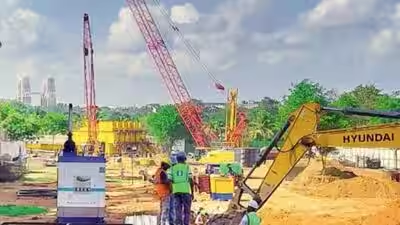
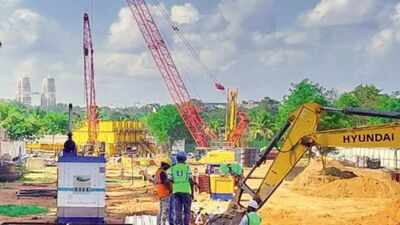
BENGALURU: The Bangalore Development Authority (BDA) commissioned a study led by an IIT-Bombay professor to assess the traffic impact of its proposed Hebbal short tunnel following widespread criticism of the project.However, the August 2026 study, titled Integrated Traffic Micro-simulation Study – Bengaluru: Hebbal Flyover & Hebbal Short Tunnel, prepared by Prof Archak Mittal for Rithwik Projects Pvt Ltd, has come under scrutiny from the Indian Institute of Science (IISc) and city-based mobility experts, who have flagged gaps in its methodology, data and assessment of traffic benefits.MEN AT WORK: Hebbal short tunnel project work has been underway since June, even as the IIT-B study was conducted in August
Data sourced from contractor’s report
Prof Ashish Verma, convener of the IISc Sustainable Transportation Lab, who reviewed the IIT-B study, said the traffic data used in the report was sourced from detailed project reports (DPRs) provided by the contractor.“The model reports the speed of traffic for 2027 at peak hour in base case as 13.7 kmph against 4.3 kmph reported in DPR of Hebbal short tunnel project,” Verma’s review states. It also points out that the study did not report queue lengths before and after the proposed interventions and that its methodology was not discussed in sufficient detail.Verma told TOI that there is no ramp at the proposed elevated corridor for vehicles travelling towards Windsor Manor. Therefore, only vehicles turning from Mehkri Circle would be able to use the flyover, while a large share of vehicles travelling straight would continue to depend on the existing underpass.He also questioned how the proposed Mehkri Circle elevated corridor would integrate with the larger east-west corridor proposed between Yeshwanthpur and KR Pura.“There was no clarity on how traffic would be handled on existing roads after the proposed projects shift congestion, or how the projects would be integrated,” he said, adding that the environmental impact of such traffic shifts also needed to be assessed.
‘Poor quality, no origin-destination survey’
Former chief technical adviser to the Directorate of Urban Land Transport (DULT), Satyajit Arikutharam, described the IIT-B study as being of “extremely poor quality” and said it contained multiple flaws. He also flagged shortcomings in the original DPRs, from which the study drew much of its data.Arikutharam said the study was supposed to examine four scenarios — the base case, each of the two projects separately, and both projects together — but assessed only two: the base case and the combined tunnel-and-elevated-corridor scenario.He said the need for the short tunnel cannot be established without fresh survey data, as the traffic data in the DPR predates the opening of an additional ramp at Hebbal flyover in January 2026.“The traffic situation has changed since then,” he said.Arikutharam also said the DPRs and IIT-B study used passenger car unit (PCU) conversion factors dating back to the 1990s. According to him, these assign higher conversion values to two-wheelers than those recommended under newer IRC guidelines, potentially inflating the estimated contribution of two-wheelers to congestion by around 30%.The IIT-B study itself notes that neither DPR contains an origin-destination survey accounting for passengers’ different destinations, he said. Such a survey is critical to determine the likely traffic load on one or both projects.Arikutharam also said the study did not consider the impact of a Metro line and the proposed long tunnel in its traffic projections.The IIT-B study has recommended increasing the distance between the elevated corridor and tunnel from 80 metres to 250 metres for more efficient traffic movement. This could require changes to the existing project design, Arikutharam said.
Study commissioned after project faced criticism
A BDA official told TOI that the IIT-B study was commissioned after the tunnel project faced public opposition.“There was a lot of negative publicity and outcry against the short tunnel road, so we decided to go for another third-party institutional evaluation,” he said.The official said the study found that the tunnel and elevated corridor were “very much required” for future traffic and described it as a positive report supporting the project.He said the project is expected to be completed by the end of January 2028.