









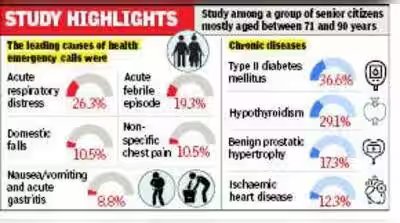
Kolkata: Acute respiratory distress, high fever, domestic fall and non-specific chest pain emerged as top reasons for health emergency calls by the elderly citizens living in Kolkata. A study among a section of senior citizens living in parts of south Kolkata, Salt Lake and New Town also revealed 20.7% of them live alone and 10.5% needed emergency hospitalisation.Findings on various parameters of health and security issues faced by senior citizens were presented during a recently concluded conference on geriatrics care in the city. Banchbo Healing Touch Foundation (BHTF), an organisation dealing with elderly members, had included 358 elderly for the study. The study said 52% of them were found to with their spouses and 27.4% lived with family.“One of the most striking findings was that 86% of the members were partially dependent, while another 7% were fully dependent. Only 6.1% were classified as independent. This indicates that a large proportion of older adults may require varying degrees of assistance with daily living, mobility, monitoring and continuing care,” said Dhires Kumar Chowdhury, geriatric care specialist and activist and media coordinator for the three-day Geritaric Society of India conference held in Kolkata.Most of the BHTF members who were considered for the study were between the age of 71 and 90, placing the majority within an age-group where chronic disease, functional limitations, social vulnerability and the need for sustained care become increasingly important.Hypertension was the most prevalent condition, affecting 81.8% of them followed by diabetes, hypothyroidism, ischemic heart diseases. The cognitive health front condition, however, was found comparatively better with 79% showing no cognitive impairment, while the study recorded moderate impairment in 8.7%, subjective impairment in 6%, dementia in 4.2%, depression in 1.1% and Alzheimer’s disease in 0.6%.The study also found that 15% of members had a caregiver, highlighting the important role of trained caregivers within the ageing-care ecosystem.“The health profile of the studied population demonstrated a substantial burden of chronic conditions which require continuous monitoring and preventive intervention particularly relevant to home-based care,” added Chowdhury.Doctors said elderly care must not be confined only within the four walls of the hospital, it is equally important within the community. “We are treating patients in a hospital when the illness is acute. Once patients go back home, it is important to continue the care. They could be patients of diabetes, heart failure, dementia or stroke. The quality of life will to a large extent depend on the care received after discharge from hospital,” said Arunansu Talukdar, the head of geriatric medicine at Kolkata Medical College and Hospital.With the advancement of technology, it is also possible to monitor a geriatric patient very closely. “The human touch in the care is also important. An advantage in India is the strong inter-generational bond we have within our families,” he said.