









TRAPPED IN TRAFFIC: As school bus speeds drop, brisk walkers outpace them; Thursdays the worst commute day
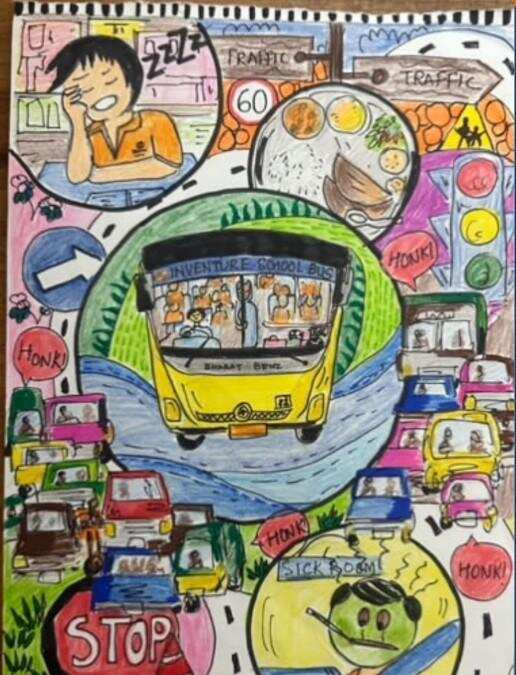
A grade 7 student’s drawing of daily commute — girdlock, honking, missed meals, and an unwell child
Bengaluru: Traffic mess on Whitefield-Sarjapur road — the city’s showcase corridor that hosts marquee tech companies — has increased a 10km school commute time from 92 minutes in 2024-25 to 112 minutes in 2026-27. This means nearly two hours is spent in metal containers called school buses.School buses on this east Bengaluru road are clocking an average speed of 9.2kmph. For perspective, as per data from TomTom Traffic Index (the annual analysis of global traffic trends and commuting behaviour), the average speed during rush hour in Bengaluru in 2025 was 13.9kmph.Analysis of GPS data from 61 school buses of Inventure Academy near Dommasandra Circle shows that students are spending nearly two hours a school day travelling to and from school. Over 200 school days, that works out to 374 hours — equivalent to nearly 53 school days spent on the road.The area has 42 private schools and more than 1,000 school buses, according to the school’s mapping, potentially affecting around 40,000 students travelling by school bus.Thank God It’s Not ThursdayMorning travel time on this stretch has increased from 39 to 47 minutes, while evening travel time has jumped from 53 to 65 minutes. Thursdays are the worst: afternoon travel between the school and Varthur Kodi averages 76 minutes, with buses moving at only 8.4kmph. Tuesday is relatively better at 59 minutes, while Wednesday averages 68 minutes.The slowest stretch is towards Prestige Lakeside Habitat and Palm Meadows, where buses average just 6.4kmph — the average speed of brisk walkers. Routes towards Gran Carmen, Adarsh Palm Retreat, and AECS Layout-Kundalahalli fare somewhat better at 11.3kmph.“During peak hours, traffic along this corridor can move extremely slowly, significantly increasing students’ commute time. Walking is not a practical alternative, given the lack of footpaths and concerns around safety and exposure to pollution,” the school said.And delays are becoming routine. About 60% of trips arrive after their scheduled time, 15% are delayed by at least 30 minutes, and 4% of buses run an hour late.Multiple bottlenecks are feeding the traffic mess. Buses heading towards Whitefield pass through Gunjur Temple and Double Road diversion, while the temporary closure of Club Road has pushed more traffic onto the already congested route. Those heading towards Sarjapur Road via SH-35 face an incomplete flyover, damaged roads and potholes.Eventually, buses from different routes converge on the same constrained 10km stretch between Dommasandra Circle and Varthur Kodi.“Some 86% of our students travel by school bus. While schools are doing their part to optimise school transport, govt must ensure basic road infrastructure and more efficient traffic management. Our analysis highlights how data and technology can enable smarter planning. For instance, Thursdays are consistently the worst for traffic. Could more offices allow employees to work from home that day, or stagger office timings so that schools and workplaces are not all putting vehicles on the road at the same time?” said Nooraine Fazal, founder of Inventure Academy.LOCATION-SPECIFIC INTERVENTIONSFive critical bottlenecks require defined intervention, clear responsibility and visible completion timeline.1. DOMMASANDRA CIRCLE* Specific challenge: Broken roads, potholes and incomplete flyover work reduce usable road space width and disrupt junction movement* Location-specific action: Repair damaged stretches; complete priority flyover work; introduce a junction-specific traffic-flow plan2. GUNJUR* Specific challenge: High traffic volumes converge on narrow roads; the temporary Club Road closure adds further pressure* Location-specific action: Managemovement at turnings and school-hour traffic flow; deploy personnel at choke points; review diversions3. VARTHUR KODI* Specific challenge: Narrow and encroached roads, diversions and conflicting traffic movements create sustained congestion* Location-specific action: Clear obstructions; repair diversion routes; introduce scientifically planned junction cycles during peak hours4. VIBGYOR ROAD – KUNDALAHALLI* Specific challenge: Poor road condition and waterlogging reduce usable road space, especially during and after rain* Location-specific action: Resurface damaged stretches; address drainage; strengthen school-hour traffic management5. GRAN CARMEN* Specific challenge: Broken roads, weak signal management and the U-turn arrangement disrupt traffic flow* Location-specific action: Repair damaged stretches; recalibrate signal timings; provide a dedicated U-turn bay or relocate the median opening.— Source: Inventure Academy