







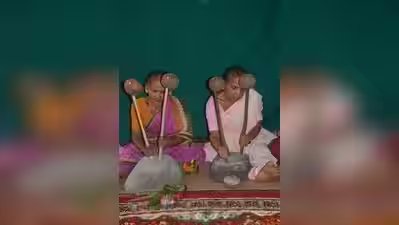
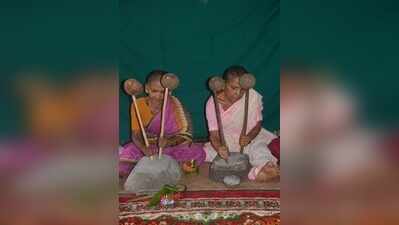
Keri: Women working in agro-horticultural fields in Sattari and its surrounding areas once used everyday household utensils such as Davali and Maand to create folk music believed to enthral Ganapati.Davali, a spoon made from a coconut shell and bamboo stick, was traditionally used to serve cooked food, while Maand, a wooden trough carved from jackfruit wood, was used to knead finger millet flour for pancakes or serve rice gruel to cattle.During Ganesh Chaturthi, however, the utensils were put to a special use. Early on the second day of the festival, women would play Davali and Maand to create folk music and sing traditional songs. The ritual was believed to awaken Ganapati from his night’s sleep.Laxmi Harvalkar, a septuagenarian folk artist from Brahma Karmali, said, “We were not allowed to play percussion folk musical instruments, and hence, women preferred to use their domestic utensils to create unique folk music for entertaining Ganapati from early morning on the second day of Ganesh Chaturthi. We put ash powder on the inverted wooden trough and rub two spoons made from coconut shell and bamboo artistically against it to create folk music.“Along with this folk music, we recite songs that describe how Ganapati, seated on the back of a mouse, comes to perform a dance. Through tradition, it is believed that Ganapati loves this folk music, and hence, the performance of Davali-Maand accompanied by songs reflecting the socio-cultural life of the agrarian community was once considered essential.”Subhadra Arjun Gawas, another septuagenarian folk artist from Ghoteli No. 2 in Sattari, said, “Forgetting our day-to-day pains and sufferings, we played this folk music and recited folk songs as it was a mandatory ritual to entertain Ganapati, who was believed to awaken from his night’s sleep immediately after listening to this unique folk music.”Today, the folk tradition is on the verge of extinction, with only a few folk artists left who can perform it during Ganesh Chaturthi.