










Bengaluru: From the humble dal bowl to the gym bag, Karnataka’s iconic tur dal is making an unlikely transition. Kalaburagi’s GI-tagged dal, traditionally cooked as dal and sambar, is now being reinvented as a ready-to-eat protein bar as Karnataka looks to cash in on growing appetite for convenient, plant-based nutrition. In a bid to take Kalyana Karnataka’s signature crop from a kitchen staple to a new-age health snack, Bangalore Bioinnovation Centre, under the IT, BT department, has developed ready-to-eat energy bars using locally grown pulses.The energy bars completely made from tur dal and other pulse varieties of the region, which are yet to be released for retail sales, are part of Kalyana Karnataka Bio-Economy Mission and have been developed in collaboration with the agriculture department under Kalaburagi Pulses initiative. According to senior officials, the new range comprises six variants based on tur dal, black gram, green gram and Bengal gram, besides a multi-pulse variant and a higher-protein formulation.Priyank Kharge, minister for IT, BT, said that the larger objective of this exercise was to address a longstanding challenge for pulse-growing regions such as Kalaburagi — much of the produce leaves the district as raw grain, while processing and higher-value activities take place elsewhere. The centre is now exploring a different route by converting locally grown pulses into shelf-stable, plant-based protein products with the aim of retaining a larger share of the value chain within Kalyana Karnataka.
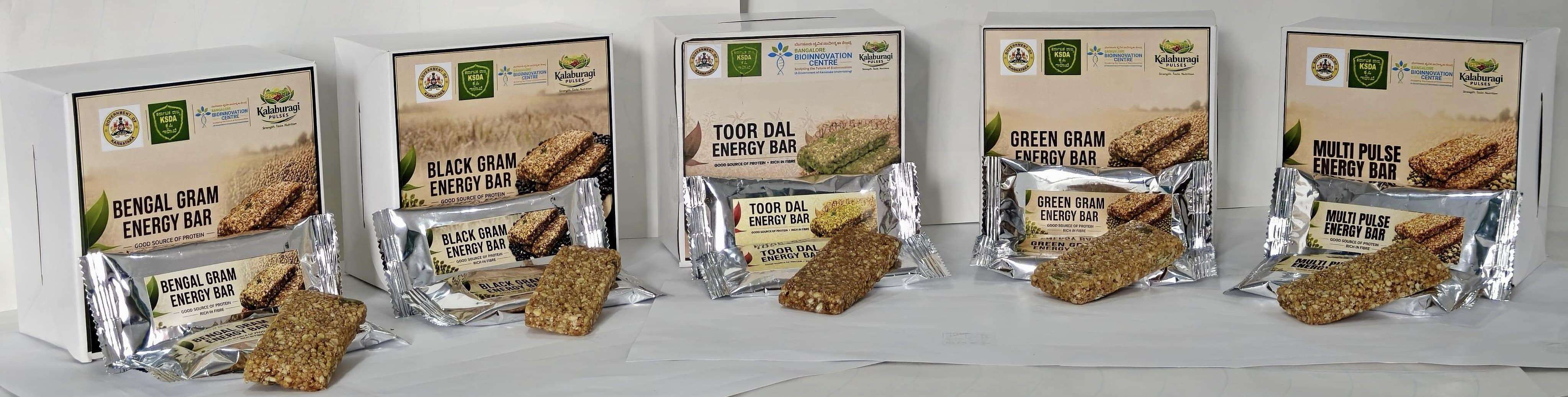
A range of ready-to-eat protein bars, developed by Bangalore Bioinnovation Centre using pulses grown in Kalaburagi, including GI-tagged tur dal, as part of the Kalyana Karnataka Bio-Economy Mission.
The four single-pulse bars use pulse crisps as the principal pulse component, combined with roasted peanuts, jaggery, oats and pumpkin seeds. The formulations contain no synthetic colours, flavours or chemical preservatives, according to officials. The single-pulse variants contain approximately 4g of protein per 30g bar, with around 122-123 kcal and 1.8-2g of dietary fibre per serving. The higher-protein FOS variant provides approximately 4.85g of protein per 30g serving.“Karnataka has strong agricultural production, but the next opportunity is to create more value from what we grow. Innovation is not just about developing new products; it is about understanding what we produce, recognising emerging market and consumer demand, and finding new ways to present our agricultural products so that they can reach more consumers and increase consumption,” Priyank Kharge said, highlighting that the initiative is an example of how Bengaluru’s innovation ecosystem can work with Kalyan Karnataka to turn locally grown pulses into higher-value products.The centre’s managing director, Mohamad Adil AA, said they wanted to look beyond the pulse as a raw commodity and explore what else could be created from it. “By developing ready-to-eat products using locally grown pulses, we are demonstrating a possible pathway for value addition that can eventually be taken up by FPOs, SHGs and MSMEs in the region,” he said. Kalyana Karnataka Bio-Economy Mission is developing a region-specific bio-economy roadmap around the agricultural strengths of the region, with tur, red banana and sugarcane as key focus crops.The bars are currently at the product-development stage. The centre will undertake shelf-life and stability studies, accredited nutritional testing, consumer acceptance trials, packaging and FSSAI licensing before the products move towards wider adoption. The bars are currently at the product-development stage and available at the centre. “Soon, the bars will be available in retail sector across Karnataka after going through necessary protocols,” the official clarified.