








Jaipur/Sikar: Sikar district offers an unusually sharp before-and-after of what govt schooling in Rajasthan can look like — sometimes within the same week. At one end sits a village school built in 1957 that has never been repaired and shuts down at the first sign of rain. At the other sits a brand-new, fee-charging residential girls’ school, launched this year as a flagship Rajasthan govt project, where parents paying over a lakh in fees say they still can’t get uniforms or textbooks.Both stories end the same way: with protesters at a govt office, and officials moving only after the showdown.A building that has stood since 1957 — and never been touched since
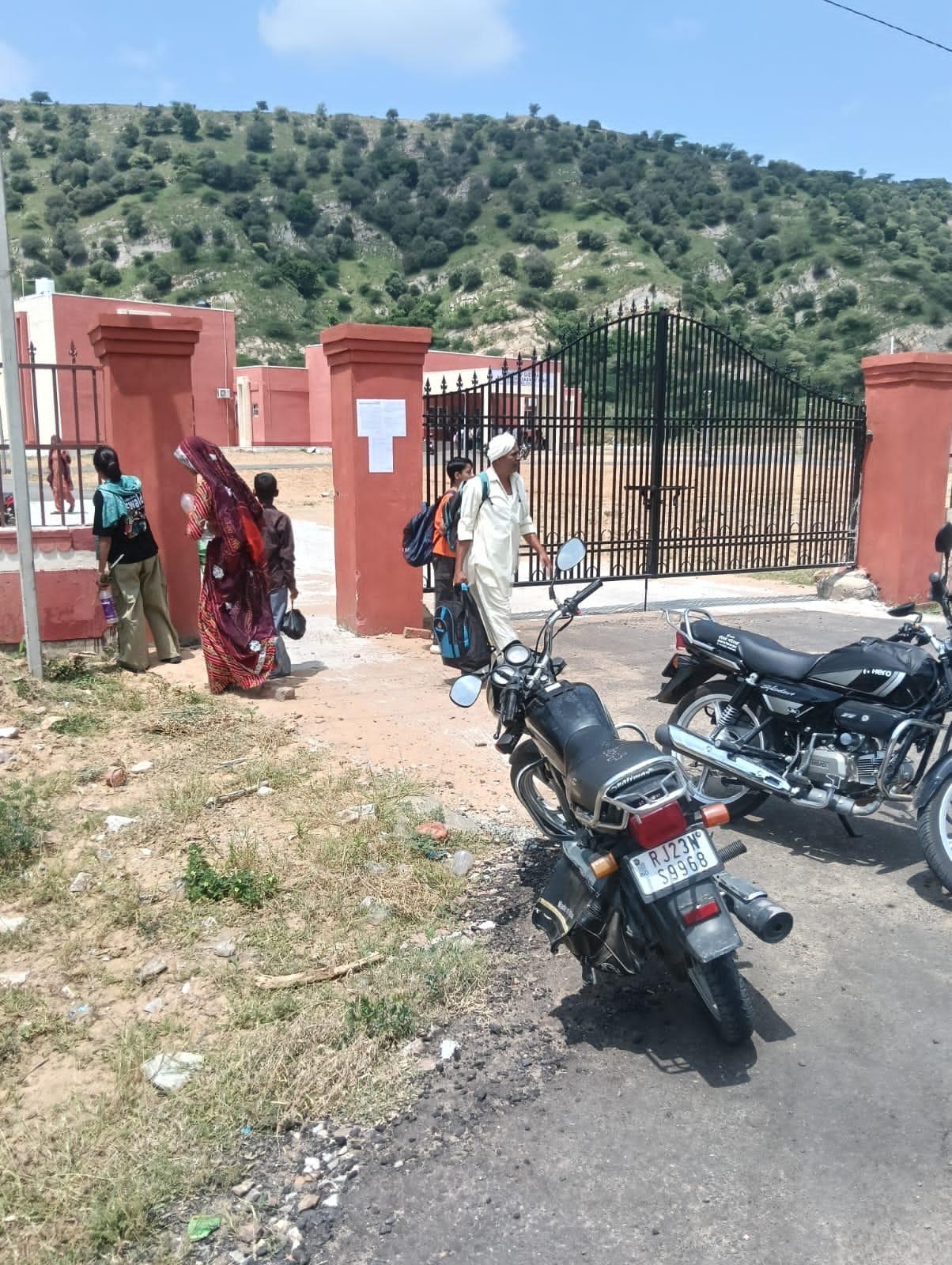
Parents taking their children back home from Sainik School in Sikar
In Ramgarh Shekhawati’s Thedi village, students walked to the Sikar Collectorate this week, accompanied by SFI national vice-president Subhash Jakhar and MP Amraram, to submit a memorandum over the state of their school. The building is so dilapidated that the principal sends students home whenever it starts raining, even lightly, for fear of collapse. The Class 1–12 school runs without a Geography, Hindi Literature or Sanskrit teacher; Classes 11 and 12 share a single Political Science teacher between them. “It is dangerous to sit inside the school building,” said Lakshmi Sharma, a student who studied there from Class 1 to 12 and said she never saw an improvement in that time.
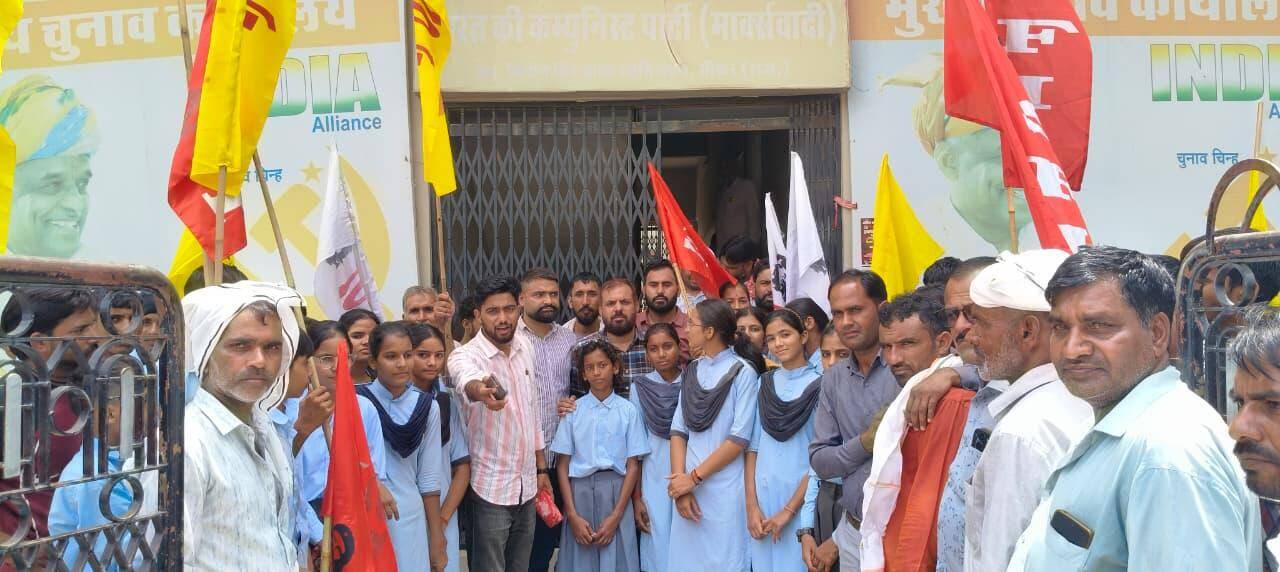
Students outside Collectorate in Sikar
Subhash Jakhar said the school has just eight teachers against 15 sanctioned posts — roughly 50% vacant. MP Amraram, who walked with the students to the Collectorate, said the school — which runs from Classes 1 to 12 — does not have enough rooms, and that its roofs and walls pose a potential accident risk. It is waterlogging and the fear of collapse during rain, he said, that force the administration to send children home in the first place. The school land itself, he pointed out, is recorded in revenue records as pasture. Jakhar added that the staffing crunch is already showing up in enrolment. “With around 50% of the posts vacant, the quality of education is continuously declining,” he said, adding that the lack of facilities and teachers was also causing enrolment to fall rapidly.Complicating matters further, the school building sits on johad (pond) land, which means govt funds cannot legally be spent on repairing it. Collector Ashish Modi told villagers that govt land could instead be allotted for a new building, and after a local Bhamashah offered seven bighas of land in exchange, directed officials to prepare both a construction proposal and a separate proposal to fill the vacant teacher posts. Villagers and SFI pressed for more than just the building itself — their memorandum also demands a technical inspection of the structure and basic facilities the school still lacks entirely: a playground, laboratories, a library, toilets and drinking water.
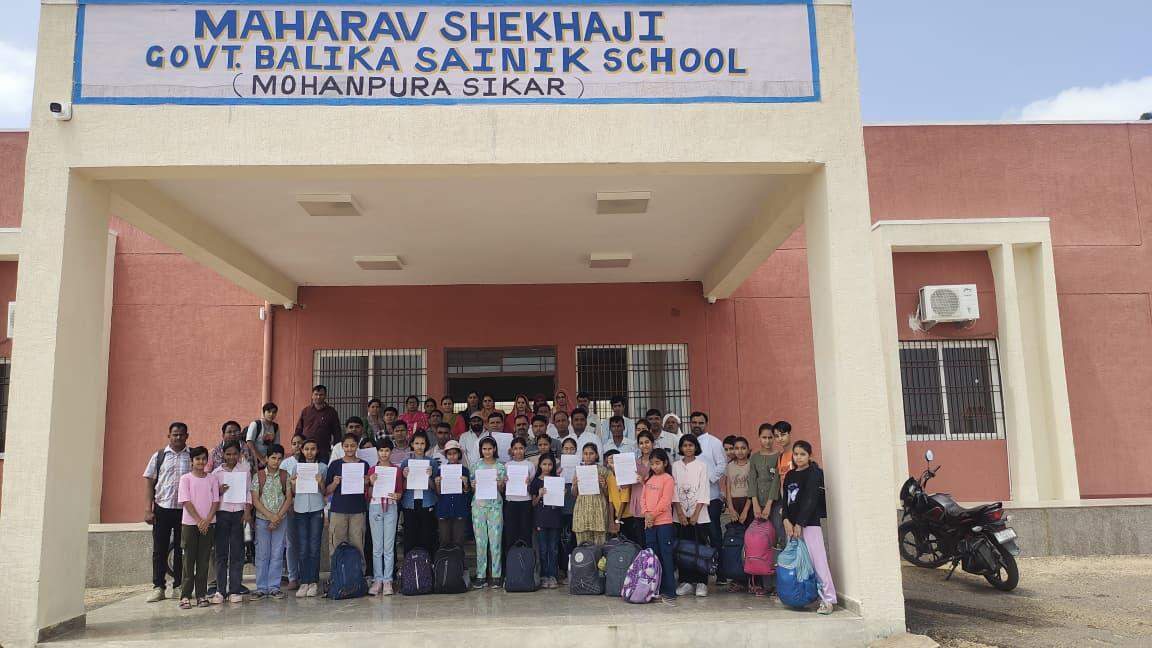
Students protest at Sainik School in Sikar on August 23
A ₹1.5-lakh fee, and still ‘no proper food, medical facilities’At the other end of the district’s education spectrum sits Sikar’s newly launched Balika Sainik School — one of two residential girls’ schools, opened this year under the state’s flagship Sainik School project. The schools were announced in the Rajasthan’s budget of 2024-25, with the state promising a Balika Sainik School — modelled on the defence ministry-run Sainik School Chittorgarh — in every division to provide girls aspiring to join the armed forces, paramilitary and police with specialised training.On Aug 23, enrolled students and their parents protested there, alleging that despite a fee of Rs 1.5 lakh plus Rs 40,000 in mess charges, they were not supplied uniforms, textbooks or sports equipment, that electricity was unreliable, and that food and water in the hostel mess were erratic. Three days later, the state education department approved Rs 65 crore for the school’s development. The allocation was made, but the money is yet to arrive.Now, parents have said they will step up their protest and not send their wards to school until tangible improvements are made.“Students were promised playgrounds and training facilities, but the administration has not arranged either. Our wards do not get proper food in hostels. Physical education teachers have also not been posted,” said Krishna Pal Singh Bhakar, a member of the parents’ association, which has now announced a protest in Jaipur on Sept 5.The contrast is instructive. Thedi’s problem is the oldest one in Indian public education: a building nobody has funded in nearly 70 years, staffed at half-strength, sitting on land the govt cannot legally touch.Sainik School’s problem is newer and, in some ways, more uncomfortable — it suggests that even where the state has decided to spend serious money on a premium, fee-charging model, execution lags so far behind the announcement that parents who are already paying have to march to get what they were promised. Money alone, in other words, is not solving Rajasthan’s school problem — how and when it actually reaches a classroom seems to matter more.