








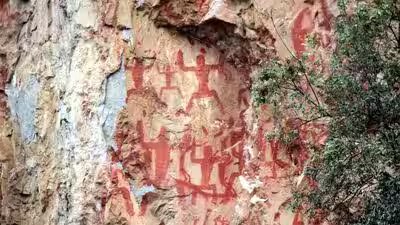
Ancient paintings covering limestone cliffs in southern China may owe their remarkable survival to an unexpected ingredient known as ‘blood.’ A new study of the ‘Huashan rock art’ in Guangxi published in the ‘Journal of Archaeological Science’ suggests that the artists used a mixture containing lime, calcium phosphate and blood as a binder, helping the pigment form an unusually strong connection with the rock. The paintings, created more than 2,000 years ago, have endured in a hot, humid and rainy environment where natural weathering would normally be expected to damage exposed artwork. Researchers examined fallen fragments from three Huashan sites and found evidence that blood proteins helped trigger the formation of a dense mineral structure around the pigment. The finding offers an explanation for the paintings’ durability and also raises questions about why blood was selected as part of the ancient recipe, including a possible connection with fertility rituals.
The 2,000-year-old Huashan rock art in China
The Huashan rock art stretches along the Zuojiang River valley in Guangxi, southern China. The wider rock art belt contains more than 80 sites, with paintings covering tens of thousands of square metres. The Huashan site is the earliest and largest of these locations and has been recognised as part of the Zuojiang Huashan Rock Art Cultural Landscape, which was added to the UNESCO World Heritage List in 2016.The paintings are dominated by red figures depicting people, animals and objects. Some of the shapes resemble bronze objects associated with cultures in the Yangtze River Basin and Yunnan. Earlier dating evidence discussed in the study places the artwork broadly between the Spring and Autumn Period and the Han dynasty, with some dating results suggesting that parts of the Huashan site are more than 2,000 years old. What makes their survival particularly surprising is the environment. The cliffs are exposed to heavy rainfall, high temperatures, humidity and storms. Yet much of the artwork remains firmly attached to the limestone. The study set out to investigate how the paintings were made and why they have remained so durable.
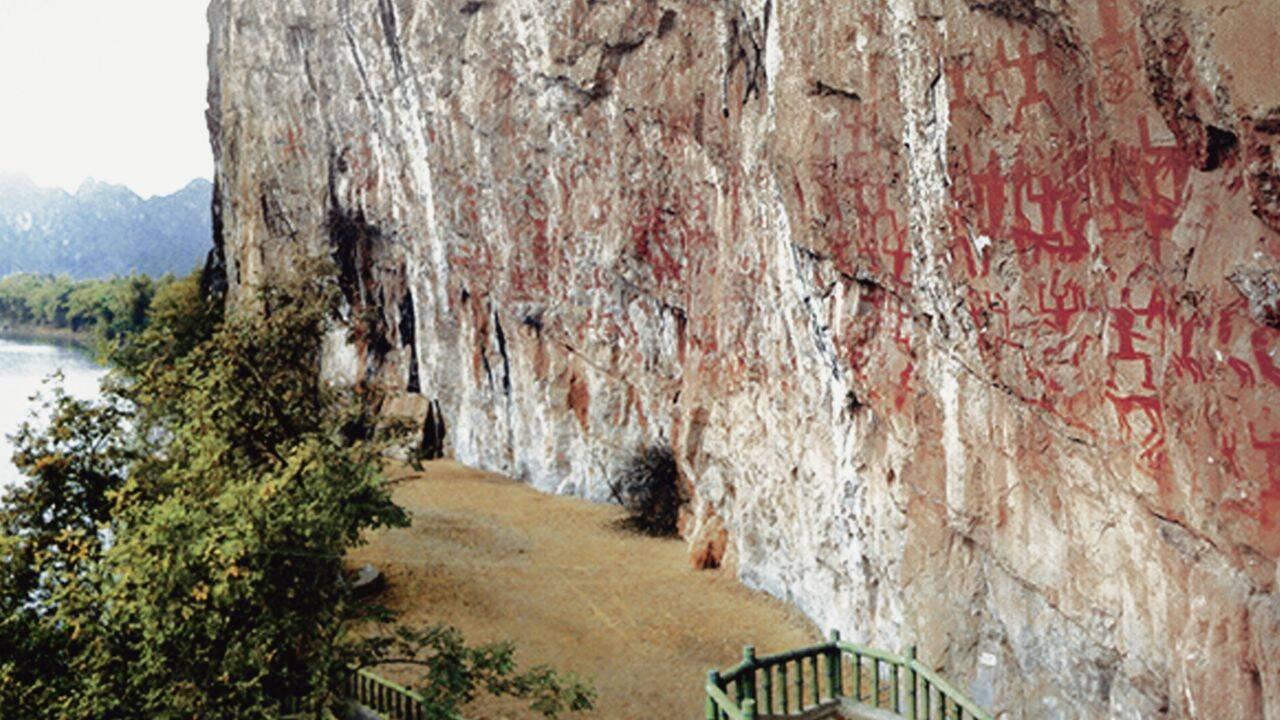
Huashan Rock Art Panel. Image Credit: Bradshaw Foundation
What did researchers find inside the ancient paint used for the rock art
Researchers examined fallen fragments from three sites named Gaoshan, Daningshan and Tunpingshan. They also collected limestone with natural deposits, hematite ores, red sand and red clay to compare the materials found in the paintings with their natural surroundings. The analysis showed that the artwork was made up of three main layers: the limestone base, a mortar layer and the red pigment. The red colour came from red clay containing very small hematite particles.The surprising discovery concerned the ‘mortar.’ According to the study, it was not simply ordinary clay or another straightforward natural adhesive. Instead, the researchers found evidence for a composite mixture made from slaked lime, calcium phosphate and blood. The team used several scientific techniques to study the samples, including Raman spectroscopy, energy-dispersive spectroscopy, Fourier-transform infrared spectroscopy and proteomics. Together, these analyses provided evidence for both the mineral and organic components of the ancient material.
How could blood have helped the paintings survive for 2,000 years
The researchers believe the blood played a crucial role in turning the mortar into an exceptionally strong mineral binder. The proposed process began with a mixture of slaked lime, calcium phosphate and blood being spread across the limestone cliff. The red clay pigment was then applied while the mortar was still partly wet. As the lime reacted with carbon dioxide in the air, calcium carbonate formed. But the study suggests that proteins from the blood helped drive the formation of a particularly dense calcium carbonate structure.That mineral structure effectively surrounded and locked in the tiny hematite particles. At the same time, it created a strong bond between the painted layer and the limestone underneath. The strength of that connection was apparent when researchers prepared samples for examination. Some of the well-preserved painted layers were so firmly attached to the rock that an electric drill was needed to separate them.This mineral structure could explain why the artwork has remained attached to the cliffs despite thousands of years of exposure to harsh weather. The blood itself has not simply remained as a conventional adhesive for two millennia. Instead, the study suggests that its proteins helped create a durable mineral structure that continues to protect and hold the pigment in place.
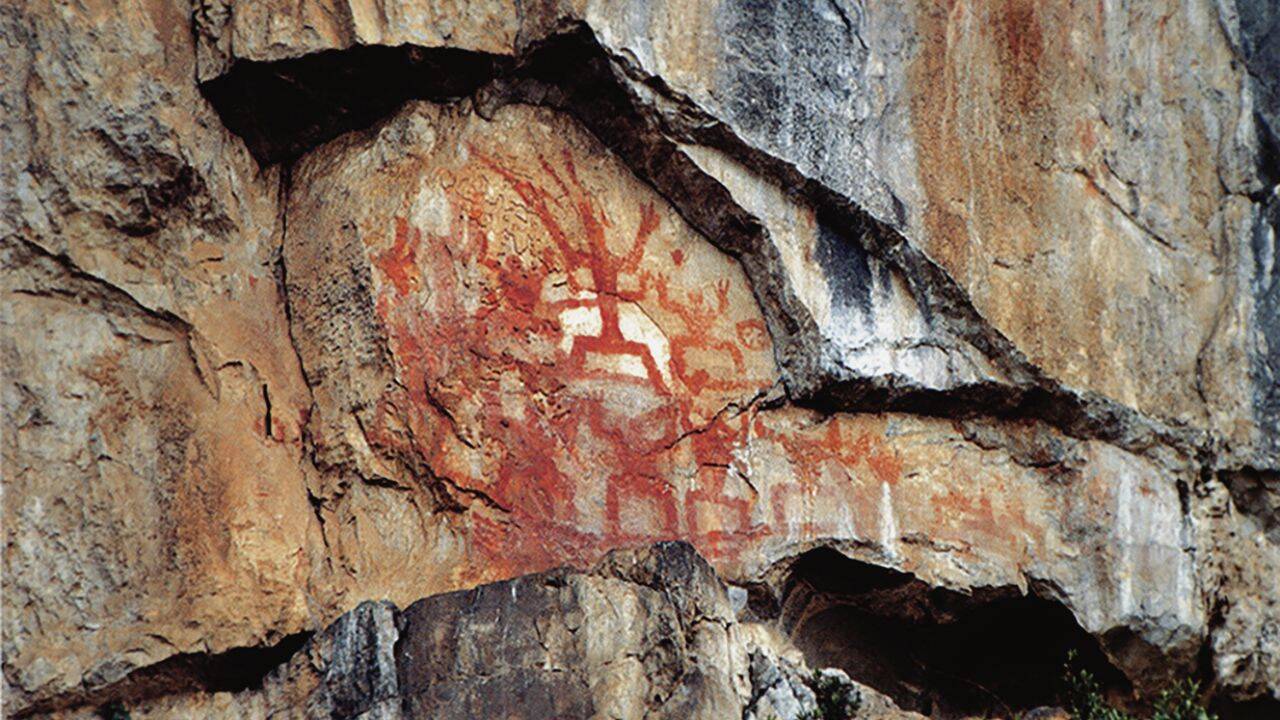
Chenxiangjiao Rock art site, one of the 38 Rock Art sites of the Zuojiang Huashan Rock art cultural landscape. Image Credit: Bradshaw Foundationtion
Was the blood human or animal
The researchers believe the ancient mixture may have contained both human and animal blood. More intriguingly, they suggest that some of the human blood could have come from women who had given birth. This possibility is based on the study’s interpretation of the cultural background of the people who created the paintings. The researchers identify the creators as indigenous communities living around the Zuojiang River between roughly the 5th century BC and 2nd century AD. They describe these communities as fishing, hunting, gathering and early farming societies with matrilineal traditions.The researchers therefore propose that the use of blood may have had a cultural or symbolic meaning connected with female fertility. However, the study does not claim that this interpretation has been definitively proven. DNA analysis was also attempted to learn more about the possible blood donors, but no DNA could be recovered. The researchers suggest that the strongly alkaline calcium hydroxide environment of the original mortar may have destroyed the genetic material.
Does the discovery change the understanding of ancient rock painting
The findings suggest that the creators of Huashan rock art had a sophisticated understanding of materials. Instead of simply mixing red pigment and spreading it over a cliff, they appear to have used a carefully prepared mortar and pigment system.The study describes the production of the paintings as technically intensive, not simply labour-intensive. In other words, the achievement may have depended less on applying large quantities of paint and more on knowing how different natural substances could work together. It also offers a glimpse into the practical knowledge of the people who created them. Blood, lime and red earth may sound like simple materials, but together they produced a remarkably resilient form of ancient paint. The Huashan cliffs therefore preserve evidence of an ancient technological process in which biological material helped create a mineral structure capable of protecting art for thousands of years.