










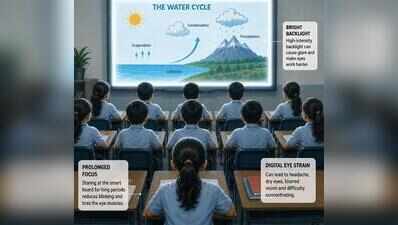
Noida: The district administration on Friday directed schools to cut back on smartboards and digital boards as teaching tools and return to conventional blackboards, citing rising concerns over excessive screen exposure among students.

A circular issued by district magistrate Medha Roopam asked school managements to ensure balanced use of digital boards, following complaints from parents about the impact on children’s mental and physical health. The order caps smartboard use at 30 minutes a day for classes 1 to 5 and 60 minutes for classes 6 to 8.According to the parent association, some schools had been displaying textbooks directly on pre-loaded smartboards and relying on digital screens for classwork, question-answer sessions and homework.The circular noted that average screen exposure among students had climbed to four to five hours a day in some cases, even as use of blackboards, greenboards and whiteboards declined. It also flagged poor attention to backlight and screen settings on digital boards.
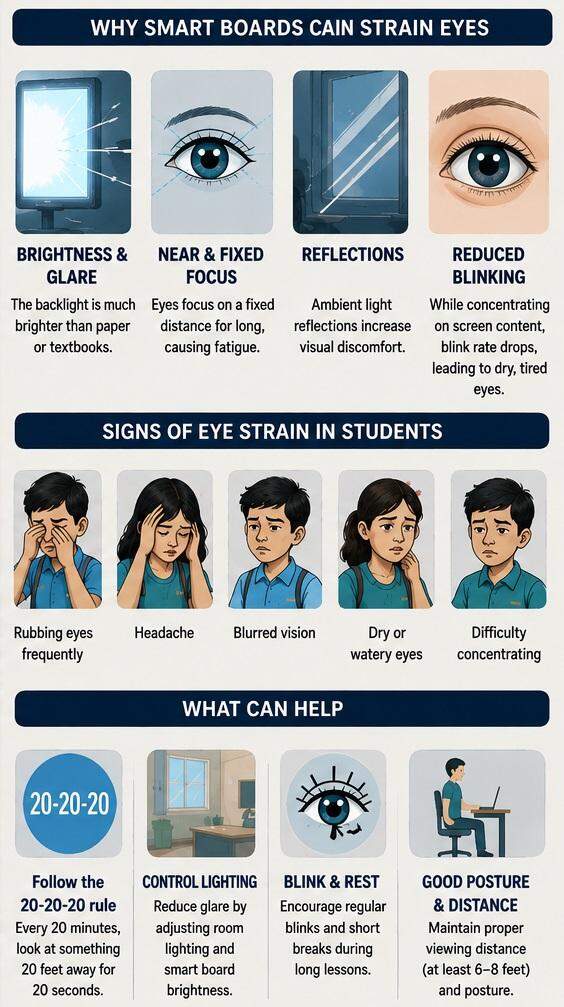
Citing guidelines from World Health Organisation and NIMHANS, the administration warned that excessive screen time could cause digital eye strain, headaches, dry eyes and early-onset myopia, besides affecting students’ behavioural, cognitive and intellectual development.The circular said smartboards should function “primarily as a supporting medium” for explaining difficult concepts and displaying pictures and videos, rather than being made mandatory for every subject or classroom activity. It directed schools to use conventional boards regularly for writing, practice and participatory sessions.“Smartboards should never be a complete substitute for traditional teaching methods. There is a need for interactive and participatory teaching instead of constantly displaying textbooks on screens,” Roopam said.Schools were also asked to avoid using backlight when smartboards are used only for writing, to prevent unnecessary screen exposure. The administration prescribed the 20-20-20 rule, under which students take a break every 20 minutes to look at an object roughly 20 feet away, and called for greater focus on activity-based learning, outdoor games, storytelling and group activities.Schools have been told to follow PRAGYATA guidelines on digital education during online classes too. Under these norms, pre-primary and kindergarten students should get no more than 30 minutes of screen time a day, mainly for parent communication and guidance. Students in classes 1 to 8 should have a maximum of two sessions of 30-45 minutes each per day, while those in classes 9 to 12 should have up to four such sessions. Mandatory breaks of 10-15 minutes must be maintained between all screen sessions.Most schools TOI spoke to welcomed the move but said a strict cap may be difficult to enforce, since digital tools are now built into classroom teaching and the curriculum. Several principals said that limiting screen time in school may have little effect if students use phones freely at home.“Practically, it is difficult to completely limit screen exposure in schools because computers, smartboards and digital tools are now part of the curriculum. The focus should instead be on using screens judiciously and balancing them with conventional teaching,” a private school principal said.Apeejay School principal Neha Sharma, who is also the city coordinator for CBSE schools, said technology should complement, not replace, conventional teaching. “Smartboards, digital resources and interactive tools can make concepts more visual and engaging, but technology is most effective when used with purpose. It should enhance a lesson, not become the lesson itself,” she said, adding that the school also emphasised reading, storytelling, peer conversations and hands-on activities to build students’ thinking and social skills.Another principal said unscheduled closures, such as the recent nine-day break in Ghaziabad during kanwar yatra and on high-pollution winter days, often make online classes unavoidable, adding to screen exposure.“Every day when my daughter comes back from school, she looks completely exhausted and often complains of a headache or eye pain. With so much teaching happening on smartboards and digital screens, I worry that the prolonged exposure is taking a toll on her health. DM’s decision to regulate screen time in schools is a much-needed step. As parents, we want children to benefit from digital learning, but there also needs to be a proper balance with traditional classroom methods,” said Vineet Mittal, father of a class 1 student at a private school.Doctors have long linked prolonged screen exposure to eye strain, headaches, neck and back discomfort, poor posture, reduced physical activity and a higher risk of overweight and obesity. Dr Vivek Jain, senior director and unit head of paediatrics at Max Hospital, said children below two years should generally avoid routine screen exposure, except for meaningful video interaction with family. “For ages 2 to 5, recreational screen time should ideally be capped at about an hour a day. For school-going children and adolescents, parents should aim to keep recreational use within 1-2 hours a day, ensuring screens don’t compromise sleep, physical activity, studies, meals or family time. Educational screen use may need to be considered separately, depending on the child’s needs,” he said.