









Bengaluru: India’s artificial intelligence (AI) ambitions could hit a major roadblock if researchers and startups are unable to find the data they need at the right time. Seeking to bridge this gap and address the data discovery problem, Karnataka on Wednesday launched Tathyakosh.in — a single platform designed to make millions of public datasets easier to discover and assess.According to officials, the digital public good brings more than 1.5 million datasets from 458 sources onto a single searchable platform. Its historical coverage currently stretches back to 1947.Facilitated by Karnataka’s Centre of Excellence in Artificial Intelligence (ACSEL Technology Forum) and IIT Alumni Centre Bengaluru (IITACB), the platform was launched by Priyank Kharge, Minister for Home, IT, BT and E-Governance. Officials said the platform would help researchers, developers, startups, policymakers and the public discover and assess datasets without having to search multiple government portals and institutional repositories.The name ‘Tathyakosh’ is derived from the Sanskrit words ‘Tathya’, meaning “that what it is” or “truth”, and ‘Kosh’, meaning a repository or storehouse. The platform brings together public datasets from diverse sources and makes them easier to discover and assess.The datasets are catalogued using standardised information based on parameters such as domain, geography, time period, format and access type. The platform covers 16 domains, including health, agriculture, education, infrastructure, environment, economy and governance.It draws data from 346 Indian sources and 37 international repositories containing India-relevant information. More than 92% of the datasets are open access, while 95% are machine-readable.“India’s AI ambitions will depend not only on talent and computing power, but also on our ability to find and use the vast amount of data that already exists across our institutions. Tathyakosh addresses a fundamental gap by making this data discoverable, structured and easier to use. By building it as an open, non-commercial Digital Public Good, we are creating an important piece of infrastructure for researchers, startups, developers and policymakers to build with Indian data,” Kharge said.Ashok Kamath, Director, ACSEL Technology Forum, said the platform addresses a fundamental challenge in India’s data ecosystem. While the country generates enormous volumes of public data, finding the right dataset, understanding its quality and determining whether it can be used often requires navigating multiple disconnected platforms.“India has no shortage of data. The challenge is knowing where the data is, whether it is relevant, whether it is reliable and whether it can be used. We wanted to make it easier for a researcher, developer, policymaker or startup to discover what already exists before spending time and resources looking for it elsewhere,” he said.
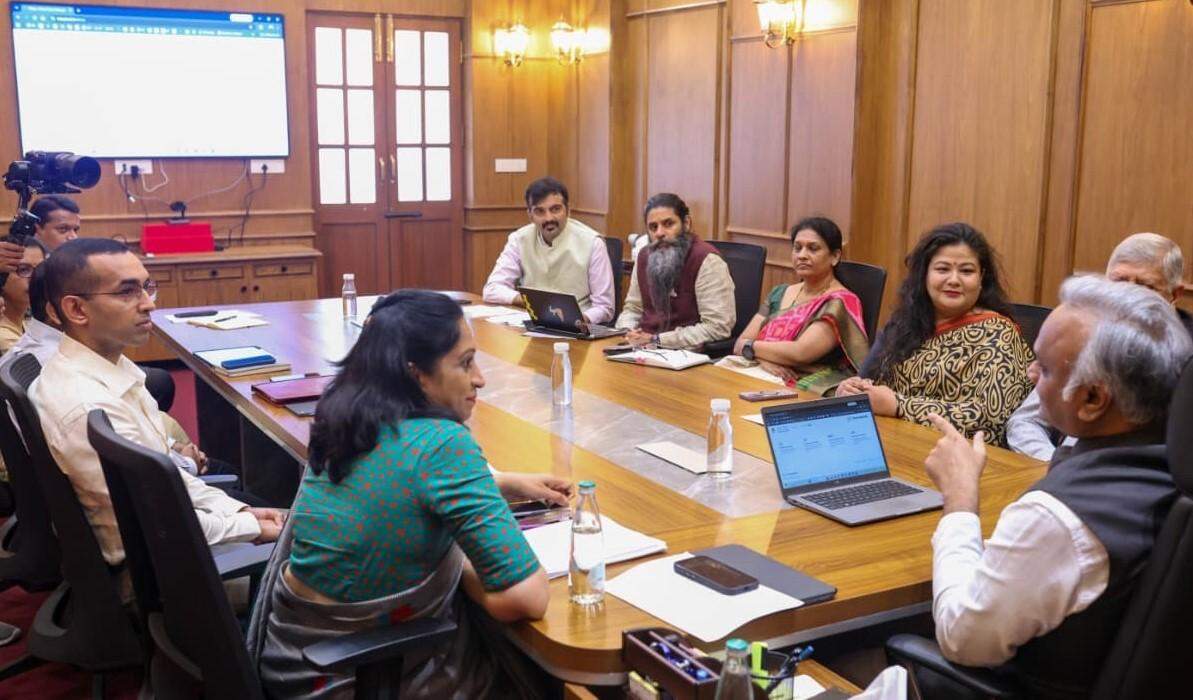
Karnataka Minister Priyank Kharge launches Tathyakosh.in–a digital platform featuring more than 1.5 million public datasets, at Vikas Soudha in Bengaluru on Wednesday.
A strong Karnataka focusTathyakosh already has more than 50,000 Karnataka-specific datasets catalogued. These include data from the Karnataka Open Government Data Portal, Mahiti Kanaja, KSRSAC/K-GIS, the Indian Institute of Science, the Raman Research Institute and other institutions in Bengaluru.The platform could support researchers and universities undertaking cross-sectoral policy analysis, startups developing data-driven and AI applications, and technology teams working with data-intensive applications.As an open, non-commercial Digital Public Good, Tathyakosh is designed to expand as more government, academic and institutional datasets are added, potentially creating a single gateway to India’s public data landscape.