










HYDERABAD: For two consecutive years 2024 and 2025 Telanga na’s Jeevandan programme earned national recognition, including awards from the Centre and the National Organ & Tissue Transplant Organisation (NOTTO), for record Ing Ing the the highest cadaver organ donation rate in the country.But official Jeevandan data accessed by TOI, covering 2013 to 2026, shows that one in every five patients registered for an organ transplant died while waiting for one.According to records, 19,386 pa-tlents registered for organ trans-plants in Telangana during this period, of whom at least 4,106 died. While 5,307 underwent successful transplants roughly one in four registered patients as many as 9,413 are still on the waiting list.The gap is also reflected in the annual transplant to donation ratio. Around 7,500 to 8,000 organ trans-plants are performed in the state every year, even as annual organ donations remain below 1,000.The highest number of donations was recorded in 2025, at 763.
Wait is for five key organs
Most of those who died over the past 13 years were waiting for five key organs liver (2,240), kidney (1,537), lungs (229), heart (96) and pancreas (4). This is despite significant numbers of these organs being donated.Between 2013 and 2026, the Jeevandan programme received 1,724 kidney, 1,724 liver, 506 lung and 258 heart donations among the highest across categories.
Why does the gap persist?
On the eve of World Organ Dona tion Day, which is observed on Aug 13, a Jeevandan official attributed the gap to a lack of participation from govt and private hospitals.“These five are the organs we need the most for transplants. But it is tough to meet patients’ require ments since only four or five private hospitals in Telangana consistently contribute to organ donation. Govt hospitals’ contribution is next to zero.In comparison, Tamil Nadu has around 120 private hospitals extending support,” the official sald.Sources said that despite NIMS, Osmania and Gandhi hospitals hav ing dedicated trauma blocks to treat road accident victims a key potential source of deceased organ donors organ donations from these facilities remain low.Currently, Telangana has four govt hospitals and 37 corporate hospitals registered under the Jeevandan programme.“Many hospitals hesitate to declare a patient brain dead due to a lack of trained staff, legal concerns or the absence of counselling teams. Hence, many cases go unreported,” another Jeevandan official said.They also pointed out that not a single relative of an organ transplant recipient has so far pledged to donate organs.“When an accident victim is declared braindead, it often becomes very difficult to persuade the family to consent to organ donation. But even those who benefit directly from transplants are not becoming advocates and spreading awareness,” the official added.
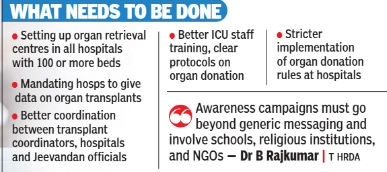
What is needed
Multiple challenges
Dr Bandari Rajkumar, member, healthcare reforms doctors association, suggested that awareness campaigns go beyond generic messaging and involve schools, colleges, religious Institutions, community leaders and NGOs.“Greater public participation is crucial. Many potential donors are lost because families are not counselled in time or remain unaware that one donor can save multiple lives,” said Dr Sree Bhushan Raju, nodal officer, Jeevandan, adding social media can spread awareness.Dr N Vani, DME Telangana, sald that more awareness will be created for the families “waiting for a phonecall for an organ.”