










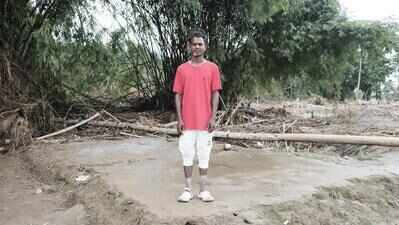
Sivasagar: Relief materials provided by the govt, social organisations and individuals may have ensured that flood-hit villagers in Sivasagar did not go to sleep hungry in relief camps, but they have done little to fill the void in 31-year-old Debiram Panika’s life.Debiram, who found his wife Dipali’sbody trapped under debris 10 days after the floods swept her away, has been searching through the silt and wreckage for his 4-year-old daughter for the past 20 days — clinging to the hope that he will find her.TOI spotted him along with a few men searching for his daughter, clearing the debris of bamboo and trees, which were carried by the floods on July 19, at Hiloni Nepali Khuti on the banks of the Dikhow river.His neighbour Sibeswar Karmakar, 55, said, “For the past 20 days, Debiram has gone to the village with every sunrise, searching through the debris for his daughter, hoping she may still be trapped somewhere beneath it.”With tears streaming down his face, Debiram said, “I still can’t believe what happened to us… the village… The floodwater ruined everything. It snatched away my wife and my little daughter. I just started building a pakka house — it was kutcha earlier. The floods left me alone. What’s the point of staying alive? I haven’t found my daughter’s body yet.”He added that the river, which villagers could once cross on foot, betrayed them this time — slamming into Hiloni Nepali Khuti and its neighbouring villages, turning them into a land of devastation.“It might take time, but one can rebuild property. Nothing can compensate for the loss of loved ones. She (daughter) was just 4 years old,” he said softly.Hiloni Nepali Khuti village is home to around 500 families — about 280 from the Gorkha community and 220 from the Adivasi community. While most Gorkha families depend on dairy farming, Adivasi residents largely work as daily-wage labourers or rely on cultivation.Debiram, himself a daily wager, said, “It wasn’t a flood — it was like a tsunami. The devastation was beyond imagination. On July 19, the river changed its behaviour in a way no one here had ever seen before.”His house stood about 200 feet from the Dikhow’s bank. Villagers claim the river has eroded nearly 30 to 40 feet of land at Hiloni Nepali Khuti.