









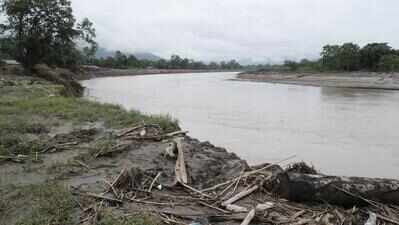
Hiloni Nepali Khuti (Sivasagar): Residents who lost their homes to devastating floods are struggling to determine what caused their ruin — a natural calamity or human negligence.They suspect mechanised extraction of sand and stones from the Dikhow River over the past 15 to 20 years, coupled with the movement of overloaded dumpers, may have worsened the disaster.The floods wiped out Hiloni Nepali Khuti, Natunbasti, Signalbasti and Lines 6, 7 and 8 of Sontok Tea Estate in Bihubor.Originating in Nagaland’s Zunheboto, the Dikhow takes a sharp U-turn near Hiloni Nepali Khuti. Villagers said that on July 19, the swollen river, carrying huge quantities of silt, logs and firewood from the upstream hills, broke from its usual course and slammed into Hiloni Nepali Khuti, Natunbasti and nearby villages instead of negotiating the bend.Gobinda Sharma, 30, whose village was reduced to ruins within hours, told TOI, “The river usually swells in the monsoon, and water overflows and enters the villages on its banks. On the other hand, the water level of the river decreases extensively during winter, and people can even cross the river on foot. However, the flood caused by the river was no less than a tsunami.”Sharma, whose family has lived along the Dikhow for generations, said the river’s behaviour began changing after heavy machinery was introduced for sand and stone extraction.“Earlier, the villagers used to extract stones from the river manually in boats. They used to collect stones on boats and store them on the banks, from where the stones were sent to stone crusher units. It was the livelihood of the villagers. However, the introduction of heavy machinery for stone and sand extraction for more benefit by certain powerful people has not only triggered heavy ecological damage to the river but also snatched the livelihood of about 500 families in Hiloni Nepali Khuti,” he added.Gopal Sharma, 65, who rescued his 23-year-old daughter-in-law and 5-year-old grandson, said villagers once used around 200 boats for stone extraction. The boats disappeared after machinery forced residents to change occupations.Gopal and other villagers urged the state govt to stop illegal sand and stone extraction and prevent a recurrence of the July 19 devastation.All 16 villages under Bihubor Panchayat were submerged. Houses were buried beneath 4 to 6 feet of silt and mud. Weeks later, a pungent stench from silt, livestock carcasses and suspected human remains trapped beneath debris and massive piles of driftwood hangs over the devastated villages.

Gobinda Sharma, a resident of Hiloni Nepali Khuti village in Bihubor