







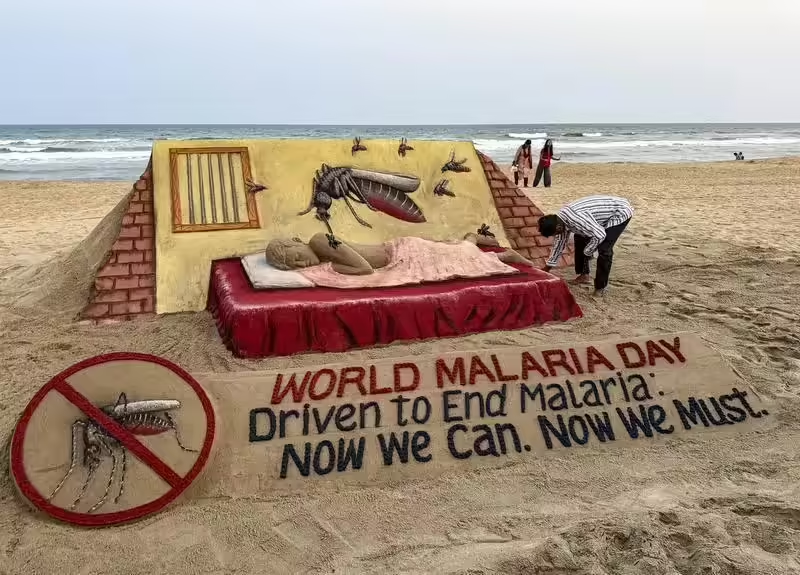
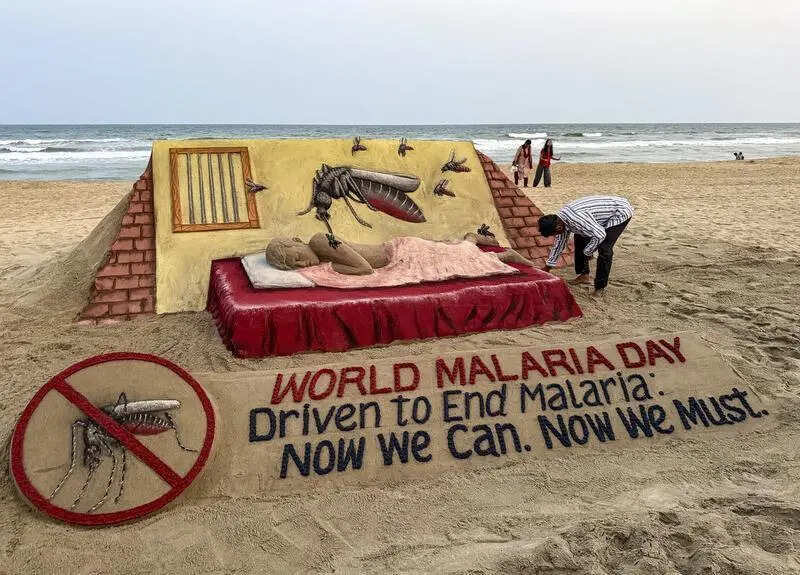
Pune: Why does India, despite decades of control programmes, still struggle to eliminate malaria when countries with comparable climates have succeeded?As of early 2026, the World Health Organization (WHO) has certified over 40 countries and territories as malaria-free, including Egypt (2024), China (2021) and Sri Lanka (2016).India has made significant progress in its fight against malaria, with a reduction of 80.5% in cases and over 78% in deaths between 2015 and 2023. Only 83 deaths were reported in 2023. But, according to WHO, India is the top contributor among South East Asian countries as over 17.65 lakh suspected and confirmed cases were reported in 2023.India aims to eliminate malaria by 2030, with high-burden areas concentrated in tribal regions, specifically Odisha, Chhattisgarh, and northeastern states.Ahead of World Malaria Day on April 25, experts said a complex mix of surveillance gaps, poor hygiene, inequity and systemic challenges were the prime culprits for India lagging behind. The primary challenge in India is the diverse epidemiology, said Dr Neena Valecha, former regional advisor for malaria at WHO’s South-East Asia Regional Office.“The districts range from high transmission to near-zero transmission, and so, the approaches need to be tailored. Although surveillance has improved, it needs to get better to cover non-govt entities as well. The present diagnostics are cost effective. However, more capacity building for quality microscopy can help as more sensitive diagnostics can be helpful in areas with very few cases and which are near elimination,” Valecha said.Adrian Hill, director of the Jenner Institute, which is a part of Oxford University, is, however, hopeful. Hill led the design and development of the leading malaria vaccine R21/MM in collaboration with the Serum Institute of India. “We have two vaccines licensed now and deployed over the last 20 months. One of these is from the Serum Institute of India with high efficacy and a low price,” he said.“Many other malaria vaccines are in the pipeline that may work well at every stage of the lifecycle and provide even better protection. Vaccines are also coming along for Plasmodium vivax malaria, which is of great interest in India. The long-acting injectable drugs have shown promising results in trials and could be very valuable for the goal of eliminating malaria in entire countries or even eradicating the disease for good,” Hill added.Dr Himmat Singh, a scientist at the National Institute of Malaria Research pointed out that the changing behaviour of mosquitoes was a challenge in India.“Mosquitoes are adapting by stinging people more often outdoors, besides also resting outside homes, enabling them to avoid interventions such as ‘indoor residual spraying’ or ‘long-lasting insecticidal nets’. As a result, even in areas that have good coverage of such interventions, some mosquitoes survive and continue to transmit malaria,” Singh said.Another important change is the timing. “More mosquitoes now sting in the early evenings or early mornings, when people are not yet under bed nets or have already woken up. Insecticide resistance is also a major concern,” Singh added. “With repeated use of insecticides, some mosquitoes develop the ability to survive exposure. These resistant mosquitoes then reproduce, gradually increasing their numbers, while susceptible ones decline. Over time, often within a few years, a majority of the mosquito population can become resistant, making insecticide-based control methods much less effective.”Health services must also focus on asymptomatic patients, said Dr Rajpal Singh Yadav, malariologist and a former senior scientist at WHO.“The hidden reservoir of asymptomatic and submicroscopic malaria carriers is a significant operational challenge in the last-mile efforts for malaria elimination in India. Undetected parasite infections will likely be prevalent in natural low malaria transmission settings (semi-arid and urban areas), and where anti-malaria interventions have reduced the incidence to a very low level (below a certain public health threshold). This may lead to marginalised attention, low budget allocation and suboptimal surveillance, leading to sudden malaria hotspots.”“As elimination efforts proceed, maintain malaria microscopy as the gold standard, ensure supply of quality-assured rapid diagnostics, and in low transmission settings, consider the use of molecular/DNA tests for malaria diagnosis (eg, qPCR based on genome-mined repeat sequences) and allocate resources for xenomonitoring of malaria parasites in mosquitoes as the non-invasive procedure,” Yadav added.The inequitable distribution of quality health services must be tackled, said Dr Amitav Banerjee, who has over 20 years of experience as a field epidemiologist in the Indian Armed Forces. “Quality health services must be placed throughout the country, including tribal areas,” he said.“Most of our health services are concentrated in urban areas. There is massive migration from tribal and rural regions for jobs. Most of these migrants stay in overcrowded housing and poor surroundings and serve as moving reservoirs of malaria. In this poor field placement, surveillance, data collection and reporting remains on paper only as there are no staff to carry out these activities where they are most needed.“