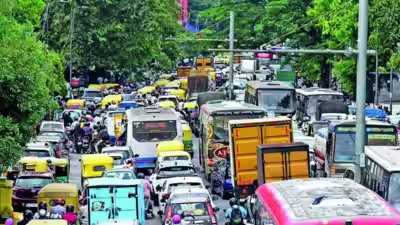









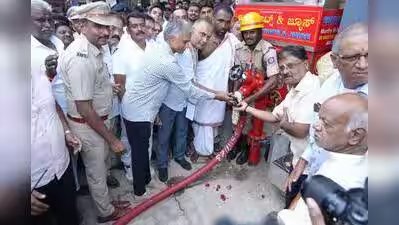
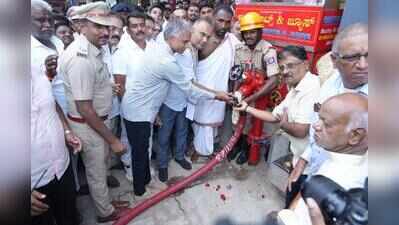
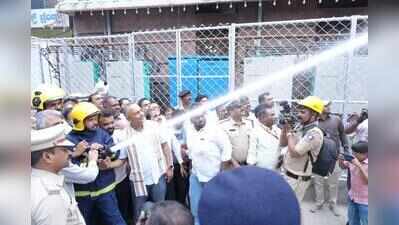
Bengaluru: In an age of smart sensors and high-tech emergency response systems, the tech-capital is reviving a decades-old firefighting tool that had quietly disappeared beneath the city’s rapid urbanisation: Fire hydrants!The revival has begun not in the city’s gleaming tech corridors, but in its oldest and busiest trading hub of Chickpet, where narrow lanes and packed markets often leave fire engines stranded during emergencies.Monday, Bengaluru development minister Krishna Byre Gowda and Gandhinagar MLA Dinesh Gundu Rao inaugurated a pilot network of underground fire hydrants installed beneath the newly white-topped Rangaswamy Temple (RT) Street.The idea is simple but potentially life-saving: instead of relying solely on bulky fire engines to squeeze through congested streets, firefighters can tap directly into strategically placed hydrants for an immediate water supply, saving precious minutes when every second counts.Officials say the pilot project is designed to tackle one of the biggest firefighting challenges in Bengaluru’s historic commercial districts, where ageing buildings, cramped roads and heavy traffic often make it nearly impossible for fire tenders to reach the heart of an emergency.According to fire department officials, a 350-metre dry water pipeline has been laid beneath the road, with nine hydrant valves installed along the stretch. During a fire emergency, tankers can feed water into the pipeline at a designated source point, allowing firefighters to draw water from any of the nine valves closest to the incident spot.Idea comes up after decadesThe initiative stems from a series of major fire incidents reported in Chickpet and surrounding localities over the past few years. In Feb this year, a massive blaze gutted several commercial establishments at Kumbarpet. In Aug 2025, five members of a family lost their lives in another fire incident in Nagarthpet area.“During the Feb fire, we had to stretch hoses for over a kilometre from the nearest fire tender to reach the incident spot. The roads were so narrow that our vehicles could not enter at all. It was an extremely difficult operation. That incident made us seriously consider bringing back a fire hydrant system for the city,” a senior fire officer said.Officials said the department initially explored the possibility of creating a permanent water source using BWSSB infrastructure. However, space constraints in the densely built-up locality made such a proposal difficult to implement.Greater Bengaluru Authority (GBA) constituted a committee comprising representatives from the fire and emergency services department, police, BWSSB and other agencies to identify measures to improve fire safety in the Pete area, which houses numerous garment, electrical and cosmetics shops where fires can spread rapidly.After several rounds of discussions, the fire department proposed installing hydrant systems along roads being taken up for whitetopping. The proposal was accepted and implemented as a pilot project. Sources said similar systems are now being considered on additional roads being developed under the B-Smile programme.British-era infra that disappearedAccording to officials, hydrant systems dating back to the British era existed in several parts of the city, particularly in older localities. These systems consisted of underground water pipelines connected to hydrant valves installed along roads, allowing firefighters to access water directly during emergencies. “Those pipelines carried stored water that could be used whenever fire tenders ran out of supply. They were laid decades ago and served as an emergency backup system. However, Bengaluru has not had a functional hydrant network for at least 15-20 years,” said a senior fire officer.Officials believe the systems gradually disappeared as roads were redesigned, underground utility networks were altered and BWSSB upgraded water infrastructure. Many hydrant valves installed along roads were either removed, stolen or lost during successive infrastructure projects. Some long-time residents recall seeing hydrants in parts of the city such as KR Market, MG Road, Brigade Road and the old Cantonment areas during the 1970s and 1980s. Today, however, little trace remains of the once-common emergency infrastructure.Box(mugshot to be taken)‘Globally proven measure’Welcoming the proposal, Uday Vijayan, managing trustee and president of Beyond Carlton, said the city is reviving a globally proven fire-safety measure.“Fire hydrants are standard infrastructure in many cities across the world and were once present in parts of Bengaluru as well. As the city expanded, many of them vanished or fell into disuse. Reintroducing them is a practical step towards strengthening emergency response and improving urban fire safety,” he said. Vijayan recalled seeing a few hydrants in parts of the old Cantonment area, including the MG Road-Brigade Road belt, during the 1970s, though he had never witnessed them being used.According to Vijayan, “Access to water is the most basic requirement for firefighting. Hydrants allow firefighters to draw water close to the incident site instead of depending entirely on large fire engines carrying water. In many cases, this can significantly improve response time and help firefighters begin operations much earlier,” he said, adding that such systems have been successfully used across the world for decades.However, he cautioned that the success of the initiative would depend on reliable maintenance and uninterrupted water supply. “A hydrant cannot become a showpiece. It is useful only if water is available round the clock whenever an emergency occurs,” said Vijayan.