









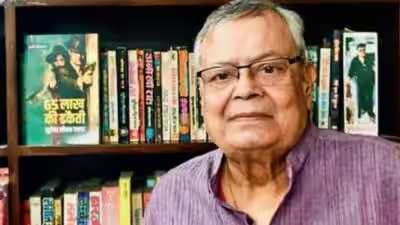
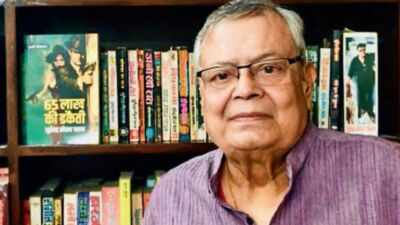
The Hindi pocket book has largely receded from public view. But Surender Mohan Pathak continues to thrill — one surprise twist at a timeThere was a time when Surender Mohan Pathak was everywhere. You could see his books hogging premium space in AH Wheeler railway bookstalls. You would find a fellow traveller on an inter-city bus immersed in a ‘Khoon Ke Aansoo’. Or you could find a ‘Reporter Ki Hatya’ carefully lodged between textbooks in a naughty classroom. Filmmaker Anurag Kashyap once admitted to hungrily consuming them in his youth. “My first edition print run used to be 1 lakh copies those days,” recalls Pathak. Those days are gone. In times of malls and mobiles, pulp fiction has ceased to be our preferred companions on summer afternoons colonising our imagination. But Pathak’s books continue to be more than a passing reference as in ‘Mirzapur’. OTT series ‘Vimal Khanna’, based on his eponymous anti-hero, is streaming on Amazon Prime. In his book-lined study, the writer still devotes six hours a day, scheming tales of intrigue on his laptop. His latest novel, ‘Kahira Connection’, came out last month. Pathak is 87 years and 322 books old. But the writer speaks with the enthusiasm of IPL commentators and the clarity of detectives in mystery novel climaxes. “I am a businessman. My business is writing. I write novels like a carpenter makes chairs, or a halwai makes jalebis,” he says without hesitation, and with honesty. For decades, the bestselling writer submitted hand-written manuscripts. He maintained this practice until his hands started shaking. Pathak also manages significant hearing loss. During the interview, when the hearing aid briefly stops functioning, he responds to handwritten questions. “Majboori hai budhape ki (It’s a compulsion of old age),” he says, changing the battery. But the loss hasn’t dulled his wit. “Sometimes, to enjoy the last word in a family argument, I just take off the aid,” he laughs. Not many know his oeuvre includes 30 joke books. Like his novels, Pathak’s childhood was filled with twists and turns. He was born in Lahore, where his father worked as a stenographer in a British firm. After Partition, the family landed in Shahdara after spending a year in Jalandhar. It was a tough life for refugees. To escape long queues, water had to be filled from public taps by 4am. Pitiless homeowners raised rents to Shylockian levels. For two 7×9 feet rooms, the Pathaks coughed up Rs 50, a princely sum those days. “Following outcry, the govt set up a rent controller’s office. Our rent was scaled down to Rs 25,” he recalls. A summer holiday in Amritsar would change his life. Pathak had read Nirala’s novel, ‘Nirupama’, and Premchand’s ‘Gaban’ in Urdu, a language he comfortably reads. When Pathak told his maternal uncle that he wanted to read more, he willingly provided the lending library fees. Every day, the 15-year-old would trudge 12 kms to and fro for books by top crime writers: Ibn-e-Safi, Kushwaha Kant and others. Decades later, life would take a full circle when Pathak’s blurb was used to promote Safi’s books. Pathak copiously read the maestros: Agatha Christie, Arthur Conan Doyle and James Hadley Chase. His study library also showcases Elmore Leonard and Richard Stark, two old masters of crime. “Legends have an X ingredient,” says Pathak, also the batchmate of ghazal singer Jagjit Singh in DAV College, Jalandhar. His first story was published in ‘Manohar Kahaniyan’ in 1959 and debut novel, ‘Purane Gunah Naye Gunahgar,’ in 1963. “I came to know of my mistakes only after readers pointed them out. I learnt by hit and trial,” he says candidly. The birth of Hind Pocket Books in 1958 created the perfect platform for modestly priced, accessible romantic/social dramas and crime fiction. Gulshan Nanda emerged as the OG of pulp fiction, his romantic novels closely linked to Rajesh Khanna’s rise to superstardom. In crime and detective fiction, Om Prakash Sharma, Ved Prakash Kamboj, Colonel Ranjit (pseudonym) and Pathak took centre stage. The Sunil series, crafted around the fearless investigative journalist Sunil Chakravarty, has birthed 122 Pathak novels. But the writer feels that he will be remembered for Vimal, the razor-sharp runaway from law with goodness in his heart. Pathak says he read Richard Stark’s Parker novels many times. “I wanted to understand how he developed that character,” he says. There are 48 Vimal novels, including ‘Painsath Lakh Ki Dakaity’ (The Rs 65 Lakh Heist), now in its 24th edition, and regarded by many as his best. During his early years in Indian Telephone Industries, where he worked from 1964 to 1998, Pathak wrote only on Sundays. In 1985, the Rajiv Gandhi govt declared a five-day working week for sarkari employees. “I became a weekend writer after that. I would write for 13-14 hours without breaks,” he says. After office hours in Dariyaganj, he would drive to the Press Club of India and go for a walk to India Gate. He would return by 7pm when the bar opened. “I would often be served the evening’s first drink prepared by a gifted Malayali barman who could pour a precise 60ml without help. My quota was three pegs of 100 Pipers whisky,” he recalls. Pathak lived for 48 years in Krishna Nagar colony. Unlike the East Delhi colony, where everybody knew him, it is a different story in Noida’s Sector 93, where he moved for family reasons in 2012. Sometimes his daily routine of tapping away at his laptop breaks when an unusual fan arrives, like the day a few years back when (then) Polish ambassador Adam Burakowski visited him. “I want to write 24 hours a day,” Pathak says. But, as his favourite protagonist Vimal might declare, life doesn’t always unfold the way we want.