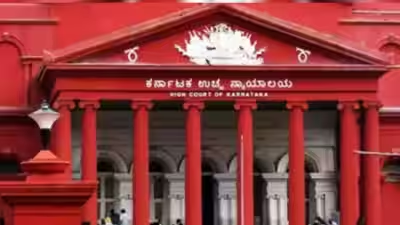










Bengaluru: The FIR over alleged irregularities in Karnataka Public Service Commission’s (KPSC) veterinary officer recruitment examination has again put the state’s premier recruiting agency under scrutiny, raising a familiar question: Can the govt insulate public recruitment from recurring scandals?Experts and former civil servants say the latest case reflects a deeper institutional problem rather than an isolated lapse. It has assumed greater significance after the alleged NEET (UG) paper leak, which dented confidence in competitive examinations.The controversy comes close on the heels of KPSC chairman Shivashankarappa S Sahukar’s suspension over allegations that he influenced recruitments in another case. Together, the incidents have reignited concerns over an institution that has struggled to inspire confidence.Repeated investigations, cancellations, and prolonged litigation have left lakhs of aspirants facing years of uncertainty. While every major controversy has prompted promises of reform, implementation has often remained incomplete.The commission’s credibility suffered its biggest blow in 2011 when its chairman HN Krishna was arrested by the Lokayukta over allegations of accepting bribes in recruitment. The scandal stalled recruitments and triggered a comprehensive review after the change of govt in 2013.Siddaramaiah’s govt appointed a committee headed by former UPSC chairman PC Hota to recommend structural reforms. Its proposals included a transparent search committee to appoint the KPSC chairman and members, videography of interviews, reduced discretion in viva voce, stronger document verification and procedures aligned with UPSC standards.Over the years, KPSC introduced OMR-based evaluation, provisional answer keys, CCTV surveillance at examination centres and biometric attendance in some recruitments. But experts say the changes addressed procedures rather than governance.“Accountability mechanisms remained weak, and appointments themselves continued to attract criticism,” said a retired senior bureaucrat familiar with the commission’s functioning.The 2021 FDA examination paper leak further exposed these weaknesses. Investigators alleged an organised network had infiltrated the recruitment process, forcing cancellation of the examination.Recruitments have also faced repeated court challenges over answer keys, reservation, evaluation and selection lists, delaying appointments by months and, in some cases, years.Recognising these concerns, the Siddaramaiah govt announced another round of reforms in 2025, including a search committee for KPSC appointments, a review of the number of commission members and measures to improve transparency after acknowledging that several Hota Committee recommendations remained unimplemented.Experts now advocate secure computer-based examinations, encrypted digital question paper delivery, tamper-proof audit trails, mandatory third-party audits, AI-assisted surveillance, GPS tracking of confidential material and stronger cyber security. “Technology cannot substitute integrity,” observed another former senior official, who was part of KPSC. “Transparent appointments to the commission, fixed accountability, independent oversight and time-bound recruitment are as important as digital security.”However, MB Maramkal, political strategist, said: “Political interference remains KPSC’s biggest weakness. Every govt seeks a role in recruitment, while the quota-based appointment of members has acquired caste overtones. That creates room for manipulation, and unless it changes, the cycle will continue.”