









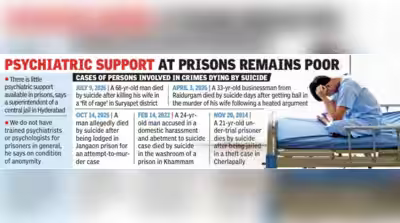
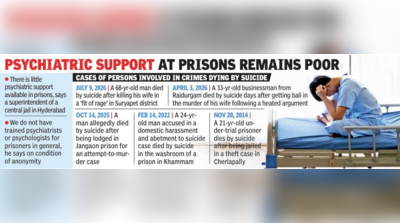
Hyderabad: The suspected suicide of Rajkumar, accused in the Shabad mass murder case, has again brought into focus a pattern often repeating itself in serious criminal cases: accused persons dying by suicide after the alleged crime. In the past week alone, at least three such cases were reported in Telangana. Mental health experts, however, caution against drawing plain conclusions about such deaths, and push for proactive intervention mechanisms.On July 6, a 22-year-old Pocso accused who escaped from Mahabubnagar prison attempted suicide in his native village hours after running away. On July 9, a 68-year-old man in Suryapet allegedly killed his 60-year-old wife by striking her on the head with a stick before dying by suicide after realising she was dead.
CJP Jantar Mantar Protest Updates
Rajkumar, accused in the Shabad mass murder case, was also found dead in an apparent suicide after allegedly killing six people.Psychiatrists say such deaths are rarely driven by a single emotion and should not be interpreted as an admission of guilt.“One common misunderstanding is that if an accused dies by suicide, it automatically means they were feeling guilty or admitting the crime. That’s not necessarily true,” said Dr Vivaswan Boorla, psychiatrist at the Institute of Mental Health (IMH), Erragadda.“Fear of legal consequences, losing one’s reputation, shame, helplessness, and the feeling that life has come to a dead end often play a bigger role. It’s usually a combination of factors rather than just guilt. Some people may also experience guilt or remorse, but it’s difficult to say that this is the main reason in every case,” he said.According to Dr Boorla, warning signs may sometimes be visible, although suicides remain difficult to predict. “A person may become withdrawn, stop interacting with others, lose sleep, appear extremely anxious or hopeless, talk about death, or even say that life is over. But suicide is never easy to predict. Some people show clear warning signs, while others may not show any obvious signs at all,” he said.While experts admit that such acts can at times be unpredictable, psychiatrist Dr Anita Rayrala of IMH said psychological risk assessment can be useful in certain violent offenders who come into the correctional system, especially those displaying signs of persistent aggression, revenge-driven behaviour or other abnormal behavioural patterns.“In one case we handled one and a half years ago, a prisoner had committed six murders; some before coming to prison, some during his parole. The killings happened over a period of time. Only when such behaviour was noticed were we called for a psychological assessment. We had opined that he was having an anti-social personality and high risk behaviour and did not give a ‘safe for community’ certificate him after the risk assessment. But this practice is rare,” she said.Dr Rayrala said such assessments are not intended to explain every violent crime or suicide but may help identify individuals who require psychiatric monitoring.Asked about psychiatric support available in prisons, the superintendent of one of Hyderabad’s central jails told TOI, “We do not have trained psychiatrists or psychologists for prisoners in general. As part of a central government initiative, we have de-addiction centres at prisons and counsellors who help in case someone’s in need of it.”Dr Vivaswan Boorla also said families and authorities both have a role to play in recognising behavioural changes. “Families should take sudden behavioural changes, like extreme aggression, hopelessness or suicidal talk, seriously and encourage the person to seek help. Authorities should also be aware that people facing severe legal or personal crises may be at higher risk and monitor them appropriately,” he said.