








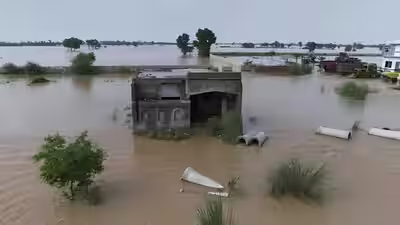
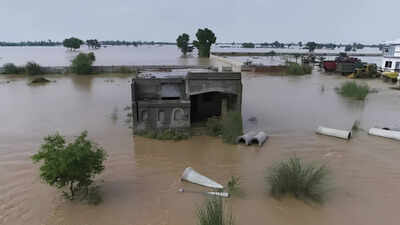
GURDASPUR: With memories of last year’s devastating floods still haunting thousands of families in Gurdaspur, the Punjab water resources department has launched a massive de-silting drive in the Ravi river, hoping to prevent a repeat of the disaster that left villages submerged, crops destroyed and livelihoods shattered.Officials say the work is being carried out on a “war footing” at Dharamkot Pattan, where heavy machinery is working round the clock to clear tonnes of silt and riverbed material that accumulated after last year’s floods severely disrupted the river’s natural flow.“The drainage capacity of a river decreases when silt and debris accumulate, increasing the risk of flooding as water cannot flow freely,” said executive engineer (XEN) Gurveer Singh.He said the objective of the ongoing exercise is to remove bottlenecks, restore the river’s carrying capacity and ensure the smooth passage of floodwaters before the peak monsoon season.The urgency stems from the scale of destruction witnessed in 2025, when the Ravi breached its embankments at nearly 50 locations across Gurdaspur district.The floods affected 329 villages, claimed one human life, killed 610 heads of cattle and destroyed crops spread over 73,443 acres, inflicting massive financial losses on farmers.After the floodwaters receded, huge quantities of silt and riverbed material were deposited in the river channel, reducing its carrying capacity and increasing the likelihood of future flooding.Following a detailed survey, the department identified critical bottlenecks and prepared a Detailed Project Report (DPR) in accordance with the Government of India’s National Framework for Sediment Management (NFSM).The project has also received technical approval from the Joint State Technical Advisory Committee (STAC), comprising experts from the Punjab Government and the Centre.In an effort to ensure transparency and prevent any irregularities, the department is using Keyhole Markup Language (KML)-based digital geo-fencing, enabling officials to monitor every stage of the de-silting operation and ensure excavation is carried out strictly within the approved zones.The excavated silt and other materials are being stored at designated safe locations for future flood-control works. Officials said weak embankments are also being strengthened, while sandbags are being prepared for emergency deployment during the monsoon.With the monsoon gathering momentum, officials admit that time is of the essence. “The department is committed to completing the work within the stipulated time frame to safeguard lives, agricultural land and property.Continuous monitoring is being carried out to restore the Ravi’s natural flow before the river is tested once again by heavy rains,” Gurveer Singh said.For thousands of residents living along the Ravi’s banks, the success of the de-silting drive could mean the difference between another season of fear and one of much-needed relief.