









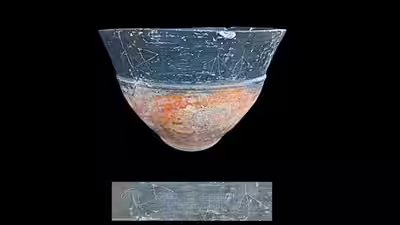
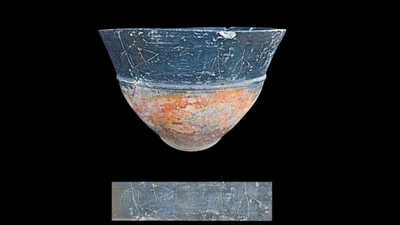
CHENNAI: An intact black-and-red ware bowl unearthed along with iron weapons, copper objects and a possible steel sword at Thelunganur in the water spread area of the Mettur dam near Salem could offer vital clues to a writing system that existed more than 3,200 years ago.The bowl, discovered by a Tamil Nadu department of archaeology team, carries five graffiti signs arranged from left to right, making it the longest sequence of such marks recorded in the state. Excavators believe this may be an early form of writing as another bowl bears the same five symbols in a different order.This, they feel, could be a precursor to the advent of the Tamil Brahmi script that dates to sixth century BCE.The recently found graffiti could be contemporary to Indus Valley Civilization as Thelunganur and Mangadu, twin Iron Age sites near Salem, have been dated to between 1,600 BCE and 1,200 BCE, the final phase of Indus Valley Civilization.“In the 1960s, ASI had found three graffiti signs in different orders at Sanur near Chengalpet. Now we’ve found five symbols in two different orders. We have to decipher the meaning,” said K Rajan, adviser to the TN department and a co-author of a morphological study of Indus signs and graffiti marks found in Tamil Nadu.Archaeologists have so far unearthed around 16,000 graffiti-inscribed potsherds across Tamil Nadu. According to a recent morphological study, graffiti marks found at sites including Kodumanal, Keeladi, Thulukkarpatti and Kilnamandi in Tamil Nadu and in Indus Valley sites have 90% similarities. Indus Valley Civilization existed between 3,300 BCE and 1,300 BCE.Researchers said Tamil-Brahmi stone inscriptions and inscribed potsherds bear symbols at the ends of letters, suggesting these could represent an earlier form of communication.Among the other artefacts that caught the excavators’ imagination is a 1.9m iron spear. “We also found arrowheads, axes, swords, daggers, knives and iron nails,” said S Paranthaman, excavation director at the site. “One other object found is suspected to be an ancient steel sword.”Excavators also recovered complete skeletal remains of two Iron Age individuals.“We found four types of burials — pit, cist, urn and sarcophagus — at a single site, reflecting the composite nature of the community. This indicates that the site evolved from the Early Iron Age to the Late Iron Age,” Paranthaman said.The site gained prominence after a steel sword found here was dated to 1,200 BCE, one of the world’s oldest.