










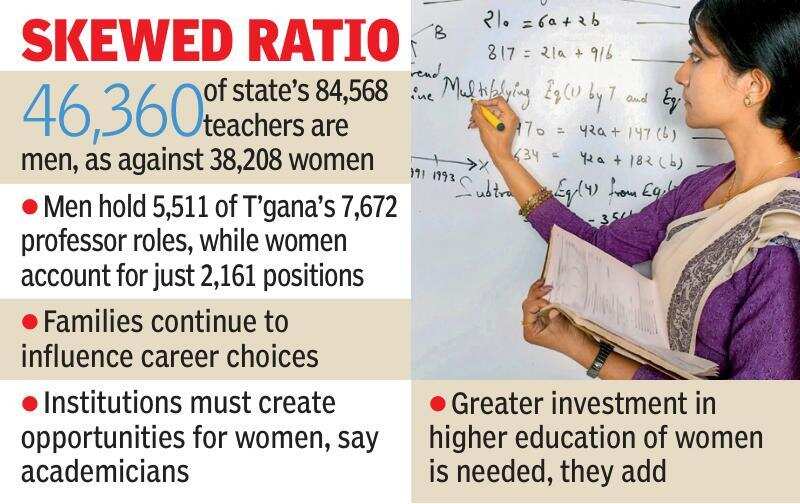
Hyderabad: Women now outnumber men in Telangana’s higher education classrooms, but the same is not true of the people teaching them. The All India Survey on Higher Education (AISHE) 2023-24 shows 9,13,216 women enrolled in higher education institutions against 8,74,244 men, with a total enrolment of 17,87,460. Among faculty, however, 46,360 of the state’s 84,568 teachers are men against 38,208 women. The gap widens a little more at the top: men hold 5,511 of the state’s 7,672 professor positions, while women account for just 2,161 positions.A senior woman professor from a research institute in Hyderabad, who did not wish to be named, said women’s presence in academia thins out as one looks above. “The gap has certainly narrowed compared to earlier decades and the numbers are improving, but women begin to drop off as they move from school to universities and then into academic careers. Socio-cultural conditions – like families not prioritising supporting a woman’s education to that level – continue to influence career choices, while research expectations, which often become a hurdle around the system we currently live in, often make career progression into the higher level challenging,” she said.
She also said institutions need to put in more thought about how they create space for women at senior levels. “This is not about men doing anything wrong. It is about ensuring that women’s perspectives are encouraged and considered while designing education, framing policies and leading institutions. If we want truly inclusive higher education, institutions have to think differently about creating opportunities for women. And undoubtedly, some are,” she told TOI.Professor E Venkatesh of the University of Hyderabad (UoH) says the situation has changed now compared to decades ago. “Over the years, awareness has increased and initiatives such as self-help group movements, ‘Beti Bachao, Beti Padhao’ have encouraged more women to pursue higher education,” he said.But getting into a college and building an academic career are two different things, he said. “Dropouts at different stages of higher education, socio-economic constraints, limited research fellowships and financial support, and the pressure to take up jobs after graduation continue to affect women’s progression into academia. Vacant teaching posts also contribute to the gap. Greater investment in higher education of women, more fellowships and targeted support for women can help improve representation,” he said.Women do slightly outnumber men among non-teaching staff, with 31,095 against 30,313, but the imbalance inside classrooms, mainly at the senior academic levels, continues to be there.