










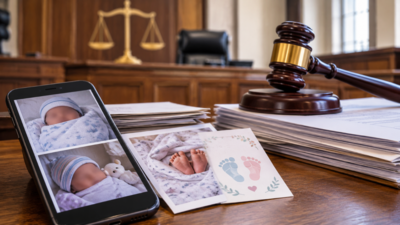
A woman deceived her former partner into believing she had given birth to his two children, sending him ultrasound images, baby photographs and messages announcing their arrivals, a High Court judge has ruled. The elaborate deception also led the man’s mother to believe she had become a grandmother, with the woman claiming the babies were being cared for by relatives and social services. In a judgment handed down on 26 February 2026, Mrs Justice Judd found that the pregnancies and children had been fabricated, describing the man as the victim of a “sustained and elaborate campaign of deceit” that continued for around three years.
How did the woman convince her ex-partner he had two children
John and Jane met around the beginning of the Covid-19 pandemic, approximately five years before the court proceedings. According to the judgment, John, who was in his mid-thirties, retained his own home but spent considerable time with Jane, who was in her early fifties. In late 2022, Jane told him that she was pregnant and, in January 2023, allegedly sent him an ultrasound image. John said that her stomach became visibly larger as the pregnancy progressed and that he had touched it on several occasions.In early May 2023, following an argument at Jane’s home, she called the police and made allegations of assault against John. He was arrested and spent several months in prison on remand. Two days after his arrest, Jane sent a message to his stepfather announcing the arrival of a baby girl. The message read: “She’s here everybody! Shiloh Rose 5lb 9oz 1.44 am [May 2023].” She also contacted John’s mother, sending messages and a voice note in which a crying baby could be heard in the background. Over the following months, she shared photographs of a baby she identified as Shiloh and claimed that relatives were looking after the child, with the local authority also allegedly involved.After John was released from prison, the relationship resumed. Jane reportedly told him that Shiloh was staying with a family member and that the local authority had said he was not allowed to see her. She continued sharing photographs of the child and subsequently told him that she was pregnant again, with the second baby due in August 2024. In August that year, following another argument at Jane’s home, John’s mother collected him. She later told the court that Jane appeared visibly pregnant at the time. Jane subsequently messaged John’s mother, claiming that she had given birth to a boy. The message stated: “I’ve had him, that same night, 2.07 am. I got discharged yesterday; he is in SCBU. I don’t know for how long, but social services have said they would support me with anything I need and to go home and rest.” She named the baby Aryeh and sent photographs of him to John and his mother.
How did the woman maintain the fake baby story and receive £30,000 from her ex-partner
The judgment detailed how Jane continued to provide information about the children, including messages suggesting that Shiloh was staying with her niece in different parts of England. She also claimed that the children were connected to a travelling family and that social services had become involved in their care. In one message, she discussed whether she should apply suntan lotion to Shiloh because of the child’s skin colour. She also told John’s mother that the baby had developed an infection and that doctors were investigating whether prescribed medication had contributed to the condition. At another point, she described her son as having “a wide nose, big lips and blue eyes” and said she would send photographs once he had recovered.Jane also allegedly told John that she had sold the children for £500 in August 2024, although she continued sending messages and photographs about them afterwards. John regularly transferred money to Jane for herself and the children, while his mother also sent money intended for their needs. According to the judgment, John produced a schedule showing that he had paid Jane approximately £30,000 over two years. He became increasingly concerned about the children’s whereabouts and made enquiries with the police and local authority. In October 2024, he applied to the court to establish where the children were and to obtain parental responsibility. Jane, meanwhile, sought a non-molestation order, alleging verbal, physical and sexual abuse.The dispute took a different turn when Jane’s barrister informed a judge during the non-molestation proceedings that the couple did not have any children together. She claimed that she had been pregnant twice but had miscarried on both occasions. When questioned later, she initially denied having told John that they had children and claimed that the messages and photographs were not hers. In a subsequent witness statement, however, she admitted telling him that they had children, blaming the deception on her daughter’s partner, whom she said had devised the plan as revenge for alleged violence by John. She also claimed that the photographs had been taken from the Facebook account of a woman she did not know.
What evidence exposed the woman’s fake pregnancies
The High Court ordered further investigations to establish whether the children existed. Evidence Matters examined Jane’s phone, while searches were carried out at hospitals and through birth registration records. Although the phone investigation revealed numerous messages and social media posts referring to Shiloh and Aryeh, it did not produce independent evidence that either child had been born. The court also found no records of births at hospitals in the UK, no birth registrations and no local authority or police records supporting Jane’s claims about social services involvement.Her medical records also raised questions about the alleged pregnancies. There was no record of Jane receiving antenatal care during either period, although she had not attended her GP during the dates in question. A blood test taken in 2021 showed a serum FSH level of 60 IU/L, which her medical practice said could indicate menopause, although the judge noted that the result was not definitive without further tests. An expert examination of the ultrasound image sent to John found that it was more likely to have been taken between 2001 and 2007 than in the 2020s. Bank statements also showed that Jane had visited a tanning shop on the day she claimed to have given birth to Shiloh, while containing no recorded purchases of nappies, baby clothes, prams or other children’s items.During the proceedings, Jane admitted that she had sent the messages and photographs herself. She also acknowledged that the crying baby heard in the voice notes was not evidence of a newborn in her care, claiming that she had deliberately played a soundtrack from YouTube in the background to make the recordings sound genuine. The judge also considered evidence that Jane had searched online for information about cancelling passports, changing names, temporary care of a newborn and foster care. Photographs of children sent to John and his family were eventually confirmed to be pictures taken from another woman’s Facebook account.
Why did the High Court rule that the two children never existed
Mrs Justice Judd considered two possible explanations: that Jane had carried out an elaborate deception over several years, or that she had secretly given birth to two children and placed them with other people without their whereabouts being traced. The judge acknowledged that John and his mother genuinely believed Jane was pregnant, particularly because they said they had seen her visibly pregnant and because she had sent them an ultrasound image. However, she also considered the absence of birth records, medical evidence and independent sightings of the children, alongside the inconsistencies in Jane’s accounts.The judge found that Jane had repeatedly lied and changed her evidence, while also withholding or deleting digital material. She noted that the respondent’s daughters had been reluctant to give evidence and that their conduct had made it difficult for the court to establish the truth. Nevertheless, the judge concluded that the evidence against the children genuinely existing was stronger than the evidence suggesting that Jane had given birth. She stated: “I have come to the conclusion that it is more likely that the respondent fabricated the pregnancies and the children than that she genuinely gave birth.” She emphasised that the finding was made on the civil standard of proof, rather than the criminal standard.In her concluding remarks, Mrs Justice Judd described the deception as particularly cruel because it had led John and his mother to believe they had children and grandchildren. She said: “The behaviour was cruel, leading a man and his mother to believe they had children and grandchildren respectively.” The judge also said she could not establish Jane’s precise motive. Although financial fraud was a possibility because she had received considerable sums from John, the issue had not been explored in detail during the proceedings. The judge added that Jane’s reported mental health difficulties might also have played a part, but said a detailed investigation into that matter was beyond the scope of the case.The judgment was delivered by the High Court’s Family Division on 26 February 2026. The parties were anonymised as John and Jane, while the children’s alleged names were given as Shiloh and Aryeh. The judge expressly directed that their identities and identifying family details must remain protected in any published version of the judgment. The judgment also recorded that John was seeking permission to appeal.Disclaimer: This article is based on information contained in the publicly available High Court judgment, John v Jane [2026] EWHC 415 (Fam), handed down on 26 February 2026. The Times of India has not independently verified the allegations or evidence presented during the proceedings. The findings reflect the court’s conclusions on the civil standard of proof and should not be interpreted as a criminal conviction. The identities of the parties and alleged children have been anonymised in accordance with the court’s directions.