








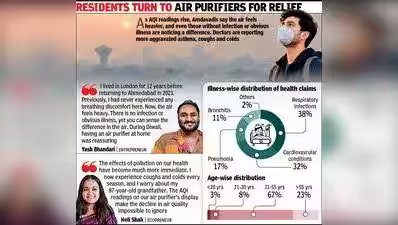
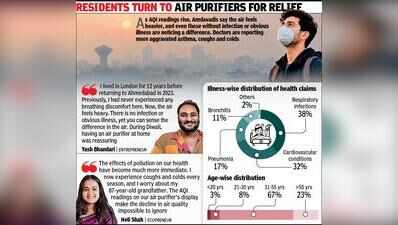
Ahmedabad: Persistent cough, lingering cold and fever, and breathlessness are among the complaints Amdavadis are taking to doctors as winter mornings in the city begin under a layer of haze instead of clear skies.Ahmedabad’s air quality index touched 328 around 9.30 am on Tuesday, placing it in the “very poor” category, according to AQI.in. Central Pollution Control Board (CPCB) recorded the city’s 24-hour average AQI at 164 at 4 pm, categorised as “moderate”, and its bulletin listed PM10 as the prominent pollutant.This comes amid a sharp rise in demand for respiratory medicines. Drugs worth Rs 78 crore used to treat respiratory ailments were sold in Oct alone, according to Pharmarack. While the sales data does not directly link pollution to the rise in complaints of respiratory illnesses, doctors have reported more patients with aggravated asthma, cough, cold and other respiratory ailments as air quality worsens.Mahesh Pandya, environmentalist and director of Paryavaran Mitra, said, “Construction sites, debris handling and roadwork release dust into the air when dust-control measures are not followed. There is an urgent need to cover construction materials and prevent dust from spreading beyond project sites.” He added that AQI readings in Ahmedabad and several other major cities had hovered around 500 during Diwali. While fireworks contributed to the spike, he cautioned that the deterioration in air quality should not be attributed to firecrackers alone.Worsening air quality has also led several residents to install air purifiers as a precaution, especially for children and senior citizens.“I am concerned about the kind of air we breathe. We installed an air purifier last year. It has an AQI indicator too. These are measures we would be compelled to take in the long run in the interest of our own health,” said Nishtha Sheth, an Ahmedabad resident.Paryavaran Mitra recently submitted a representation to state govt seeking a scientific assessment of air pollution, solid waste management and water pollution in Gujarat. In its representation to the chief secretary, the NGO has called for ward-wise studies to identify local sources of pollution.