








Wind turbine blades can last for years, but what happens to them after they are no longer needed is a challenge. A facility in Fairfax, Iowa, USA, is now recycling old wind turbine blades and turning their materials into products that can be used in concrete, mortar and asphalt.Regen Fiber opened its production facility in Fairfax in 2024 and began production at the site. The company has developed an all-mechanical recycling process for wind turbine blades. According to Recycling Today, unlike processes that use heat or chemicals, this method relies on mechanical processing to break the blades down.The recycled materials can be used in industrial applications, including the production of concrete, mortar and asphalt. The process is designed to recover materials from the blades and prepare them for use in construction projects, including projects linked to the energy industry.The facility is expected to process more than 30,000 tons of wind turbine blades each year when operating on a one-shift-per-day schedule.
How blades are processed
The recycling process begins with extracting reusable components from the blades. The blades are then mechanically shredded. During this process, materials including fiberglass mesh and polyester resins are prepared for use in concrete and asphalt production. The company describes the method as an “all-mechanical recycling process” that avoids using heat or chemicals.The shredded blade materials are converted into fibres and additives. These materials are intended for use by concrete and asphalt producers. According to the recyclers, its process recycles 100 per cent of the wind turbine blade.Jeff Woods, director of business development at Travero, which owns the company, said the recycled materials can also help improve the performance of concrete and asphalt.
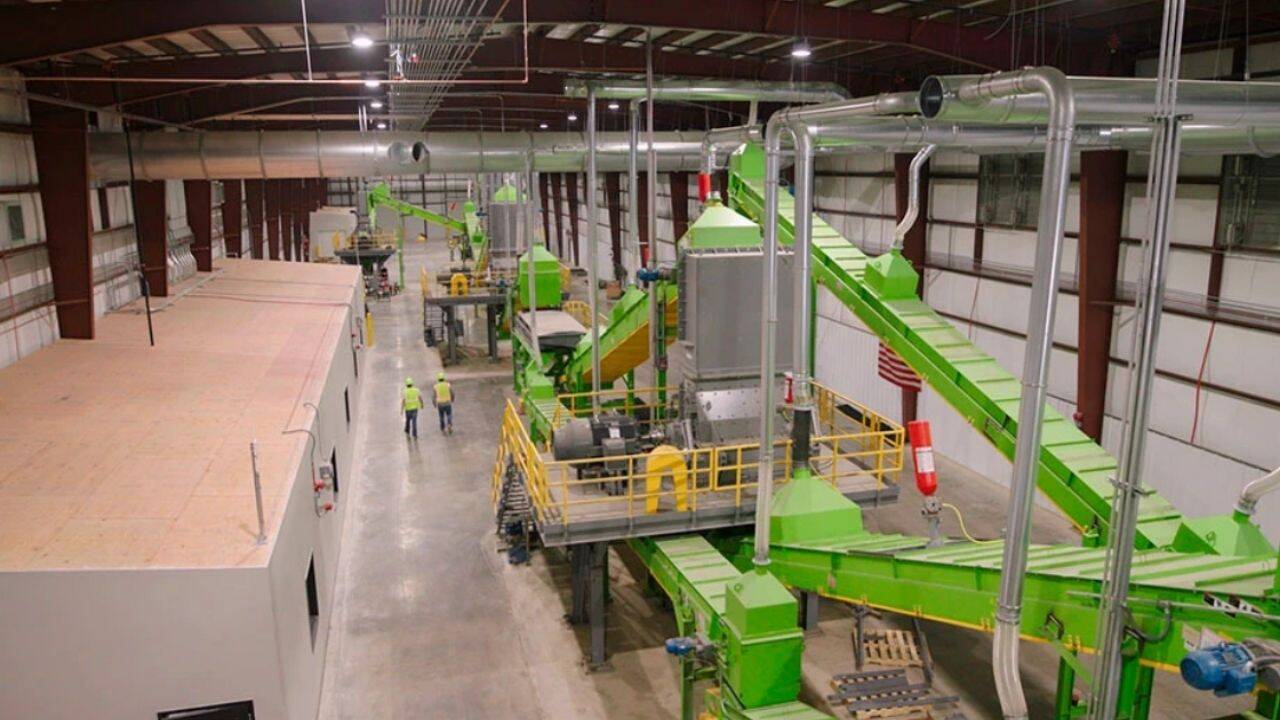
Regen Fiber’s facility recycles old wind turbine blades into materials for concrete and asphalt.
“Our process recycles 100 percent of the wind turbine blade, creating fibers and additives that enhance the durability and environmental resistance of concrete and asphalt,” Woods said.He added that the materials can improve the structural integrity of roads and buildings and make them more resilient.The process therefore gives the recovered blade materials another use instead of treating them simply as waste.
30,000 tons of blades a year
The Fairfax facility is Rthe company’s main production site and is located at its headquarters. At full one-shift production, the facility is expected to process more than 30,000 tons of blades annually.The Fairfax facility is not the company’s only operation connected to wind turbine blade recycling. There is also a facility in Des Moines, Iowa, that handles new turbine blade manufacturing scrap material.The company also operates a blade processing facility in Lubbock, Texas. That facility is located to handle end-of-life blades from the southwestern United States, an area with significant wind power activity.The different facilities handle different types of blade material. The Des Moines operation focuses on scrap generated during the manufacture of new turbine blades, while Fairfax and Lubbock are connected to the processing of end-of-life blades.