







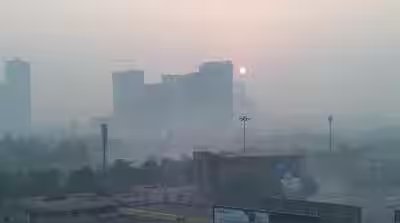
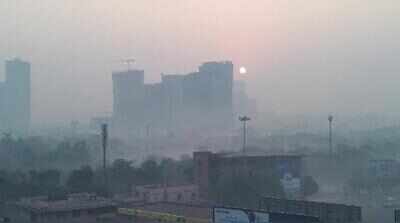
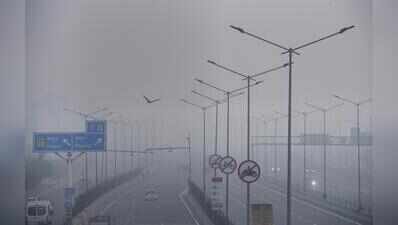
Noida: Firecracker emissions pushed up pollution in Noida, with the air quality index (AQI) rising 21 points from 297 (poor) on Nov 7 to 318 (very poor) on Diwali day (Nov 8). Steady wind limited the rise to 332 on Monday, and overall pollution was no worse than on Diwali. The air stayed “very poor” and did not slip into the “severe” category as feared despite rampant violations of the Supreme Court-ordered window to burst crackers.SC had allowed green firecrackers in Delhi-NCR between 6am and 7am and between 8pm and 10pm for two days ahead of Diwali, but fireworks continued well past midnight when a complete ban took effect.This year’s post-Diwali air is the fourth-cleanest in the past 10 years. Only 2022, 2024 and 2025 recorded cleaner air after the festival, at 299, 274 and 320 respectively.An analysis of the AQI figures for the past decade shows Noida’s post-Diwali air was at its worst in 2021, when the AQI of 470 deteriorated to the “severe” category. It was at its best two years ago, in 2024, at 274. This year, a day after Diwali, the AQI was 332.In Ghaziabad too, 2021 recorded the poorest air a day after Diwali, with an AQI of 470 on Nov 5. The best post-Diwali day was in 2022, when the AQI stayed at 266, in the “poor” category. This year’s 324 on the day after Diwali was exactly the same as last year’s.Diwali-day pollution in NCR cities has never crossed 456, the highest being recorded in Ghaziabad on Nov 14, 2020. Noida recorded 425 that year, its worst Diwali day in the past decade. For both cities, 2023 was the best year, with Noida at 189 and Ghaziabad at 186. Weather that year, including rain, helped clear dust and pollution to a large extent. This year’s Diwali-day AQI of 318 in Noida and 344 in Ghaziabad places them in the middle of the 10-year range.Pre-Diwali levels held no surprises either. On Saturday, Noida’s AQI of 297 and Ghaziabad’s 277 were both in the “poor” category. The 10-year data show 2023 was the best year for pre-Diwali pollution, again linked to weather and rainfall, with Noida at 156 and Ghaziabad at 160, both in the “moderate” category.Ghaziabad’s pre-Diwali pollution peaked in 2017 at 408, even though Diwali fell early, on Oct 19, before winter had properly set in. In Noida, the worst pre-Diwali day was in 2018, at 347, when Diwali was on Nov 7.Environmentalists say several factors apart from a firecracker ban influence Diwali pollution. “Weather conditions play a significant role in mitigating pollution levels and there are doubts that even the department fudges with data,” said Amit Kumar, who has filed complaints with IGRS and CAQM expressing doubt over the AQI data released on Diwali this year.Weather experts said prevailing windy conditions effectively cleared the smoke from Diwali firecrackers over the past 24 hours. According to India Meteorological Department’s (IMD) evening bulletin, two upper-air cyclonic circulations persist, one over north Haryana at 3.1km above mean sea level and another over northwest Rajasthan at 0.9km. A trough also persists at 3.1km from north Coastal Andhra Pradesh to northeast Uttar Pradesh across Odisha, Chhattisgarh and Jharkhand.Under their influence, a steady wind flow kept speeds at 5-15kmph across NCR through the day. Easterly winds blew from late Sunday night until Monday evening, clearing the pollution load and improving ambient air quality. A fresh Western Disturbance is likely to affect the northwestern Himalayan region from Tuesday night, bringing a drop in temperature along with windy conditions.Six of Noida’s seven automated monitoring stations were functional on Monday. Sectors 62, 110 and 150 stayed in the “very poor” category, with AQI readings of 385, 383 and 356. All three had recorded 400-plus readings last week, suggesting Diwali festivities did little to change ambient air quality.In Greater Noida, one more station began reporting data from Diwali, taking the functional total to four. All four recorded “poor” air on Monday. The new Ghodi Bacheda station, in an upcoming real estate hub, recorded 265, while Knowledge Park III and V recorded 246 and 288. Shiv Nadar University also recorded 246.In Ghaziabad, five of eight stations recorded “very poor” air in the 300-plus range. New Tehsil Loni was six points short of the “severe” category, while Ved Vihar Loni and Wave City recorded 361 and 357.Govindpuram, which had recorded the city’s best AQI over the past week, stayed “very poor” at 323. Indirapuram and Vasundhara, two of the city’s most populated and polluted pockets, recorded the best air, at 266 and 277.