










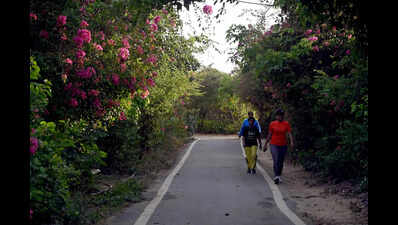
New Delhi: The Kamla Nehru Ridge is a lush green expanse with minimal concrete. It is away from dense urban construction and vehicular movement. Peacocks roam freely, monkeys swing from branches and mongooses, boars and reptiles thrive in the dense vegetation.Why then, does it emerge as the hottest part of Delhi regularly?By late afternoon and evening, the heat becomes palpable at the meteorological observatory inside the premises of the regional seismological centre, popularly known as “Bhuchaal Bhawan”.The Ridge observatory recorded the city’s highest maximum temperatures, among the manned stations, on all three days this week — 44.6 degrees Celsius on Monday, 46.5 degrees Celsius on Tuesday and 45.8 degrees Celsius on Wednesday. On each of these days, Safdarjung, Delhi’s base weather station and the benchmark for the city’s official weather readings, recorded temperatures at least a degree lower.AK Singh, the scientific officer stationed at the observatory, explained that the Ridge consistently behaves differently from the rest of Delhi.“Generally, the Ridge observatory often records the highest maximum temperature, lowest minimum temperature, as well as the maximum precipitation,” Singh said.“It’s because of its unique geography. It’s a forest, but with rocky terrain. The rocks absorb heat, thereby increasing the temperature; they also radiate the heat. Later they cool down quite quickly, thus impacting the minimum temperatures. Due to greenery, the rain in the area is also often high,” he added as he accesses the Stevenson screen (an enclosure to protect meteorological instruments) to take a temperature reading.The Ridge is one of the five manned weather observatories maintained by the India Meteorological Department (IMD) in the capital. Readings are recorded every three hours. The other manned observatories are in Safdarjung, Palam, Ayanagar and Lodhi Road.Scientists say the Ridge’s paradoxical heat is tied not only to its rocky terrain, but also to ecological degradation caused by invasive vegetation.According to Faiyaz A Khudsar, scientist-in-charge of DDA biodiversity parks programme, the landscape of this final spur of the Aravali range has long been dominated by Prosopis Juliflora, or vilayati kikar, an invasive species that disrupts the area’s natural cooling mechanisms, failing to regulate moisture and ambient temperatures effectively.“Prosopis Juliflora’s ecological function, such as water budgeting, is very abnormal, meaning, it takes far higher amounts of water from the soil than it releases in the atmosphere. It has little to no impact on ambient temperatures. Native vegetation, on the other hand, has characteristics that regulate ambient temperatures,” he said.Khudsar added that a systematic ecological restoration programme to remove Prosopis Juliflora and replace it with native vegetation has been initiated.