








GURGAON: When a pond disappears, a forest is quietly cleared, or an aquifer is drained dry, the first line of defence is expected to be the state. In Haryana, that expectation has repeatedly collapsed.In a state where forest cover is the lowest in the country, some of the major environmental battles are being fought by residents, retired officers, teachers, villagers and professionals, who first knocked on official doors, were ignored, and then turned to NGT and the Supreme Court.Their petitions have challenged builders, highway authorities, state agencies and even a paramilitary force, showing how ordinary citizens are stepping in to defend issues the state has failed to protect.
Pond under siege
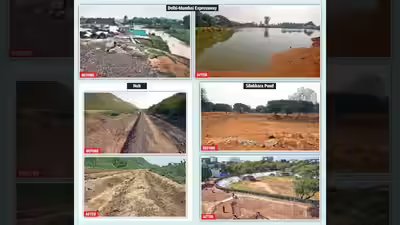
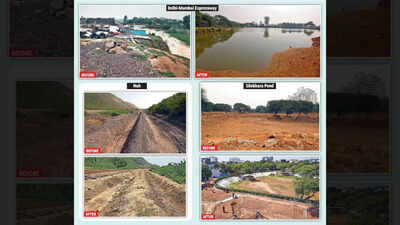
The battle over a pond in Gurgaon’s Sector 41 has run for more than a decade. Once an important water source, it was gradually filled after planning changes cleared the way for a commercial complex. In 2015, residents led by Brig Paramjit Singh (retd) and former DGP Navneet Rajan Wasan moved NGT.Wasan said he noticed the filling of the pond and complained to the deputy commissioner, but “nothing happened”. The government, he alleged, initially denied it was a waterbody until residents produced maps. “They had little option but to apologise. NGT then ordered its restoration,” he added.Even then, compliance faltered. Agencies proposed plans that would have effectively turned the pond into a swimming pool, drawing sharp criticism from the tribunal.In March 2023, NGT ordered GMDA to restore the site with greenery, pathways and aquatic life. After missing multiple deadlines, GMDA was given another extension in March 2025 till October.
E-way, broken drains
In 2021, resident Prem Mohan Gaur approached NGT, alleging that construction of the Delhi-Mumbai Expressway had damaged the local ecology by cutting trees, blocking drains and encroaching on ponds and panchayat land.“I live in this village and did not want these waterbodies destroyed beyond repair,” Gaur said, adding that he moved the tribunal after local authorities failed to act.An inquiry ordered by NGT upheld his claims. It found that a spur road had cut through a pond in Nuh and panchayat land in Hajipur, disrupting irrigation channels and leaving farmers cut off from their fields.In February 2024, the tribunal imposed Rs 45 crore as environmental compensation on NHAI and ordered that the money be used for restoration.
Roads for mining
In October 2024, residents of Basai Meo in Nuh found roads bulldozed through protected Aravali forest land covered by the Punjab Land Preservation Act. They moved Supreme Court, saying the roads had been built without notice or compensation.Villagers argued the roads were not meant to improve connectivity but to transport illegally mined stone from nearby Rawa into Rajasthan. “The CEC confirmed that a 1. 5km road had been built to carry mined stone,” said petitioner Mukeem.The committee also alleged panchayat inaction and raised questions over political complicity. The court later ordered restoration of the land.In the criminal case linked to the alleged mining network, more than six persons were arrested later.
Kalesar dams halted
A petition by a resident has also stalled Haryana’s plan to build four dams inside Kalesar Wildlife Sanctuary. The petition, filed by Sanjay Kumar, reached Supreme Court, which sought expert assessment.The Wildlife Institute of India said the dams, planned on seasonal streams, would not retain water through the year but would permanently fragment habitat used by endangered species. A court-appointed empowered committee described the likely ecological damage as “irreversible”.“The project remains frozen under judicial scrutiny. This is a reminder that forests cannot be traded away for short-lived engineering projects,” said Gaurav Bansal, counsel for the petitioner.
Aquifers in court
Groundwater depletion in Sonipat also reached the tribunal through an individual petition.In 2020, Delhi resident Varun Gulati moved the tribunal, accusing builders and industries of illegally extracting groundwater.“The pollution department did nothing, so I approached the green tribunal,” Gulati said.The case found 28 industries in violation of environmental norms, including unauthorised withdrawal of groundwater. Though the matter was disposed of in 2022, NGT asked Haryana State Pollution Control Board to ensure compliance.
Aravalis defended
One of the most significant citizen-led interventions began after a TOI report on illegal construction in the Aravalis.In Jan 2013, NGT took suo motu cognisance of the report. Later that year, Delhi University teacher and ecologist Sonya Ghosh filed a formal petition.Over 71 hearings across nearly a decade, ‘Sonya Ghosh vs State of Haryana’ became a key case for protecting the Aravalis in Gurgaon, Faridabad, Nuh and Alwar.On Dec 9, 2022, NGT closed proceedings after asking Haryana and Rajasthan govts to set up monitoring committees and continue clearing encroachments from ‘gair mumkin pahar’ land.
Camp on corridor
In 2019, city resident Ram Avtar Yadav challenged the clearing of 260 acres of Aravali forest in Mandawar for a CISF camp, alleging that the project lacked mandatory clearance under the Forest (Conservation) Act.A forest department report confirmed violations and said the land formed part of a leopard corridor. NGT barred any non-forest activity there until due process was followed. “When I saw trees being cleared in the Aravalis for a camp, I knew it was wrong. These hills are not scrubland, but living habitat. If even govt forces can take over forest land without permission, what message does that send,” he sought to know.