









HYDERABAD: Telangana’s food sector — and it’s not just about hotels and restaurants — has exploded in recent years. And so has the demand for professionals skilled in food science, business, and technology from an industry that boasts of ventures such as large-scale food processing units, packaged brands, agri-tech startups and export businesses, to name a few.Keeping the industry’s demand in mind, the Telangana Council of Higher Education (TGCHE) has now introduced a new interdisciplinary programme, BBA in Food Technology, Food Security and Agriculture, aimed at preparing students for the evolving demands of the industry.While Food Technology and Agriculture have long existed as standalone science-based disciplines, the newly launched programme marks a shift toward integrating science, management, sustainability, public policy, and technology into a single professional degree.
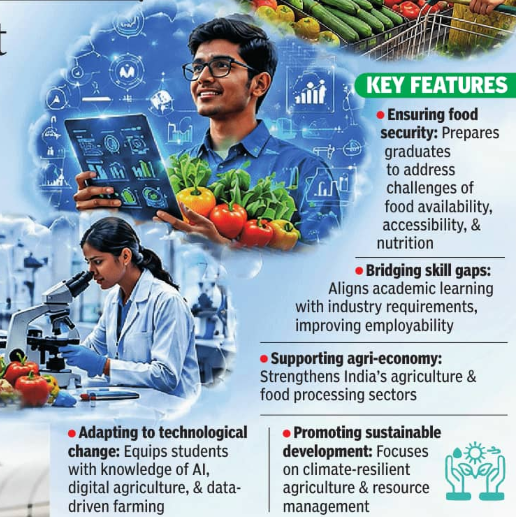
Aligned with industry requirementEducation experts say the course has been designed to align with emerging industry demands and changing global food systems.“The curriculum is structured across six semesters, beginning with foundational courses like Introduction to Food Systems, Agriculture, and Technology & Ethics, and progressing to advanced subjects such as Food Processing, Supply Chain Management, Digital Agriculture, Climate Change, and Global Food Trade,” said V Balakista Reddy, chairman of TGCHE. He said this comes amid massive demand for food technology professionals in the state due to the current socio-economic and environmental context.“Food systems across the world are undergoing a massive transformation because of climate change, urbanisation, changing consumption patterns, and technological disruption. Telangana itself is emerging as a hub for food processing, agri-tech innovation, and export-oriented food businesses,” Reddy said.“Industries today are not merely looking for science graduates, they want professionals who understand markets, regulation, sustainability, and technology together. This course is meant to bridge that gap and create industry-ready graduates.”Wider pool of students to benefitUnlike conventional food technology degrees, which typically require students to pursue the science stream with Physics, Chemistry, Biology or Mathematics in Class 12, the new BBA course opens opportunities for a wider pool of students from different academic backgrounds.
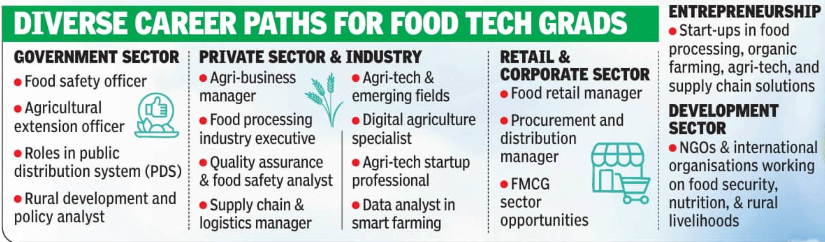
Students can also directly apply through Telangana’s Degree Online Services Telangana (DOST) platform, making the course more accessible to students interested in management-oriented careers within the food and agriculture ecosystem.Experts say this interdisciplinary structure could appeal to students who may not have pursued science at the Intermediate level but are interested in sectors such as food business management, agri-entrepreneurship, food retail, sustainability consulting, food policy, and supply chain management.The existing science-based Food Technology courses continue to be offered at several reputed institutions across the country.“Leading government institutions include National Institute of Food Technology Entrepreneurship and Management, Indian Institute of Food Processing Technology, and Central Food Technological Research Institute, which are known for strong academic and research ecosystems. In Hyderabad, private universities are also strengthening their programmes with a focus on practical training, industry exposure, and applied research,” said G Niharika, assistant professor & HoD, department of life sciences, GITAM University, Hyderabad.Domestic & global demand on riseNiharika said that the demand for food technology professionals is steadily increasing due to a growing focus on food safety, rising consumption of processed and packaged foods, and expansion of global food supply chains.“In India, government initiatives supporting the food processing sector are contributing to this growth. Globally, there is strong demand in countries such as the United States, Canada, Australia, and Europe, especially for professionals with expertise in quality assurance and food safety,” Niharika said.Industry professionals say the sector offers far more diverse career options than students generally realise, especially with the rapid rise of processed foods, nutraceuticals, health-focused brands, cloud kitchens, and direct-to-consumer food startups.FMCG giants big recruitersSharing what opportunities fresh graduates can typically start with, Samiksha Salagre, founder and food consultant at Ahar Setu, said: “Freshers can start into roles like R&D associates, QC executives, regulatory affairs executives, or production trainees. FMCG giants are big recruiters, alongside the booming D2C health food and nutraceutical startup space.”Salagre added: “What most students don’t consider, consultancy is a very real and rewarding path. For instance, our company works with early-stage food brands on FSSAI compliance, clean-label formulation, and go-to-market strategy. This kind of work sits right at the intersection of science, regulation, and business, and the demand from startups is genuinely growing fast.”According estimates shared by experts, freshers can expect Rs3 to Rs4.5 LPA in standard industry roles, with higher salaries at MNCs or for candidates with strong internship exposure. With three to five years of experience, one can earn between Rs8 to Rs15 LPA, while senior R&D and regulatory roles can go beyond Rs20 LPA.Talking about skills required, Anirudh Ajay Rathi, co-founder in Durga Trading Co., a company dealing in cotton seed and oil, and agro products, said: “Students must focus on practical learning, internships, communication skills, and understanding market trends rather than only academics. Try to gain hands-on experience in production plants, labs, and product development.”AI to transform food techExperts also believe Artificial Intelligence (AI) is poised to significantly transform the food technology industry in the coming years, especially in areas such as food safety, quality testing, production efficiency, regulatory compliance, and consumer analytics.“AI is no longer a future concept in food technology, it is already being actively used across the industry. In quality control labs, AI-enabled cameras and sensors are being used to detect contamination, colour variation, foreign particles, and product defects much faster and more accurately than manual inspection,” said Phani Prakash from Smart Food Lab, which specialises in food regulation, quality, and safety for domestic and international food products.He said that AI is also becoming critical in regulatory systems and food exports.“AI-based traceability systems are helping track ingredients from farm to shelf and ensuring compliance with strict global food safety standards. AI tools are also being used to analyse consumer eating patterns, predict demand trends, create personalised nutrition products, and assist in faster product formulation during R&D. Students entering this field should understand that the future food industry will require professionals who can combine food science with automation, data analytics, smart manufacturing, and digital compliance systems,” Phani Prakash said.