








NEW DELHI: Following the alleged gang rape of a 17-year-old girl at Delhi’s Aastha Kunj Park near Kalkaji Mandir, authorities have ordered safety audits of parks across the city and announced measures including restricted access after sunset, increased patrolling and additional security personnel.The steps have brought renewed attention to safety in public spaces, where residents have long complained of poor lighting, inadequate security and lack of maintenance.Delhi Lieutenant Governor Taranjit Singh Sandhu directed a comprehensive safety audit of all city parks within a week, focusing on lighting, security, regular patrolling and cleanliness. He also asked Delhi Police to strengthen beat patrolling around parks, including through the deployment of Pink Police personnel.The Delhi Development Authority (DDA) subsequently undertook a safety audit of its parks, identifying gaps in security deployment, surveillance, lighting, access control and boundary protection. Among the measures announced were night patrolling at 245 major parks, deployment of gunmen at 134 parks identified as vulnerable and installation of CCTV cameras at 323 additional parks.
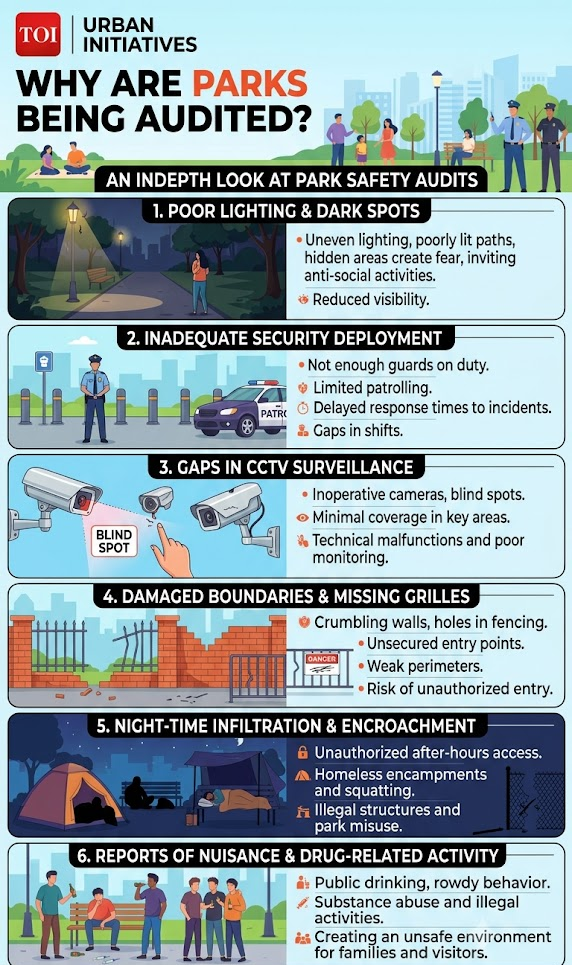
Access restrictions and the question of public safetyThe DDA said parks with multiple entry gates could adopt controlled entry arrangements after sunset by restricting access through selected gates before their scheduled closing time. Visitors would be encouraged to use well-lit pathways and illuminated areas during evening hours.The authority also announced plans to identify dark spots, install additional lighting and deploy security personnel at vulnerable entry points and poorly lit locations. Safety information boards displaying park rules, emergency contacts and public safety guidelines are to be installed across its parks.The measures follow the alleged assault at Aastha Kunj Park, where three men allegedly approached the teenager and her 17-year-old male friend while posing as policemen. Police said the men separated the girl from her friend and took her to a secluded part of the park. All three accused have been arrested.While the measures are intended to address security gaps, restricting access after sunset also raises questions about how public spaces can remain accessible while being made safer for visitors.Residents flag poor lighting and inadequate maintenanceResidents across Delhi have raised concerns about the condition of neighbourhood parks, particularly after sunset. They have cited inadequate lighting, the absence of security guards, overgrown branches blocking lights and groups gathering late at night.Rakesh Narula, a resident of East of Kailash, said the problems extended beyond Aastha Kunj Park, with several parks in the area also suffering from poor upkeep.“Two parks opposite W Block, Greater Kailash-I, used to be well maintained and properly lit when they were looked after by DLF. Now they are in a state of disrepair. Likewise, at Central Park, located in the middle of Kailash Colony and inside the main market, most of the lights are out of order. Even where they work, large branches block the light. The trees have not been pruned for years. Several representations have been made to the councillor, MLA and the corporation, but there has been no response,” Narula said.Residents also pointed to instances of people consuming alcohol and playing cards in parks in municipal colonies, despite objections from locals.“We can only approach agencies for help rather than getting into a fight with the elements every day. Ideally, there should be a single-point agency comprising representatives from all departments to address issues plaguing the parks, including encroachment, misuse, law and order and horticulture work,” said Karan Agarwal, another East of Kailash resident.A wider audit of parks across the cityThe DDA audit categorised 190 parks as high-risk, 258 as medium-risk and 288 as low-risk for priority-based interventions. Factors considered included night-time infiltration, local nuisance, encroachment, crime-prone surroundings, dense forest areas and drug-related activity.The audit found that 520 parks needed additional lighting, with work at 231 being taken up on priority. Entrances at 163 parks were in poor condition, while 233 of the 399 parks assessed had boundary-related repair requirements or missing grilles.The authority also identified shortcomings in surveillance infrastructure. Only 16 parks currently had CCTV coverage, prompting plans to install cameras in 323 more parks. CCTV footage will be retained for 15 days and made available to Delhi Police whenever required, officials said.The DDA has also activated biometric attendance in 602 parks to ensure the physical presence of guards. A central dashboard is planned to track safety and the progress of corrective measures.Coordination between civic agencies and residentsThe safety concerns have also prompted calls for better coordination among the agencies responsible for maintaining and securing public spaces.The Lieutenant Governor asked the Municipal Corporation of Delhi (MCD) and DDA to explore partnerships with resident welfare associations (RWAs), private entities and educational institutions for sustained upkeep of parks.MCD commissioner Sanjeev Khirwar said around 1,000 parks measuring more than one acre each would be targeted for safety audits and assessment. Adequate lighting would be ensured, while coordination with residents, RWAs, local police and the Delhi government would be undertaken wherever required.The latest measures seek to address immediate security concerns through surveillance, patrolling and controlled access. However, residents’ complaints about broken lights, poor maintenance and inadequate responses to grievances point to problems that extend beyond security deployment.As authorities move to make parks safer, the challenge remains to ensure that measures intended to protect visitors do not come at the cost of access to public spaces that residents depend on for recreation and everyday use.