








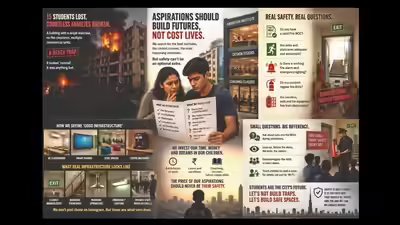

Every year, we add new things to our urban wish list: better careers, better coaching, better exposure for our kids. We hunt for the “best” institutes, the “coolest” courses, the “most happening” addresses. But last week’s fire at an animation centre in Lucknow, which killed 15 students, forced an uncomfortable question on all of us: when did we start treating safety as an optional extra, something to be checked only after tragedy strikes?As parents and young professionals, we will happily compare fee structures, faculty profiles, placements and air-conditioning. We notice the bright branding, the sleek reception, the glass doors and the beanbags. How often do we notice the number of staircases? The absence of a fire alarm? A blocked corridor? How many of us can honestly say we have ever asked a coaching centre, gym, cafe or workspace: “Do you have a valid fire NOC?”The building where the fire took place reportedly had a single staircase, no proper fire clearance, and multiple commercial units packed into one structure — a configuration experts have already called a “death trap”. Yet to the everyday eye, it was just another “normal” urban building, the kind we walk into without a second thought. That is the real lifestyle story here: the quiet, dangerous belief that disasters are things that happen on television, not on our own commute route.There is another layer to this tragedy that is harder to talk about. Families across the city work extra hours, take loans and cut corners at home to send their children to coaching, skills and “future-ready” courses, design, animation, coding, test prep. We obsess over whether a course will help them “get ahead”, but rarely over whether the place we are sending them to can get them out safely in an emergency. The price of our aspirations should never be paid with our children’s lives, yet that is what unsafe spaces quietly demand.Part of the problem is how we have come to define “good infrastructure”. For many of us, it means AC classrooms, smart boards, bright wallpapers and a coffee machine. Real infrastructure is far less glamorous: clearly marked exits, emergency lighting, sprinklers that work, staff who know how to guide people out instead of into a stampede. We don’t photograph these things for Instagram, but they are what stand between an accident and a headline.There is only so much that investigations, FIRs and sealing drives can fix after the fact. A meaningful shift also requires small, stubborn changes in our daily behaviour. Asking about exits and fire NOCs during admissions. Looking up from our phones long enough to notice where the stairs are. Demanding regular fire drills in schools, coaching institutes, offices, co-working spaces and residential complexes. Teaching children not just to chase marks and skills, but also to read a room for safety the way they read a classroom for Wi-Fi.We love to say “students are the city’s future”. The least we can do is ensure that the places we send them to learn and work are not designed like traps. Safety is not a luxury feature to be added at the end of the brochure. It is the first box that should be ticked and the one we can no longer afford to ignore.