





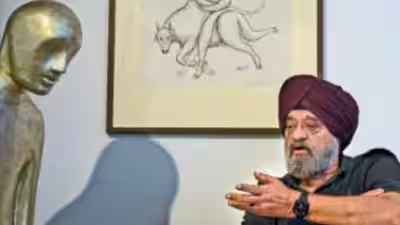
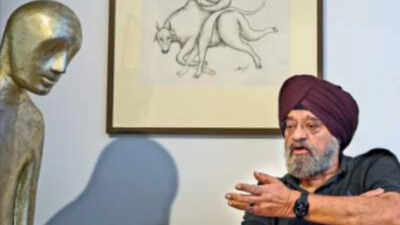
Film producer Bobby Bedi reveals how a taxi smashed into his leg in Madrid, recalls Dara Singh’s bouts and explains why microdramas will grow biggerNEW DELHI: The traffic was near-zero in downtown Madrid that September afternoon.After feasting on a formidable spread of tapas for lunch, Bobby Bedi was crossing the street, when a taxi smashed into his right leg. Paramedics who arrived on the scene gave him painkillers to manage the piercing pain.“I was in hospital for two weeks. A titanium rod was inserted to fix the leg,” Bedi says with monk-like equanimity.The producer of classics like ‘Bandit Queen’ and ‘Maqbool’ was in a wheelchair for four months and needed a walker for another five. Even now, 13 months on, he uses a crutch, and walks with a limp.“But I have driven a jet-ski since, and I climbed up Jodhpur’s Mehrangarh fort last month. The injury has made me live with a greater gusto,” admits Bedi, who last month received the prestigious FIAPF award for “outstanding contribution to film in the Asia-Pacific region”. FIAPF is an association of film producers from 30 countries.It’s been a remarkable career for the Delhi-born Bedi, whose family comes from Punjab’s Gurdaspur district. “We are descendants of Guru Nanak,” he says.His father, an income tax officer, enjoyed a stint in Bombay, where Bedi has rousing memories of watching Dara Singh and King Kong wrestle at an open-air stadium in Mahalaxmi. “They were the WWF bouts of their time,” he smiles.In Delhi, from class 5 onwards, Bedi would enrol in St Columba’s school and later graduate with economics honours from St Stephen’s college, his association with films was limited to watching discounted noon shows of Dev Anand movies such as ‘Solva Saal’ and ‘Kala Pani’.“My interest in films surfaced quite late,” he says while Astro, a friendly yellow Labrador, ambles into his Golf Links living room.The corporate world, and a series of unplanned but serendipitous incidents, led him to the movie business. In the 1980s, when TV was making rapid inroads in India, Bedi was at Sony, setting up broadcast studios for Doordarshan and private parties such as the politically influential swami, Dhirendra Brahmachari.“By 29, I had a chauffeur-driven car,” he recalls.During this phase, he met with Pradeep Krishen, who had just completed ‘Massey Sahib’, but was in a financial tangle with its producer, NFDC. “I managed to help him out because that’s what an MBA knows: negotiation,” says Bedi, an MBA in finance from Jamnalal Bajaj Institute of Management Studies.Sundeep Singh Bedi (his real name) was to become the executive producer in Krishen’s next venture, ‘In Which Annie Gives It Those Ones’, the irreverent 1989 campus drama which was recently restored by Film Heritage Foundation and screened in film festivals worldwide.With ‘Electric Moon’ (1989), also directed by Krishen, Bedi not only made his debut as a producer, but also learnt the nuances of its craft.The transformation came via Graham Easton, a senior executive of Film Finances Limited, a multinational company that offers completion guarantees to entertainment projects, who were backing the film.“Graham flew over from London to Pachmarhi in Madhya Pradesh, where the film was being shot. Over four days, he gave me a masterclass in film production, planning, scheduling, the works. ‘Electric Moon’ also introduced me to the international system of movie business,” Bedi acknowledges.Bandit Queen (1994), though, was Bedi’s breakthrough moment.He got to produce the iconic feature directed by Shekhar Kapur by chance. London-based Channel 4, who were earlier making a docudrama on Phoolan Devi but couldn’t obtain govt permission, decided to finance the venture.Mala Sen, writer of ‘India’s Bandit Queen’ (1991), was doing the script. “I waited for eight months but she couldn’t deliver. But she had made extensive notes,” he says.Writer Farrukh Dhondy, also Sen’s ex-husband, agreed to help. “We spent three weeks in Saint-Vivien-de-Médoc, a coastal village in south-west France. I would read the notes and Dhondy would write while listening to qawwalis by Nusrat Fateh Ali Khan. By the end, we had a first draft in English although Farrukh didn’t take credit,” Bedi says.The film’s screenplay is attributed to Sen. Nusrat later became the film’s composer.An under-feted aspect of ‘Bandit Queen’ is its great acting ensemble cobbled by casting director Tigmanshu Dhulia, who was an assistant director for a TV serial then.“Even some extras in the film went on to have a great career,” says Bedi. Dhulia also roped in the word-perfect Ranjit Kapoor to pen the dialogues. “He knew the language and the lehja of the land,” remembers Bedi, whose bio got better with time.Movies like Deepa Mehta’s ‘Fire’ (1996), Shaad Ali’s ‘Saathiya’ (2002) and Vishal Bhardwaj’s ‘Maqbool’ (2004) followed. “I believe they have done their best work with me,” the producer says.Now 70, Bedi remains hyperactive.Director Honey Trehan, whose ‘Sutlaj 95’ was abruptly taken off OTT, is directing the sequel of ‘Bandit Queen’ for him. “It’s about a woman who comes out of jail, marries, wins three elections and then gets shot. The second film begins where the first film ends. It is titled ‘Bandit Queen, MP’,” he announces.A documentary on Raj Kapoor, ‘Kehta Hai Joker’, is ready.“I have engaged with the subject for 20 years. Many Kapoor-family members, most now gone, were interviewed for the film,” he says.Bedi firmly believes that though India annually produces thousands of movies, the country is yet to grasp the nuanced craft of film production.He is more positive about OTTs, which, in his view, are resetting television content that ‘saas-bahu’ dramas had destroyed. And he forecasts that microdramas, the latest kid in town, will grow bigger. “Snacking is different from having a full meal,” he quips.As a gourmet of cinema, the film producer should know.