









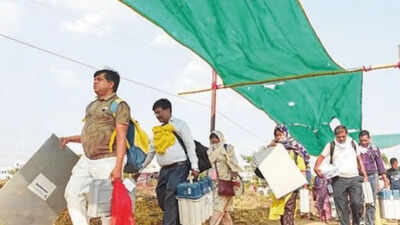
When the first vote is cast at 7 am today to decide who will be governing Bengal for the next five years, there will be an elephant in the polling booth: SIR, or the Special Intensive Revision of voters’ roll.
.
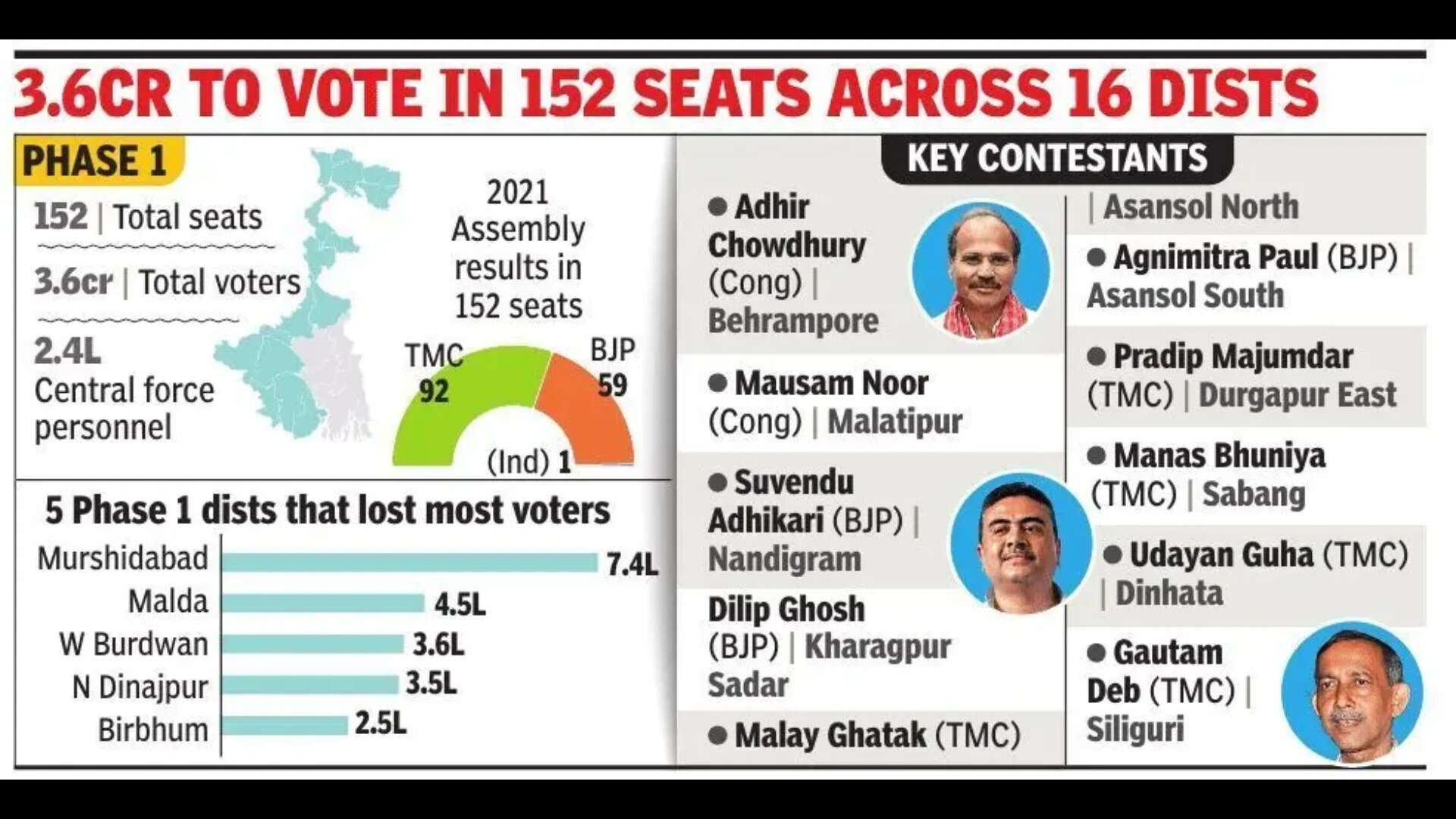
More than 3.6 crore voters across 152 constituencies will be exercising their franchise in today’s first phase of the 2026 state assembly poll; the rest of the 6.82 crore voters in the other 142 constituencies of the state will be following them next Wednesday. But this election, more so in the 152 seats going to vote today, will be as much about the mass disenfranchisement of the 27 lakh voters who will not be able to vote despite having every proof of their voting right.The Election Commission has found that these 27 lakh voters have some “logical discrepancy” or the other. This can mean anything, from misspelt names to surname mismatches (with parents) to monks serving in missions whose legal guardians are the heads of those missions. The 16 districts going to vote today have a voting strength that is 9.4% less than what it used to be before the SIR exercise (a significant portion, probably about half, are dead or “absent” or “shifted” voters).Nowhere is SIR’s shadow longer than in Murshidabad, which has lost 7.4 lakh voters, and Malda, which has lost 4.5 lakh. And it was this fact that blew up in an unprecedented barricading of judicial officers — assigned by the EC to do SIR work — in Malda’s Mothabari on April 1 when an agitated mob confined them inside a Block Development Office for over nine hours. Mothabari, for the record, lost around 45,000 voters to SIR.But it is Murshidabad that encapsulates everything that has gone wrong with SIR, originally meant to weed out non-voters but which has disenfranchised people voting for years. More than 4.5 lakh of the 7.4 lakh total deletions in this district happened during the “judicial adjudication” phase (to determine “logical discrepancy”).The most drastic impact is in Shamsherganj constituency, often described as ground zero of the crisis. Exactly 74,775 voters — representing a staggering 32% of the electorate — has been disenfranchised, sparking an intense legal and political battle that may rage on even after the new assembly is formed.All this has taken some sheen off the electoral battles in bellwether constituencies and those involving political heavyweights. But the first phase does have these, too, in good measure: the political future of at least three such heavyweights — BJP’s Suvendu Adhikari and Dilip Ghosh and Congress’s Adhir Chowdhury — hinges on how voters vote today (though Adhikari has a second chance in the second phase as he is contesting from Bhowanipore against CM Mamata Banerjee as well).Adhikari, who has spent the last few years shrugging off “defector” barbs, now faces a defector himself in his home seat, Nandigram. His challenger is Pabitra Kar, a former Adhikari acolyte with strong ties with Hindu organisations who is credited with securing a 3,500-vote lead for Adhikari in the critical Boyal area in the 2021 election. CM Banerjee stationed herself there for several hours in a wheelchair amd alleged large-scale manipulation, photographs of which went viral (and which is still the subject of a court battle). Adhikari scraped through with a 1,956-vote margin. Kar, this time, may give his former mentor some sleepless nights till May 4, when votes will be counted.Over 280 kilometres away, Congress veteran Chowdhury is fighting his own battle for political survival in Behrampore. Chowdhury is five-time MP but is now eyeing a path to political rehabilitation through the Bengal assembly after losing the last Lok Sabha poll. The BJP won this seat in 2021 and the fight this time is likely to be intensely triangular, with the Trinamool forming the third side (along with the BJP and the Congress).BJP veteran Ghosh faces a similar situation in his own home seat, Kharagpur Sadar, where he is returning after 10 years. It was his victory over former Congress cabinet minister Gyan Singh Sohanpal in 2016 that marked his ascendancy with the BJP’s state unit but he was forced by his own party to forsake the region he knew so well in the 2024 Lok Sabha poll. Ghosh will be hoping that Kharagpur’s back him a second time.Another political dynasty that is looking for succour is former Congress union minister ABA Ghani Khan Choudhury’s family. The district is seeing Choudhury’s niece, Mausam Benazir Noor, fighting to reclaim the family’s political legacy after switching back to the Congress after a stint with the Trinamool Congress and a term in the Rajya Sabha. But this district, too, is likely to see a tripolar fight and arithmetic can often be slippery in such contests.Many of the 16 districts that go to the polls today — from Darjeeling in the Hills to East Midnapore on the Bay of Bengal’s shores — have been BJP strongholds and the party would be betting on SIR deletions to keep it that way. Nine of these 16 districts — Cooch Behar, Alipurduar, Jalpaiguri, Darjeeling, Kalimpong, North Dinajpur, South Dinajpur, Malda and Bankura — gave the BJP 38 (out of a total 66), which ultimately helped it reach the 77-seat figure it had in the last assembly.But the voter anger and the consequent anti-BJP consolidation visible outside polling booths across districts may also have something to offer to the Trinamool at the EVMs. How much that anger transforms into anti-BJP votes and the number of seats to which the Trinamool can restrict the BJP in these 16 districts can well shape the configuration of the next Bengal assembly.