








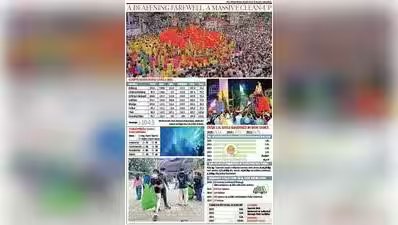
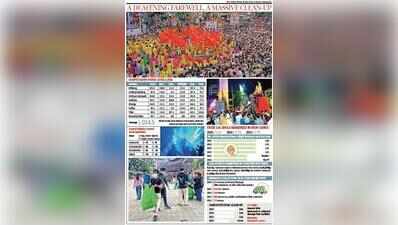
Pune: A city that proudly wears the badge of Maharashtra’s cultural capital spent its biggest festive night drowning in sound. What began as a relatively orderly Ganapati visarjan on Friday spiralled into a high-decibel free-for-all by Saturday, with several mandals openly flouting noise regulations and, in some cases, even mocking enforcement agencies.Some mandals brazenly flashed messages on digital screens announcing the use of banned plasma sound systems and pressure-mid-speaker modifications.The scale of the noise was staggering. A team from CoEP Technological University monitored sound levels along key immersion routes from Friday noon till 8am on Saturday. Average levels were 104.5 dB, peaking at 112 dB at 4pm on Friday and again at midnight, and staying above 100 dB even at 4am.Citizens said the sound was not merely loud, but relentless too.The violations began on Friday evening itself. Sound systems blasted well beyond legal limits. As the procession stretched endlessly into the night and the following day, traffic across central Pune collapsed. Karve Road, FC Road, JM Road, LBS Road, Swargate and Dandekar Bridge remained choked for hours, with congestion persisting well into Saturday evening.Despite weeks of meetings, route coordination and repeated warnings issued by Pune police, ground reality told a different story. At least eight mandals used banned plasma speakers, while seven others deployed pressure-mid systems, openly advertising the fact on digital displays mounted on their tableaux.Witnesses said police personnel were present but appeared largely passive, with little visible action against rule violators. “Police squads stationed along Kelkar Road, Tilak Road and Kumthekar Road virtually disappeared during the late-night hours,” another resident said, adding that mandals stopped wherever they happened to be, creating gaps of nearly a kilometre between processions on Tilak Road, Laxmi Road, Kelkar Road and Kumthekar Road.By dawn, when the procession resumed, the damage had already been done. The pace had slowed dramatically, exposing glaring gaps in crowd management and enforcement. “Adding to the chaos, several mandals circumvented the official cap of four tops and four bass speakers by deploying imported sound systems capable of generating significantly higher noise levels without technically breaching equipment-count restrictions,” another resident said.MPCB: Noise limits breached by up to 40 dBMaharashtra Pollution Control Board’s preliminary assessment found widespread violations across commercial and residential areas. Monitoring across 200 prominent Ganapati pandals, 15 major junctions and immersion corridors revealed that noise levels routinely exceeded permissible limits by 15 dB(A) to 40 dB(A).Although MPCB data indicated an overall reduction in average noise levels compared to 2025, peak readings remained alarmingly high. During the final immersion phase, noise repeatedly crossed 95 dB(A) and touched 104.5 dB(A) at several locations. While non-immersion festival days largely hovered around 70 dB(A), the spike became evident from the fifth day onward, culminating in the immersion-day surge.One notable exception was Laxmi Nagar Chowk, where daytime noise dropped by 15.6%, from 83.5 dB(A) in 2025 to 70.5 dB(A) this year, aided by traffic diversions and tighter restrictions on late-night processions.Citizens step in as noise watchdogsFrustrated by the lack of enforcement, citizens launched their own monitoring effort. Loudspeaker-Virodhi Punekar Manch recorded sound levels across the city and logged 158 complaints through a digital grievance platform linked directly to the police commissioner’s office. And the findings were sobering.Of the 158 complaints, 60 recorded noise levels of 100 dB or higher. The highest number of complaints came on the final immersion day, with hotspots identified at Bajirao Road-Natubag, Kothrud, Hingne Khurd, Dhankawadi, Koregaon Park and Ambegaon.While these citizen recordings cannot be directly compared with MPCB’s scientific Leq measurements, they offer a snapshot of what thousands experienced on the ground — a festival where the soundscape repeatedly crossed from celebration into assault.