








The capacity of solar panels fitted on campervans and off-grid vans is normally expected to be lower compared to what is advertised under real-world circumstances. However, some users of these vehicles have recorded cases where the capacity of solar panels exceeds their usual capacity due to unusually favourable weather. The reasons why some solar panels installed on vans generate unusually high capacity include cold weather, the cloud-edge effect, reflecting sunlight, and proper sun exposure. Solar systems in vans, especially those using the Maximum Power Point Tracking (MPPT) charger control system and highly effective solar panels, will temporarily have a capacity higher than usual due to the above factors.
How van-mounted solar panels exceeded their rated output
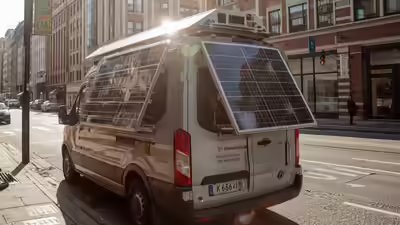
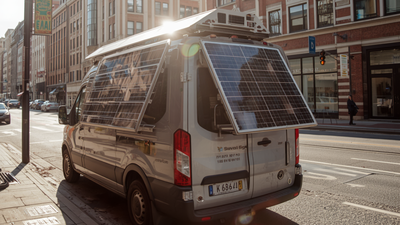
The test conducted on most of the solar panels is done using what is referred to as “Standard Test Conditions” (STC). These laboratory tests assume light intensity equal to 1,000 Watts per square meter and a solar cell operating temperature of 25°C. However, in real-world applications, conditions are dynamic, thus making the power output increase or decrease.A van owner using an XLWB Sprinter with a 2×440-watt double-sided rooftop solar array had their mind blown after the panels started to generate way too much energy.On Reddit, a user discovered from his solar app that his solar panel generation had gone off the charts. With an 880-watt rooftop solar system generating more than 1,050 watts for a while.The original poster decided to post on the forum r/SolarDIY asking what had caused their solar panel installation to seemingly exceed its limits.“I have 2x 440w double-sided panels on the roof of my XLWB Sprinter, and suddenly I am making more power than I thought possible,” they wrote.According to research done by Chengdu University of Technology, the output from solar panels installed for domestic purposes decreases with an increase in temperature. This occurs even in colder climates, with a decrease in temperature increasing the power output.This was the case in several cases of vans having installed solar power systems, since in such cases the power output was observed to be higher than the rated capacity. This was due to efficiency resulting from lower resistance.
The cloud-edge effect explained by scientists
One of the biggest reasons solar panels can temporarily produce more than their rated power is something known as the “cloud-edge effect”.Technical researchers describe the phenomenon as sunlight reflecting off bright cloud edges onto solar panels still sitting in direct sunshine. This briefly increases solar irradiance beyond normal levels. Panels respond by producing 10–30% above rated power for seconds to a few minutes.In practical terms, a 400W van solar array could momentarily produce close to 480W under perfect conditions. For off-grid vans parked in open landscapes with intermittent cloud cover, these spikes are surprisingly common.
Why cold weather improves solar panel efficiency
The erroneous belief is that the efficiency of solar panels is achieved through high temperatures. This assumption does not hold any scientific grounds since it is the presence of sunlight that matters and not the high temperatures. Cold temperatures contribute to keeping a high level of voltage and reducing energy loss due to overheating. The technical analysis done in the research states the following:Energy efficiency decreases: High temperatures have a negative impact on PV performance; there is an average loss of 0.4-0.5 % for each additional degree Celsius.That is why the van drivers feel more powerful solar energy on cold spring mornings and cold afternoons than when it is extremely hot outside. Industry specialists working for RatedPower mention that high temperatures negatively affect PV performance.
What this means for off-grid van owners
It is also great news for people who use vans and campervans because the extra solar production helps the battery system to recharge faster and allows appliances to operate longer.It must be noted, though, that professionals suggest ensuring that the electric systems are properly built because the surge in electricity might overload devices such as inverters, circuit breakers, and chargers.Nevertheless, it is quite amazing to note that such instances clearly demonstrate how much technological advancements have been made in the realm of photovoltaics. In certain weather conditions, the solar panels of a van can produce much more energy than expected.