









The larger message emerging from Uttar Pradesh’s startup journey is clear: the state’s demographic scale need not be a challenge to overcome. With skills, innovation, capital and opportunity, it can become the foundation of the state’s next phase of economic growth.From a state once associated with policy paralysis to one of India’s leading startup destinations, Uttar Pradesh has built an innovation ecosystem that is increasingly converting its demographic strength into an economic opportunity.Uttar Pradesh’s vast population has often been viewed through the lens of the challenges it presents. Chief Minister Yogi Adityanath, however, sees the state’s more than 25 crore people differently—as a vast reservoir of talent, enterprise and youthful energy. At a recent interaction with entrepreneurs and industry representatives in Lucknow, he described the state’s population not as a burden but as a demographic dividend, provided it is connected with education, skills, technology and opportunities.The transformation of Uttar Pradesh’s startup ecosystem over the past nine years provides perhaps the clearest illustration of this approach. According to official statistics, Uttar Pradesh had only around 120 startups before 2017. Today, the number has crossed 24,000, including eight unicorns. The transformation mirrors the broader expansion of India’s startup ecosystem, which has grown from around 500 startups before 2014 to more than 2.5 lakh today.This growth in UP has not happened in isolation. It has been supported by a combination of policy interventions, incubators, funding mechanisms, infrastructure, higher-education institutions and a deliberate effort to create an environment in which young people can turn ideas into enterprises.
From policy vacuum to a structured startup ecosystem
When the Yogi Adityanath government took office in 2017, the state’s innovation ecosystem was at an early stage. Startups, incubation centres, venture funding and institutional support had not yet developed into an integrated framework. The government’s first major task was therefore to create an enabling policy environment.The Uttar Pradesh Startup Policy 2020, subsequently amended in 2022, became a key pillar of this effort. It sought to encourage startups across sectors while creating a network of incubators and institutional mechanisms for mentoring, funding and market access. The policy envisaged the development of 10,000 startups and 100 incubators, with universities, technical institutions and private-sector organisations being encouraged to participate in the ecosystem.The state also created the StartInUP framework to serve as a platform for entrepreneurs and startups, helping connect them with incubation, funding, mentorship, policy incentives and other forms of support.The importance of this policy architecture is that it shifted the government’s role from merely regulating businesses to actively facilitating innovation and entrepreneurship.
Fund of Funds gives startups access to capital
One of the biggest challenges confronting young entrepreneurs is access to finance. An innovative idea may have commercial potential, but without seed capital and early-stage investment, many startups struggle to move beyond the prototype stage. Recognising this challenge, the Uttar Pradesh government established a Fund of Funds with SIDBI in 2019. The objective was to facilitate investment in promising startups through professionally managed funds rather than relying solely on direct government financing.The mechanism has subsequently been expanded, and the Chief Minister has indicated that the government is prepared to increase the Fund of Funds if required. This is significant because a mature startup ecosystem requires different forms of capital at different stages—from ideation and prototyping to commercialisation, scaling and global expansion.
Incubators become the backbone of innovation
Alongside funding, the government has focused on developing incubation infrastructure.Incubators provide startups with much more than office space. They offer mentorship, technology support, networking, business guidance, investor connections and access to specialised facilities.The state has therefore encouraged universities and premier educational institutions to establish incubation and innovation centres.Recently, the Chief Minister distributed Rs 3.42 crore in incentives among 107 startups, while Rs 1.79 crore was provided to nine incubators under the Startup Policy. Another 12 incubators were granted recognition, further expanding the institutional base of the ecosystem. The emphasis on incubators also reflects a broader shift in the government’s approach: instead of concentrating entrepreneurship only in metropolitan centres, innovation is being embedded within the state’s educational and industrial institutions.
IITs, universities and research institutions become innovation partners
Uttar Pradesh possesses an unusually strong network of higher educational and research institutions. The government has increasingly sought to connect institutions such as IIT Kanpur, IIT-BHU, Abdul Kalam Technical University (AKTU), IIMs and SGPGI with the startup ecosystem.IIT Kanpur, for instance, has proposed Centres of Excellence in areas such as MedTech and drone technology, while IIT-BHU has explored collaboration in agricultural technology. SGPGI has also been associated with efforts to develop specialised Centres of Excellence. The state government has indicated its willingness to support emerging areas including quantum computing, space technology, drones, robotics, green hydrogen and other deep-tech domains.More than a dozen Centres of Excellence are being operated or developed, creating an ecosystem in which research, innovation and commercialisation can interact. This is important because the next phase of India’s startup growth is expected to increasingly come from deep technology rather than purely digital consumer businesses.
Conventional education to innovation-led learning
The government is also seeking to change the culture within higher education institutions. According to the thought process of the Yogi government, universities and colleges cannot remain restricted to conventional academic courses. They must become spaces where students experiment, undertake research, develop prototypes and eventually create enterprises.Separate funding has been provided to universities to encourage innovation and research activities. The objective is to create a pipeline in which entrepreneurship begins on campuses. Students should not see employment as the only outcome of education; they should also be equipped to become employers and innovators.This approach is particularly relevant for Uttar Pradesh because of its enormous youth population. Even a small increase in the number of students choosing entrepreneurship can translate into thousands of new enterprises and employment opportunities.
Women emerge as a major force in the startup ecosystem
One of the most striking observations made by the Chief Minister was that women constitute a major share of the state’s startup activity, with “Aadhi Aabadi”—half of the population—operating around half of the startups, according to his remarks. This underlines a larger transformation in Uttar Pradesh’s economic landscape, where women’s participation is increasingly extending beyond traditional livelihood activities into entrepreneurship, technology and innovation.The growing participation of women entrepreneurs also broadens the economic impact of the startup ecosystem. It brings new business models, expands employment opportunities and enables innovation to reach sectors and communities that may otherwise remain outside formal entrepreneurship networks.
Startup growth is spreading beyond traditional sectors
The state’s startup ecosystem is no longer limited to IT services or conventional e-commerce. Startups are increasingly emerging in areas such as agriculture, healthcare, drones, artificial intelligence, manufacturing, education technology, clean energy, fintech, biotechnology and other technology-driven sectors.The government’s willingness to support specialised Centres of Excellence is intended to accelerate this diversification. For a state with a large agricultural economy, for example, agritech can address problems ranging from farm mechanisation and supply chains to precision agriculture and market access.Similarly, MedTech can combine UP’s expanding healthcare infrastructure with technological innovation. Drone technology can have applications ranging from agriculture and infrastructure inspection to logistics and disaster management, while green hydrogen and clean technologies can contribute to the state’s industrial transition.
The 2026 Startup Policy: taking the ecosystem to the next level
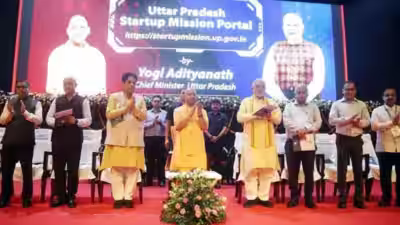
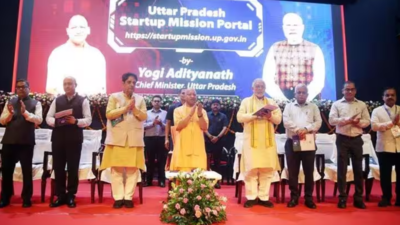
The launch of the Uttar Pradesh Startup Policy 2026 booklet and the Uttar Pradesh Startup Mission portal marks the next phase of this journey. The new policy framework comes at a time when the state’s startup base has already expanded dramatically. The focus now is therefore shifting from simply increasing the number of startups to improving their quality, scale, survival rate, access to capital and ability to compete nationally and globally.The Startup Mission portal is expected to provide a more integrated interface for the state’s startup ecosystem, bringing entrepreneurs, incubators, institutions and government support mechanisms onto a common platform. The Chief Minister has also stressed that the government is prepared to provide land on lease and facilitate plug-and-play spaces where required.Such infrastructure can be particularly important for startups moving from the idea and prototype stage to manufacturing and commercial operations.
Changing the perception of Uttar Pradesh
The startup transformation is also part of a larger effort to change the perception of Uttar Pradesh. The government’s argument is that security, infrastructure, policy certainty and economic opportunity are interconnected.An entrepreneur is more likely to invest when there is confidence in law and order. A startup is more likely to scale when reliable infrastructure and digital connectivity are available. Investors are more willing to provide capital when they see a stable policy environment.Thus, the startup ecosystem cannot be viewed separately from the broader transformation of the state’s business environment.
The demographic dividend is the next big opportunity
Uttar Pradesh accounts for roughly one-sixth of India’s population, while its share of the country’s startups is around one-tenth. State government strives to increase the state’s startup share to around 20 per cent, bringing it closer to its demographic weight.That ambition would require a substantial expansion not merely in the number of startups but in the number of high-growth enterprises capable of creating employment, attracting investment and generating intellectual property.The state’s enormous youth population could become its greatest competitive advantage if education, skilling, research, finance and entrepreneurship are integrated effectively.
From Startup State to innovation powerhouse
The journey from 120 startups before 2017 to more than 24,000 today represents more than a numerical increase. It signals a change in the economic mindset of Uttar Pradesh. The state is attempting to move from being primarily a large market and labour pool to becoming a producer of technology, intellectual property, enterprises and high-value employment.The government’s emphasis on incubators, Fund of Funds, university innovation, Centres of Excellence, deep-tech sectors, women entrepreneurs and plug-and-play infrastructure provides the building blocks for that transition.For Uttar Pradesh, the opportunity is enormous. Its population provides the talent pool, its expanding economy provides the market, its educational institutions provide the knowledge base and its policy framework seeks to provide the institutional support.The transformation of the last nine years has demonstrated what can happen when these elements begin working together.