







Veeramani P, burial ground in-charge at Otteri, says the only thing that helps him cope with the physiological and psychological strain of the job is alcohol. “I drink myself to sleep every night,” says the 31-year-old.
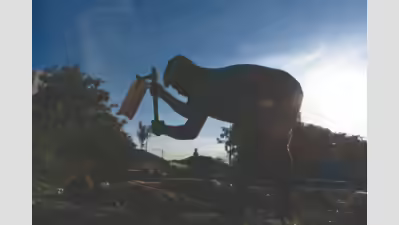
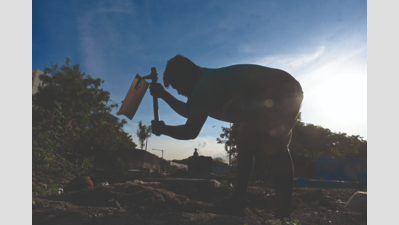
Rajesh Ravichandran punctures the soil with a long iron rod, pulls it out, examines it for a few seconds, then sniffs it. The gravedigger bends close to the ground and waits “for the smell of a decomposing body to rise from the opening”. “That’s how we know if there is a body buried there. If there is no smell, it means we can dig,” he says. Rajesh adds that he pokes the ground first with the rod to check for traces of decay.Rajesh, who has been digging graves for three decades now, says he can tell within a few seconds if the ground is ready to receive a new body. “I was six when I started. I used to watch other children playing with wooden trains, cooking sets and building blocks, while I dug graves for dead animals,” says the 40-year-old who works in the Anna Nagar East burial ground. As he grew older, he began assisting his father in digging graves and lowering bodies into them.Rajesh is from the vettiyan community, a marginalised group associated with burial ground maintenance, often, says Rajesh, facing social discrimination.Like Rajesh, several cemetery workers from the vettiyan community ‘inherit’ work at corporation-run and public burial grounds from their fathers, learning the occupation from a young age. Though families from the community have carried out burial and cremation work for generations, many workers across Tamil Nadu remain outside govt payroll systems, without permanent jobs, pension, basic safety gear, or labour protection.Sociologist Pratham Parekh says the discrimination faced by cemetery workers is rooted in deeply embedded ideas of purity and impurity that continue to shape Indian society across religions and communities. “Society constantly defines what is considered pure and impure through spaces, objects, and occupations. Shoes are not inherently dirty, but if you place them on a dining table, they become impure in the social imagination. The same logic extends to occupations,” he says.“People associated with religious spaces and rituals are often viewed as “pure”, while those who work with death, cremation, and burial are pushed to the margins and treated as “impure”. This translates into cemetery and crematorium workers not even being considered workers. Their labour is normalised because they grew up around such work,” says Parekh. “Communities also develop their own cultural and spiritual narratives to reclaim dignity. Many workers see burial as a noble deed that helps families grieve and gives the deceased a dignified farewell,” he adds. Apart from social stigma and financial instability, cemetery workers are also exposed to severe occupational health risks, many of which remain undocumented in India, says Dr Manivelan R, state nodal officer at the directorate of medical and rural health services. “In the Indian setup, we don’t have scientific studies or data on cemetery workers. Most of the information we have comes from workers visiting govt hospitals,” he says.Cemetery workers spend hours manually digging graves under the harsh sun, usually barefoot and almost never with protective gear. During the monsoon, waterlogged soil can cause graves to collapse, forcing them to dig repeatedly. Many also handle decomposed or abandoned bodies, lifting and lowering them into graves with ropes and bare hands.“Constant bending, lifting, and digging for prolonged hours can lead to musculoskeletal problems,” says Dr Manivelan. “Grave diggers also work under extreme heat stress,” he says.He adds that many develop skin conditions such as contact dermatitis and allergic reactions because of constant exposure to bodily fluids, soil and decomposing matter. “They are also exposed to infectious diseases, especially when bodies are kept for three to four days before burial. The foul smell can cause respiratory discomfort. Ideally, workers handling decomposed bodies should wear N95 masks and protective gear, but most work without any protection,” says Dr Manivelan.Veeramani P, burial ground in-charge at Otteri, says the only thing that helps him cope with the physiological and psychological strain of the job is alcohol. “I drink myself to sleep every night,” says the 31-year-old. “I see all sorts of bodies in various stages of decomposition almost every other day. People think you get used to it over time. You don’t.”Unlike sanitation workers employed at electric crematoriums, many cemetery workers are not on the corporation payroll and survive on whatever grieving families choose to give them. “The govt still doesn’t recognise this as a job, and I’m not paid. We can’t ask mourners for money. If they give, they give. Otherwise, we manage with what we have,” says Rajesh.Sometimes, he says, families hand him leftover food from the rituals, which he takes home for his wife and children. Occasionally, a few generous families give him `10,000 for a burial, which goes towards his children’s education and medicines.“When families bring a body for burial, I become the most important person there. They fold their hands, thank me, and depend on me to handle their loved one with dignity. But once the burial is over, their behaviour changes. They become dismissive and often don’t even offer any money,” he says.Veeramani, meanwhile, once dreamed of building a family of his own. But when he finally gathered the courage to ask his girlfriend’s parents for her hand in marriage, her parents refused. “They told me they didn’t want a son-in-law who works with the dead. They said it would ruin their daughter’s life and asked me to find another job. But this is the only work I know. I’ve been digging graves since I was four.”For Rajesh, the unstable income is only one part of the hardship. What hurts more, he says, is the way society treats cemetery workers. “When others walk into a tea shop, they are asked what they want to order. But when I go, people ask, ‘Who died today’.”