








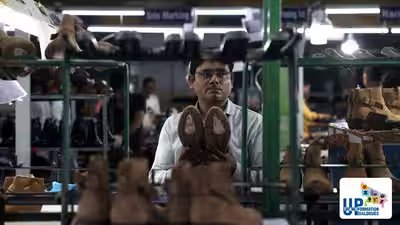
The leather industry in Unnao, a small but happening town between Lucknow and Kanpur in Uttar Pradesh, has long stood as a vital pillar of the state’s economy, channeling processed hides into both domestic markets and international exports. For decades, this bustling cluster has generated employment for thousands of workers across manufacturing units, supply chains, logistics, and ancillary services. Its contribution to foreign exchange earnings remains substantial, underscoring the sector’s strategic importance.Yet, beneath this economic success lies a persistent environmental challenge: the safe and sustainable management of tannery sludge produced during leather processing. This industrial byproduct, if not handled properly, risks contaminating soil and groundwater, invites regulatory penalties, and occasionally halts production lines.Recognizing the need for balance between industrial growth and ecological responsibility, the yogi Adityanath government in Uttar Pradesh stepped forward with an innovative intervention—the ‘Common Tannery Sludge Management Infrastructure’ in Unnao. This facility marks a forward-thinking stride toward a circular industrial economy, where hazardous waste is no longer an endpoint but a starting point for valuable new resources.The leather tanning process inherently generates large volumes of wastewater that, after treatment, leaves behind significant quantities of sludge. In the past, tannery operators faced mounting difficulties in disposing of this material responsibly. Traditional methods often relied on landfilling,which consumed valuable space and carried the constant threat of leaching harmful substances into the environment. Small and medium enterprises, in particular, struggled with the high costs and technical complexities of individual compliance. Without a shared solution, many units grappled with inconsistent waste handling, leading to operational uncertainties, increased expenses, and occasional shutdowns prompted by environmental inspections. The absence of centralized infrastructure not only strained individual businesses but also undermined the overall competitiveness of the Unnao leather cluster in a global market that increasingly demands transparency and sustainability.To tackle these intertwined issues, the ‘Common Tannery Sludge Management Infrastructure’ was designed as a centralized, state-of-the-art facility capable of serving multiple tannery units collectively. By pooling resources and expertise, the project alleviates the burden on smaller players while establishing uniform standards for waste processing. At its core lies advanced high-temperature pyrolysis technology, a thermal decomposition method conducted in low-oxygen or oxygen-free environments. Unlike traditional incineration, which can release significant pollutants, pyrolysis operates under carefully controlled conditions to minimize emissions and maximize material recovery.This sophisticated approach transforms what was once considered mere waste into a cascade of usable outputs, embodying the shift from linear disposal models to regenerative industrial cycles. The treatment workflow unfolds in a logical, integrated sequence. Sludge collected from participating tanneries first undergoes drying to reduce moisture content. It then enters the pyrolysis chamber, where high temperatures break down the material efficiently. From this process emerge several valuable streams: heavy metal residues are isolated for potential industrial reuse, organic components are converted into energy-rich bio-coal, and the remaining mineral fractions are channeled into the production of eco-friendly construction bricks. Advanced emission control systems throughout the facility ensure that operations remain well within environmental norms, safeguarding air quality and surrounding ecosystems. This methodical conversion demonstrates how modern engineering can turn environmental liabilities into economic assets, fostering a true waste-to-value paradigm.One of the most tangible outcomes of this infrastructure is the manufacture of eco-bricks from the mineral residues left after pyrolysis. These bricks utilize treated industrial byproducts rather than depleting virgin natural resources like clay. They exhibit strong durability suitable for various construction applications, offering a practical alternative to conventional building materials. Municipal authorities and infrastructure developers can deploy them in internal roads, footpaths, boundary walls, landscaping projects, public utility buildings, and even broader industrial setups.By creating a ready market for these recycled products, the project reduces pressure on landfills, conserves natural resources, and supports sustainable urban development across the region. What was previously a disposal headache now contributes directly to building greener infrastructure, closing the loop in material usage. Complementing the eco-bricks is the production of bio-coal, a carbon-rich fuel derived from the organic fractions of the processed sludge. This alternative energy source possesses favorable thermal properties that allow it to be blended with conventional fuels in industrial boilers and power generation settings.Industries seeking cleaner fuel options can incorporate bio-coal to enhance resource efficiency and lower their overall environmental impact. The advantages extend beyond energy generation; by diverting waste carbon from landfills, the process cuts disposal costs, reduces methane emissions associated with organic decay, and promotes a more circular approach to fuel sourcing.In an era of rising energy demands and climate considerations, converting tannery sludge into bio-coal represents a smart alignment of waste management with energy needs. Furthermore, the facility addresses the presence of heavy metals, such as chromium commonly used in leather tanning. Through precise separation technologies, these metals are recovered for appropriate industrial applications, minimizing their release into the environment. This recovery step not only mitigates contamination risks but also conserves valuable resources that would otherwise require fresh extraction. It strengthens regulatory compliance by ensuring hazardous components are managed scientifically rather than left to accumulate.Overall, the integrated system—collection, transportation, pyrolysis, recovery, and product manufacturing—illustrates a comprehensive circular model where outputs from one process feed seamlessly into others. The benefits of this common facility ripple across the entire leather ecosystem. Environmental compliance becomes more achievable and cost-effective for all participants, especially smaller tanneries that previously lacked access to advanced treatment options. Open dumping is curtailed, groundwater protection is enhanced, and standardized scientific handling replaces ad-hoc practices. Monitoring and reporting grow more streamlined, allowing regulators and industries to collaborate more effectively.With reliable waste management assured, tannery units experience fewer interruptions to their production schedules. This stability supports better planning, encourages expansion, and builds investor confidence in the cluster’s long-term viability. Operational continuity, once threatened by waste-related bottlenecks, now underpins higher productivity and sustained growth.On the global stage, the project significantly bolsters Unnao’s export prospects. International buyers, particularly from environmentally conscious markets in Europe and North America, scrutinize supply chains for sustainability credentials. Brands prioritize partners who demonstrate responsible waste management, reduced carbon footprints, and adherence to stringent norms.By showcasing a modern, centralized sludge management system powered by pyrolysis, Unnao positions its leather products as ethically sourced and ecologically sound. This enhances buyer trust, improves brand reputation, and secures long-term market access amid tightening global trade standards. In essence, environmental stewardship translates directly into economic resilience and competitive advantage.Beyond economics and ecology, the initiative plays a crucial role in safeguarding livelihoods. The leather sector employs vast numbers of people directly in processing and indirectly through supporting industries. By preventing disruptions and enabling steady operations, the sludge management infrastructure protects these jobs and paves the way for further employment generation in areas like waste collection, facility maintenance, product manufacturing, and logistics. Ancillary businesses benefit too, as new value chains emerge around bio-coal, eco-bricks, and recovered materials.This holistic support reinforces industrial stability and contributes to broader regional development. In many ways, the Unnao Common Tannery Sludge Management Infrastructure serves as a replicable model for sustainable industrial development across India and beyond. It moves away from the outdated view of waste as a burden toward a resourceful perspective that extracts value at every stage. Key principles at play include resource recovery over disposal, shared infrastructure for cluster-wide benefits, adoption of cleaner technologies, and the integration of circular economy practices. The project balances industrial competitiveness with environmental protection, proving that these goals are not mutually exclusive but mutually reinforcing. Ultimately, this initiative represents a significant milestone in Uttar Pradesh’s journey toward greener industrialization. Through pyrolysis-driven conversion of tannery sludge into eco-bricks, bio-coal, and recoverable metals, it transforms a chronic challenge into multifaceted opportunities. It safeguards natural resources, strengthens regulatory adherence, ensures production continuity, and elevates the global standing of the leather industry. By weaving environmental responsibility into the fabric of economic activity, Unnao exemplifies how thoughtful infrastructure can foster a circular industrial economy—one where waste becomes wealth, sustainability drives growth, and long-term prosperity benefits both people and the planet.