









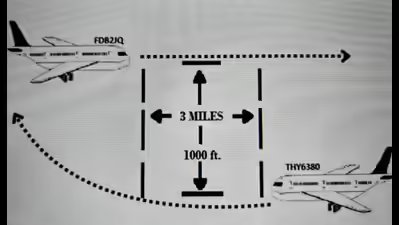
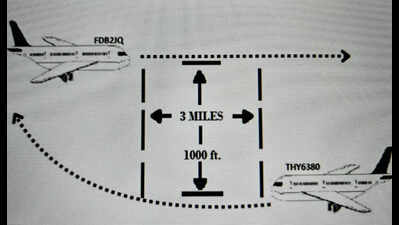
Mumbai: A serious near-miss involving a Turkish Airlines cargo flight and a Flydubai passenger flight over the Arabian Sea last year occurred because the Turkish Airlines co-pilot initiated an unauthorised climb that breached the required vertical separation between the two aircraft, said the final report recently released by the Aircraft Accident Investigation Bureau (AAIB).The Aug 30 incident occurred over the north-east Arabian sea when the Turkish Airlines cargo operating a Chennai to Istanbul flight breached the vertical separation and came in proximity of a Flydubai flying passengers from Dubai to Calicut. The Turkish Airlines flight (THY6380) was at 34,000 feet, while the Flydubai aircraft (FDB2JQ) flew 1,000 feet directly above at 35,000, heading in the opposite direction, both on the same oceanic route, P574. Both captains were on controlled rest at the time, leaving their respective first officers in charge.The Turkish Airlines first officer had earlier requested a climb to 36,000 feet through CPDLC, which is a digital text-based communication system used between pilots and air traffic controllers, particularly over oceanic airspace where radio coverage is limited. The Mumbai air traffic control (ATC) declined the request, responding, “Unable due to traffic”. However, the ATC reply was sent without a required reference number linking it to the original request. As a result, the aircraft’s onboard system did not register it as a formal response and, after 7 minutes and 30 seconds, automatically generated a reminder displaying the original climb request on the cockpit screen.When the reminder appeared, accompanied by a flashing blue attention light, the first officer interpreted it as a fresh clearance to climb and initiated the manoeuvre without cross-checking with his captain or ATC. Within seconds, both aircraft were closing on each other with insufficient separation, triggering collision avoidance alarms in both cockpits. “As per the crew statement of both the aircraft Capts were awakened from controlled rest by the sound of Traffic Advisory ‘TRAFFIC TRAFFIC’,” the report said.The Turkish co-pilot’s failure to verify the CPDLC message and the absence of the required two-pilot cross-check before executing a significant altitude change was the probable cause of the incident. The ATC’s omission of the message reference number and a gap in crew knowledge about how cockpit reminder messages function were cited as contributory factors.