









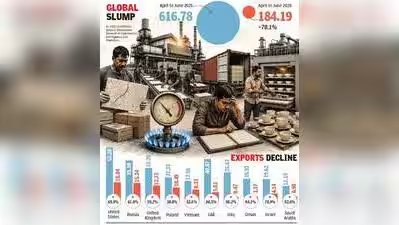
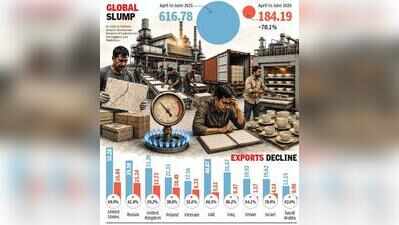
The uncertainty surrounding gas prices, disruption in its supply, shortage of containers and a sharp rise in freight costs have put Morbi’s ceramic exports in choppy waters. According to official figures, exports declined by around 70% in the first quarter of the 2026-27 financial year compared to the corresponding period previous year. Exports, which stood at around Rs 5,200 crore between April and June 2025, fell to aroundRs 1,700 crore during April-June 2026. Morbi, known as India’s ceramic hub, accounts for nearly 90% of the country’s total ceramic production and more than 85% of its ceramic exports.While some of the excess stock was absorbed by the domestic market, several units were forced to cut production because of the disruptions.The crisis was largely triggered by circumstances beyond the industry’s control.The ceramic sector had been performing well until the end of the last financial year, but the US-Israel conflict with Iran and the subsequent disruption around the Strait of Hormuz created a major shortage of natural gas and propane gas, severely affecting Morbi’s ceramic industry.Gas accounts for nearly 40% of the total production cost of ceramic tiles. Morbi’s industry was heavily dependent on propane gas. Around 900 ceramic units were consuming nearly 55 lakh SCM of propane a day, in addition to 25-30 lakh SCM of piped natural gas supplied by Gujarat Gas.According to industry representatives, propane was cheaper than piped natural gas and had a calorific value around 17% higher.Propane was supplied to Morbi’s ceramic units by several private and public sector companies.Before the West Asia crisis escalated, the average gas price for Morbi’s ceramic industry was around Rs 48 per SCM. As the crisis intensified, gas supplies to the industry were disrupted. Several units were forced to suspend production for nearly 30 to 45 days as govt prioritised gas supplies for domestic consumption.Qatar was a major supplier of LNG to India, and the disruption to shipping through the region severely affected availability.Gujarat Gas, after nearly a month of uncertainty, managed to procure supplies from alternative sources and the spot market. As a result, prices surged to as high as Rs 90 per SCM.The price of PNG supplied by Gujarat Gas later stabilised at around Rs 79 per SCM. The company was supplying around 85 lakh SCM of gas to industries.With the reopening of the Strait of Hormuz and hopes of improved availability, propane suppliers again approached Morbi’s ceramic manufacturers in July, offering supplies at prices lower than PNG.However, Gujarat Gas requires industrial consumers to provide advance estimates of their gas requirements for the following month.When Gujarat Gas sought demand estimates around July 20 for the month of Aug, a majority of ceramic manufacturers did not place their requirements because they had reached agreements with propane suppliers.As Aug approached, however, the companies that had committed to supplying propane informed manufacturers that they were unable to procure the required gas because of the changing situation in the West Asia.Gujarat Gas was then forced to procure additional gas from the spot market at the last moment. It agreed to supply gas at around Rs 89 per SCM to consumers who had not placed their requirements earlier, while those who had submitted their demand in advance were able to get gas at around Rs 79 per SCM.Meanwhile, propane suppliers offered gas at around Rs 85 per SCM. However, because propane has a higher calorific value, ceramic manufacturers still consider it relatively cheaper than natural gas on an effective consumption basis.The uncertainty over gas availability and the prolonged shutdowns, however, had a major impact on exports. When production resumed after a gap of nearly a month, Morbi’s ceramic industry initially witnessed strong demand from the domestic market because of the shortage of tiles.However, the same products failed to find sufficient buyers in international markets.“There are multiple reasons that affected exports adversely. The high cost of gas forced us to increase prices, freight rates increased by 200 to 300%, and there was also a shortage of containers,” said Manoj Unghrejiya, a leading ceramic exporter.He said domestic buyers were willing to accept the higher prices, but Morbi’s ceramic manufacturers faced intense competition in international markets.According to industry representatives, freight rates to the UAE, which were earlier around US$300-400 per container, have recently surged to around US$2,500.The industry is also facing the additional challenge of anti-dumping duties. Several Gulf nations, European countries and South Africa have imposed anti-dumping duties on Indian ceramic products, with rates ranging from 50% to 100%.With higher gas and freight costs, container shortages and anti-dumping measures in key export markets, Morbi’s ceramic industry is finding it increasingly difficult to compete with China and major European ceramic-producing countries in the international market.

Industryspeak