








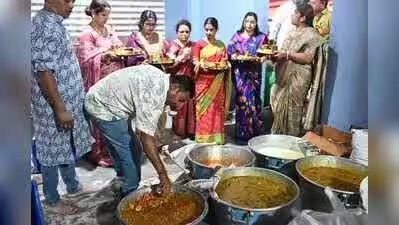
Pune: The quintessential Durga Puja bhog—comprising piping hot khichuri, labra, payesh, crisp baiguni, and chutney—remains an indispensable part of Durga Puja experience. This year, some pandals across the city, including Amader Barir Pujo, Aagomoni Prabasi Sangha, and a few others, are elevating the traditional offering by introducing live counters and bringing in specialised moiras (sweet makers) from West Bengal.At Amader Barir Pujo pandal, which is celebrating Durga Puja for its third year, bhog preparations commence in the morning with a team of 10 to 12 chefs who stay on the pandal premises. Unlike other venues that prepare bhog behind closed doors, Amader Barir Pujo has an open kitchen where visitors can witness the cooking process first-hand.According to Amit Chatterjee, founder of the Amader Barir Pujo pandal in Wakad, the rationale behind this move is to maintain high standards of food hygiene, especially in light of recent food safety violations reported across the city. He said, “Across Pune, several packed bhog services are available to devotees. However, it is difficult to ascertain the hygiene conditions of packed food, which is why we decided to organise live counters at our pandal this year.”Chatterjee added that live food preparation, bringing in traditional sweet makers (moiras), and sourcing ingredients from Kolkata provide a sense of home to devotees, especially for the probashi Bengali (migrant Bengali) community.“Although there are Bengali restaurants in Pune, onboarding traditional chefs is a way to emotionally reconnect with our roots. For instance, govindobhog is a traditional type of rice used in khichuri that has a distinct aroma and a specific method of preparation in Bengal.”Traditional, niramish (cooked without onion or garlic) Bengali delicacies—such as khichuri, labra (a mixed vegetable dish cooked in mustard oil), and tomato chutney made with jaggery—are served at the pandal. While there is no fee for children, the bhog is priced at ₹100 for senior citizens and ₹300 for adults. The pandal expects to cater to 500 to 600 people a day.Apart from serving fresh meals, the pandal has brought in moiras from Bengal to prepare authentic sweets on-site, including traditional Bengali rosogolla, payesh, langcha, and various types of sandesh.Anirban Mukherjee, who oversees the bhog arrangements at Amader Barir Pujo, said, “The sugar syrup is added to the sweets fresh every morning, giving them a 24-hour shelf life. Our sweet makers come from families that have practised this craft for generations, and we have four to five such specialists on our team.”At other pandals, like the Aagomoni Prabasi Sangha in Pashan, the menu is also strictly niramish and is prepared by an 18-member team. Expert sweet makers have been brought in from Bengal’s Bardhaman district specifically to prepare the famous Shaktigarh langcha, a regional speciality.“We try to keep our bhog preparations as authentic as possible to stay true to the essence of the festival. Since Ashtami spans two days this year, bhog will be served on all four days between Oct 17 and Oct 20,” said Rajesh Burman, general secretary of the Aagomoni Prabasi Sangha.Celebrating its ninth year of Durga Puja, the Pashan pandal begins planning its bhog a month in advance, serving the holy offering on traditional shal leaves. This pandal does not charge devotees any fees for the bhog.