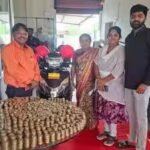











Guwahati: More than 150 farmers, grassroots practitioners, NGO representatives and development professionals gathered at Gauhati University on Tuesday for a two-day national conference on using indigenous knowledge, clean energy and grassroots innovations to address biodiversity loss, climate change and land degradation.The conference, titled “Indigenous Traditional Knowledge, Clean Energy & Grassroots Innovation to Policy Solutions for Biodiversity, Climate Resilience and Land Restoration in Assam & Meghalaya”, aims to connect community-led practices with formal policy.It was organised under the GEF Small Grants Programme, implemented by The Energy and Resources Institute (TERI) as National Host Institute under the guidance of Ministry of Environment, Forest and Climate Change and United Nations Development Programme. TISS Guwahati is the knowledge partner.The discussions focused on traditional knowledge, clean-energy solutions, appropriate technologies and modern innovations for biodiversity conservation, climate resilience and sustainable livelihoods.Manish Kumar Pandey, national coordinator of SGP-India at TERI, stressed the need to sustain community-led initiatives beyond the project period.“The project has successfully reached 11,000 beneficiaries. In this regard, the project should not be a source of fund for organisations, but a source to start working on community-driven approaches to keep the intervention going beyond the intervention period,” he said.Dr Dipankar Saharia, senior director at TERI, said more than 17,000 hectares had been brought under improved management and 2,800 hectares restored through the projects.He said the interventions had reached more than 11,000 people, with farmers accounting for 61% of the beneficiaries. The projects have covered 250 villages across 11 districts of Assam and Meghalaya and added 182 kW of renewable solar capacity.Dr Keshav Kumar, IPS (retd), adviser to Assam govt on home and political affairs, highlighted the role of indigenous knowledge in strengthening community relationships with wildlife.“The indigenous knowledge among the community in wildlife forensics helps people to have a better harmony with wildlife and people in the community,” he said.Prof Jagannath Ambagudia of TISS Guwahati called for greater integration of indigenous traditional knowledge into academic institutions. Gauhati University professor Ratul Mahanta said economic thinking was increasingly recognising “the carrying capacity of nature as the core of new economic theories.”The conference also featured discussions on green solutions, appropriate technology and renewable-energy innovations. An exhibition showcased indigenous rice varieties, traditional textiles, organic farming practices, bamboo products and solar-powered technologies.