








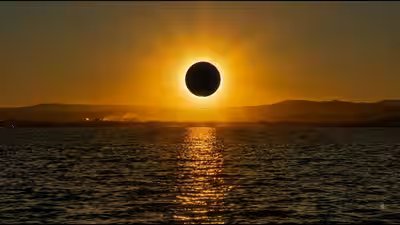
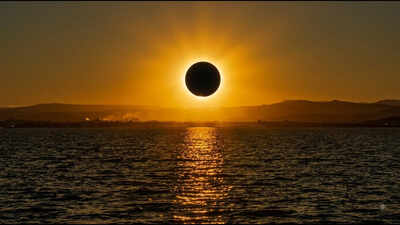
The only total solar eclipse of 2026 is happening today, 12 August, as the Moon passes directly between Earth and the Sun, casting its shadow across the Northern Hemisphere. The main path of totality will stretch through Greenland, Iceland, northern Russia, the Atlantic Ocean, Spain and a small part of Portugal.For people standing inside that narrow path, the Moon will completely cover the Sun for a few precious minutes, turning daytime skies dark and revealing the Sun’s normally hidden outer atmosphere, the corona. The event is especially significant for Europe because it is the continent’s first total solar eclipse on mainland territory since 1999.
Where will today’s total solar eclipse be visible
Totality will follow a relatively narrow corridor beginning in the Arctic before moving across Greenland and Iceland, then towards Spain and Portugal. Northern Spain will be among the most accessible locations in mainland Europe for experiencing totality.Outside the path of totality, millions more people will still see a partial solar eclipse. Across much of Europe, the Moon will cover most but not all of the Sun. The UK and Ireland, for example, will see roughly 90-96% of the Sun covered, while several other European countries will experience similarly deep partial phases.
Will Americans be able to see today’s solar eclipse
Yes, but only as a partial eclipse. The United States is outside the path of totality, so no part of the country will experience the Sun being completely covered.As reported by USA Today, during the 12 August eclipse, parts of the northern United States will nevertheless be able to catch the Moon passing across the Sun. The visible portion varies substantially by location, with Alaska and parts of the northern and northeastern US among the better-placed areas. Nasa likewise lists the partial eclipse as visible across parts of the US, extending from Alaska to North Carolina.That means American skywatchers can still witness the event, but they will not experience the dramatic daytime darkness associated with totality.
Why won’t India see the eclipse
India will miss today’s eclipse entirely. The reason is geographical: the eclipse’s visibility zone does not extend into India, and the event occurs while the Sun is below the horizon there. As a result, Indian observers will not be able to see either the total or partial phases from anywhere in the country.The Moon will still pass between Earth and the Sun, but its shadow will be falling across other parts of the planet.
What will happen during totality
As the Moon gradually moves across the Sun, daylight will begin to fade for observers approaching totality. When the last bright portion of the Sun disappears, the sky can become dramatically darker, and the solar corona becomes visible around the Moon’s black silhouette.Totality is extremely brief. The exact duration depends on location, but Nasa notes that the maximum total phase will remain under two and a half minutes.That fleeting period is what makes total solar eclipses so sought after. A partial eclipse can be observed over a much wider area, but only people beneath the Moon’s umbral shadow see the Sun disappear completely.
How to watch today’s eclipse safely
Anyone watching the partial phases must use proper solar-viewing protection. Ordinary sunglasses are not sufficient. Nasa recommends certified eclipse glasses or a safe solar viewer when looking towards the Sun.Only during the brief period of totality, when the Sun’s bright disc is completely covered, can observers safely look directly at the eclipse without solar filters. Protective eyewear must be put back on immediately as soon as even a small part of the Sun reappears.
A rare celestial event unfolding today
Today’s eclipse is unusual not because total solar eclipses are exceptionally rare globally, but because the Moon’s shadow only crosses a small portion of Earth each time.For observers in Iceland, Greenland and parts of Spain and Portugal, today offers the chance to stand directly beneath that shadow. For much of Europe and parts of North America, the event will appear as a dramatic partial eclipse.And for India, the spectacle will remain entirely beyond the horizon. For a few minutes today, however, parts of the Northern Hemisphere will experience something extraordinary: the Moon will cover the Sun, and daylight will briefly give way to darkness.