







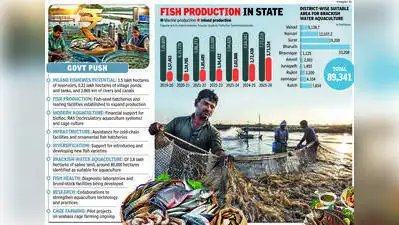
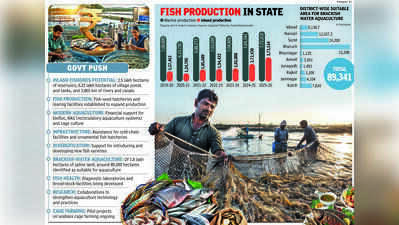
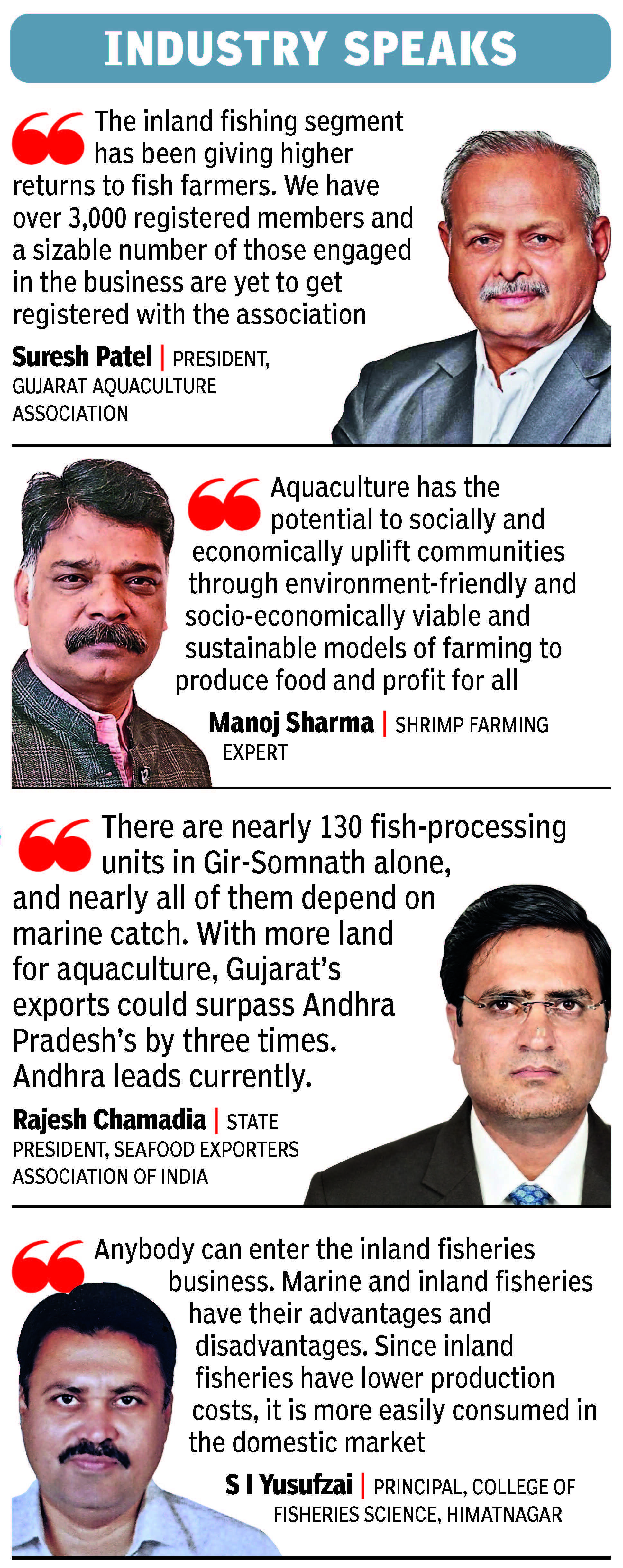
Gujarat’s fish basket is getting a boost from an unlikely quarter—the state’s inland waters. While marine fish production grew by just 1.1% in 2025-26, inland fisheries surged 37%, emerging as the main driver of growth in the state’s fisheries sector. Rising freshwater fish production, along with prawns and shrimp from aquaculture and brackish-water farms, helped overall fish production grow by 9.9% during the year.Gujarat produced 11.5 lakh metric tonnes (MT) of fish in 2025-26, comprising 7.7 lakh MT of marine fish and 3.7 lakh MT of inland fish. Compared to the previous year, marine production increased by 8,167 tonnes, while inland production rose by nearly 1 lakh MT.The share of inland production increased from 21.2% in 2021-22 to 32.6% in 2025-26. Industry sources describe the rise as significant, given that marine fishing covers a much larger geographical area than inland production.The shift is also reflected in the composition of the state’s fish basket. There is greater diversification in freshwater fish breeding at inland centres. Aquaculture is also spreading across coastal districts, with shrimp among the most widely cultivated produce.“There is huge scope for growth of aquaculture in Gujarat, and the sector can transform the socio-economic status of lakhs of fisherfolk,” said Manoj Sharma, a shrimp farmer and director of Mayank Aquaculture Pvt Ltd, which has been recognised among the state’s top 50 SMEs. “Aquaculture can change rural economy. Varieties like shrimp can be cultivated on a much larger scale along the coast.”For farmers already in the business, the economics are proving attractive. Navsari-based Vasu Tendel, who has been involved in aquaculture for more than a decade, said inland fishery has generated better returns than marine fishing.Suresh Patel, president of Gujarat Aquaculture Association, said his farms cover about 200 hectares and employ more than 350 people. “Inland varieties fetch double or more the price of marine catch,” he said.Processing industry adds to growthThe growth is being supported by Gujarat’s seafood-processing infrastructure. Out of the 671 marine fish processing units across 13 coastal states and Union territories, Gujarat has 137, with a combined daily capacity of 7,646.8 MT— about 19.5% of the national capacity of 39,927 MT. Aquaculture and inland fisheries are expanding in Bhavnagar, Jamnagar, Rajula, Porbandar, Anand, Bharuch, Navsari, Valsad, Surat and Khambhat, with shrimp among the highly cultivated varieties.Larger aquaculture companies, particularly those dealing in prawns and shrimp, have increasingly entered fish processing. Processing is important for exports, and processed shrimp and prawns generally command higher export values than several other marine species.However, most processing units in Gujarat continue to handle marine catch. Only about a dozen, largely concentrated in south Gujarat, process aquaculture produce.Industry sources say seafood exports could increase substantially if more coastal saline wasteland is brought under aquaculture and inland fisheries.Marine fisheries face a slower tideThe rapid growth of inland fisheries contrasts with the relatively modest increase in marine production, which rose by just 1.1% in 2025-26.“There has been a change in the pattern of fish availability. Global warming is also playing a role. We are now urging fishermen to adopt deep-sea fishing using bigger trawlers,” said Velji Masani, president of All India Fishermen Association.Processing-industry representatives, however, point to another concern: increasing juvenile fishing. “An increasing number of fishermen are taking the easier route of juvenile fishing, as these fish are bought by the fishmeal production lobby,” said a fish-processing unit proprietor.Experts say marine production may now be approaching its optimum level, leaving limited room for substantial growth. Inland fisheries, by contrast, remain a developing sector with production rising each year.The sector is also attracting people beyond traditional fishing communities. Traders and investors are entering aquaculture through artificial ponds, reservoirs, small waterways and brackish-water bodies. The cost structure is another attraction. Marine fishing requires boats, crew, fuel and equipment, while inland aquaculture can involve a largely one-time investment in creating ponds, with natural freshwater resources also used in some locations.Experts estimate that the cost of producing inland fish can be nearly one-third that of marine fish, although disease outbreaks remain a significant risk for aquaculture farms.“The optimum use of water bodies has started in all districts of Gujarat, which is why inland fish production has increased. Cultured fish production has also risen,” said Jagdish Fofandi, an exporter of marine products from Veraval.Mukesh Panjari, president of Shree Porbandar Machhimar Boat Association, pointed to a different challenge for aquaculture. “There is a huge difference in the taste of marine and inland shrimps. Those who love shrimp prefer the marine variety,” he said.
Industry speaks