








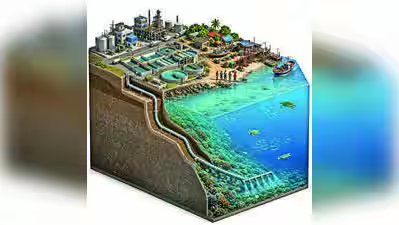
Gujarat is increasingly looking towards deep-sea discharge systems to address the challenge of industrial wastewater disposal, with projects planned for textile processing units in Jetpur and industrial clusters in Ahmedabad.While industry representatives view the pipelines as critical to sustaining operations and meeting environmental compliance, concerns over the potential impact of treated effluent on marine ecosystems have come to the fore in Porbandar, where fisherfolk are opposing the Jetpur project.The two projects highlight the growing challenge of balancing industrial growth with environmental protection in a state that is home to major textile, chemical, pharmaceutical and other manufacturing clusters.The Jetpur-Porbandar project, being implemented by Gujarat Water Infrastructure Ltd (GWIL), envisages transporting 80 million litres per day (MLD) of industrial effluent through a 119-km pipeline for discharge into the deep sea near Chikasa village, close to Navi Bandar in Porbandar district. Estimated to cost Rs 675 crore, the project is being funded 80% by the state govt and 20% by the Jetpur Dyeing and Printing Association.However, the proposal has triggered opposition from Porbandar’s fishing community, which fears that even treated industrial wastewater could affect marine life, and hence, their catch and livelihood. A recent meeting between fisherfolk and govt officials to address these concerns ended without a resolution, according to Shree Porbandar Machhimar Boat Association.The controversy has brought into focus a critical question facing industrial Gujarat: Can deep-sea discharge provide a viable solution to the growing problem of effluent disposal without transferring the environmental burden from land to the sea?Ahmedabad project awaits executionA similar proposal for Ahmedabad’s industrial clusters is moving through the planning stage, with the detailed project report (DPR) under preparation, according to industry representatives.The proposed project envisages a pipeline of around 190km, with a capacity of approximately 100 MLD, to carry treated industrial wastewater for deep-sea discharge. Ankit Patel, chairman of The Green Environment Services Co-Op. Soc. Ltd, said necessary permissions have been secured for pipeline alignment and disposal point, including those from Kalpsar authorities and for laying the line along the expressway.Industry representatives see the project as a crucial intervention for Ahmedabad’s textile processing, chemical and pharmaceutical units, many of which face mounting pressure to manage wastewater in compliance with environmental norms.Shailesh Patwari, former Gujarat Chamber of Commerce and Industry (GCCI), said the project was earlier estimated to cost around Rs 1,700 crore, with industries expected to contribute about 30% of the total.“Ahmedabad-based industry associations have already paid Rs 20 crore towards the project, but there has been no progress for around a year,” Patwari said, urging state govt to initiate work.The project is expected to support around 200 textile units and 1,500 chemical and pharmaceutical units, he said, warning that environmental compliance pressures could threaten the operations of these industries and the livelihoods of around 4 lakh people.Patwari also cited pollution in the state’s river systems as a reason for developing alternative effluent disposal infrastructure. He argued that deep-sea discharge was becoming an urgent requirement for industrial continuity rather than an optional intervention.
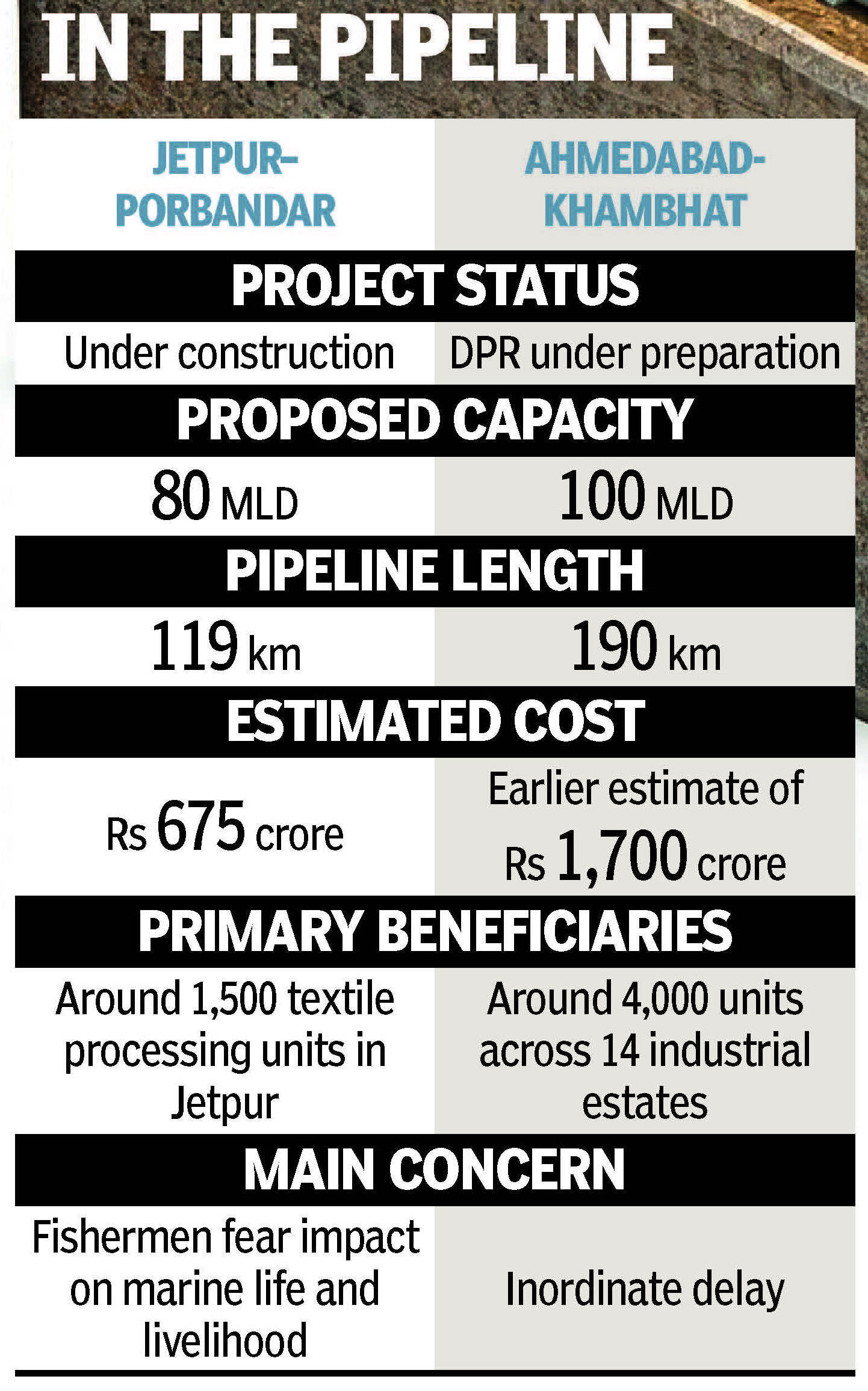
Projects proposed
Industrial necessity versus environmental concernsWhile the Ahmedabad project is yet to move into visible on-ground execution, the Jetpur proposal illustrates the concerns that can arise when industrial wastewater disposal plans intersect with coastal livelihoods.Jetpur is a major textile printing and dyeing centre, with around 1,500 processing units and an estimated annual turnover of Rs 3,000 crore. The industry provides direct and indirect employment to around 2.5 lakh people. Its representatives say the proposed pipeline will help meet wastewater disposal requirements as the cluster expands.Jenti Ramoliya, president of the Jetpur Dyeing and Printing Association, has maintained that the project followed studies and water sampling by pollution control authorities. He said wastewater would be treated before discharge and that its high total dissolved solids (TDS) content would not adversely affect seawater.Fisherfolk in Porbandar, however, remain unconvinced. The coastal economy supports around 4,800 registered fishing boats, provides direct employment to approximately 30,000 people and indirect employment to another 1 lakh. Fishing industry representatives fear that changes in marine water quality could affect fish populations and the wider food chain.Environmental activists have also raised concerns about possible impacts on marine species, including Olive Ridley and green sea turtles, as well as other sensitive coastal habitats.The competing arguments underline the need to assess deep-sea discharge projects not only in terms of industrial capacity and wastewater disposal, but also through robust environmental monitoring, transparent disclosure of water-quality data and safeguards for communities dependent on coastal ecosystems.For Gujarat, the challenge is no longer simply how to dispose of industrial effluent. It is how to build infrastructure that allows industry to grow without shifting pollution risks to another ecosystem or placing traditional livelihoods in jeopardy.Dyeing hub’s pollution complaintsFor more than 15 years, Jetpur’s dyeing and printing industry has faced frequent scrutiny over industrial effluents. In 2009, farmers demanded closure of processing and dyeing units, alleging that wastewater and industrial waste were reducing soil fertility. Gujarat Pollution Control Board (GPCB) issued seven-day notices directing units to take corrective measures.In June 2012, Rajkot district administration issued a notification warning against the illegal discharge of untreated industrial water into rivers, lakes and land.Gujarat High Court had repeatedly directed authorities to curb the practice, while a common effluent treatment plant was being developed at Derdi.The issue escalated in 2018, when the Bhadar river stretch between Jetpur and Saran was reported to be among India’s most polluted, with a biological oxygen demand of 426 mg/litre.GPCB ordered a month-long shutdown of Jetpur’s common effluent treatment plant and issued closure notices to 26 saree-printing units at Dhareshwar GIDC.
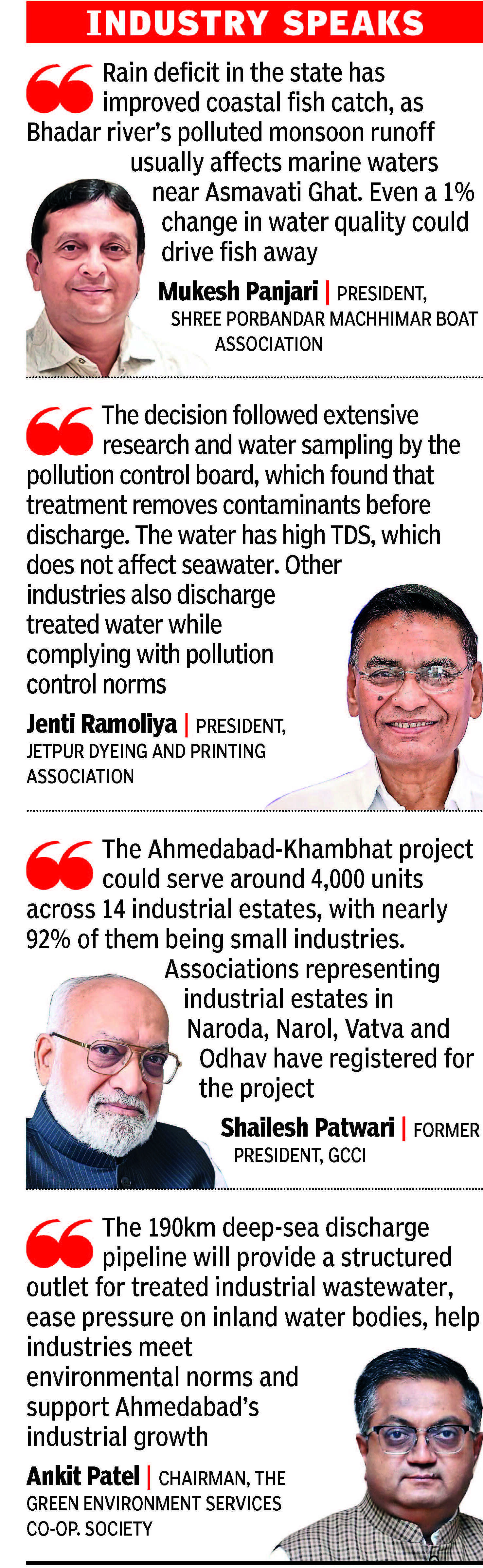
What the industry has to say