









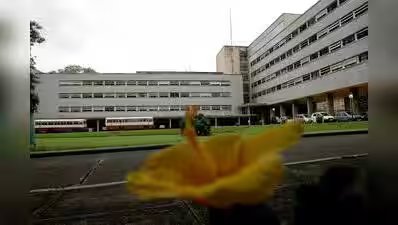
Mumbai: Almost four decades after its last major academic expansion, the premier Tata Institute of Fundamental Research (TIFR) is planning a significant addition to its main Colaba campus, with an 11-storey academic building in the pipeline. The proposed building will house laboratories for different departments, addressing a long-pending need for additional research and academic infrastructure on the main campus spread over 15 acres.The need for expansion has become more urgent over the years, particularly after the institute was granted deemed university status in 2002. Over the past two decades, its student capacity has increased substantially, but its infrastructure at the main campus in Colaba has not kept pace with the growth, said sources.The last academic block on the Colaba campus came up around the mid-1980s, followed by the Pelletron facility, an ion accelerator project built in collaboration with BARC in the late 1980s. Since then, TIFR’s expansion has largely taken place outside its main campus, with centres coming up for radio astronomy in Pune, for applied mathematics and biological sciences in Bengaluru, and for theoretical sciences in Hyderabad. In Mumbai, the institute also has a campus in Mankhurd which houses Homi Bhabha Centre for Science Education.Apart from its location within a sensitive military zone, the Colaba campus’ proximity to the coastline and concerns about the loss of its green cover were seen as significant constraints to its expansion. “The permissions were delayed, but now everything seems to have fallen into place. The institute is hoping to start the construction soon,” said a professor from the campus. A multi-storeyed students’ hostel is also in the pipeline as part of the proposed expansion, but permissions are awaited, said sources.“The expansion is happening for the first time in decades. Over the past few years, it has been difficult to provide accommodation for all our students. Several students were even housed in accommodation facilities outside the campus, which was unaffordable in a city like Mumbai and also inconvenient,” said an official, adding that one of the residential buildings was also given away to accommodate students in the past.Across its campuses, the institute has over 40 classrooms and over 180 laboratories. “With new professors joining the institute over the years, space constraints have become increasingly severe. Most laboratories are now operating in cramped conditions, with limited scope for expansion within the Mumbai campus. Consequently, much of the institute’s infrastructure and laboratory expansion has shifted to campuses outside Mumbai,” added a professor.Sources indicated that construction work on the building is likely to commence soon, following the institute’s clearance of the site. The institute has a dedicated space committee that oversees the allocation of space to various departments. However, the actual allotment is expected to take place at a much later stage.In several past reports, the institute has acknowledged space constraints as a major limitation to its expansion. It has noted that its student strength could have been higher if adequate infrastructure were available. The reports have also acknowledged that research outcomes could have been further enhanced with more spacious individual laboratories, additional office space, and adequate housing facilities on its residential campuses. Some of these concerns have been addressed through the expansion of the Hyderabad campus.