








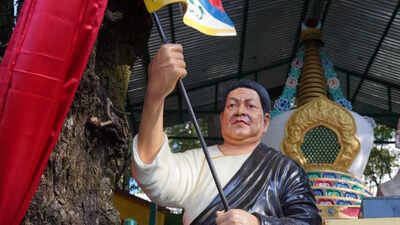
DHARAMSHALA: Honouring those who laid down their lives for Tibet’s freedom, a 6.5-foot statue of Tibetan activist Lobsang Rangzen was inaugurated at Lhagyal-ri, behind the Tsuglagkhang Complex, the main Tibetan temple and official residence of the Dalai Lama, in McLeod Ganj, Dharamshala, to protest against China’s Ethnic Unity and Progress Law.Talking to TOI after the inauguration, Tenzin Kunsel, president of the Regional Tibetan Women’s Association, Dharamshala, which organised the function, said Rangzen, 52, a resident of Queens, New York, died by self-immolation outside the United Nations headquarters in Manhattan on July 2, 2026.Notably, China’s Law on Promoting Ethnic Unity and Progress was formally passed by the National People’s Congress on March 12, 2026. It was signed into law by Chinese President Xi Jinping and officially took effect on July 1, 2026, a day before Rangzen self-immolated.Tenzin Jigme, press officer at the Department of Information and International Relations (DIIR) of the Central Tibetan Administration, said parliamentarian Lopon Thubten Gyaltsen attended the function as the chief guest and inaugurated the statue dedicated to Rangzen.Jigme said that, on the occasion, Gyaltsen said, “The Sino-Tibetan conflict remains unresolved.” He recalled that Thupten Ngodup was the first Tibetan to self-immolate for the cause in 1998. He also referred to subsequent self-immolations by Tibetans inside Tibet and in exile since 2008, taking the total to nearly 170.Giving more details, Tenzin Kunsel said that Lobsang Rangzen self-immolated in front of the United Nations headquarters in New York City, USA, to protest against China’s Ethnic Unity and Progress Law.Elaborating on the law, she said, “China’s new Law on Promoting Ethnic Unity and Progress could have significant consequences for the Tibetan people, particularly for the preservation of our language, culture, religion, and identity. But we must ask ourselves: What will happen to the younger generations if they grow up unable to speak their own mother tongue, unfamiliar with their own history, and disconnected from the culture and traditions of their homeland?”