









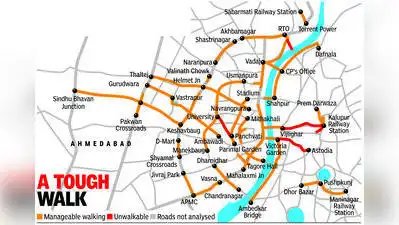

A footpath’s purpose lies in its name itself — a path for foot travel built to keep pedestrians safe from motorised vehicular traffic. But for most Ahmedabad residents, walking even a short stretch feels like clearing an obstacle course — jumping over missing paver blocks; having to step into moving traffic, thanks to encroachments, parked vehicles, oddly planted trees or an abruptly ending pavement, and dodging a two-wheeler rider cruising on the footpath.In light of the Supreme Court declaring the right to walk a fundamental constitutional guarantee, having a seamless walking experience remains a distant, almost absurd luxury.For Mihir Patel, who lives on Shela’s Club-O7 Road, finding a safe stretch for his morning walks means driving 3km to Godhavi Canal Road. “There are no pavements where I live. I cannot walk amid heavy traffic due to the dust and school rush hour. Everyone drives recklessly. It’s too risky,” he says.“Younger people can dodge traffic, but senior citizens are left with nowhere to go,” says Ajay Baria, a pharma company executive interviewed on Ashram Road. His colleague, Soham Sahu, points to the constant threat from wrong-side drivers. “You are constantly terrified of being hit.”
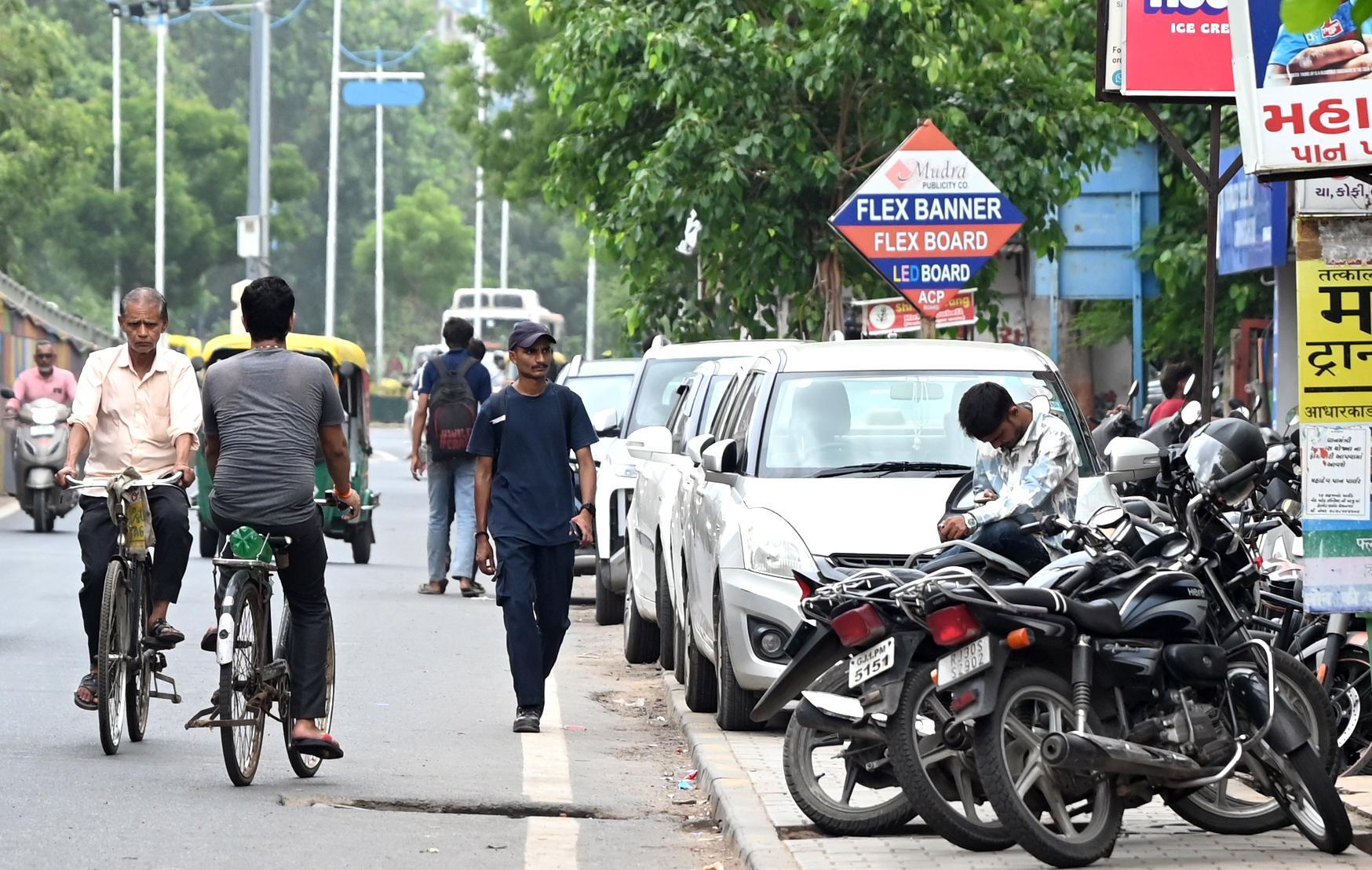
Near AEC crossroads
A recent report substantiates such experiences with data points. Revealing the good, the bad and the ugly of Ahmedabad’s footpaths, the State of Indian Streets 2026 report hands the city a poor 42.3 out of 100 on the Walkability Index and places it 12th among major Indian cities.Published by the Council for Active Mobility, the Road Safety Network and urban data company Neural City, it has evaluated pedestrian infrastructure across 1,789 street locations in Ahmedabad using a dynamic street evidence model to assess real-world usability.The results: Nearly a third of the streets surveyed lacked pedestrian facilities. Ahmedabad’s score on ‘Parking Encroachment’ is 35.7 out of 100, due to parked vehicles universally taking up public space.On ‘Protection and Crossings’, Ahmedabad languishes at 28.2 due to the absence of protective bollards. Ahmedabad has almost completely overlooked its visually impaired citizens.On ‘Disabled Accessibility’, a critical parameter, the city score was a dismal 20.6, driven by a 98% failure rate in providing tactile paving that effectively makes it difficult for blind people to use pavements.In a social media post, Akshay Kanchan of Neural City points out that physical infrastructure often provides a false sense of progress. Across 10 of the 12 major Indian cities surveyed, over half of all sidewalks had severe obstructions.
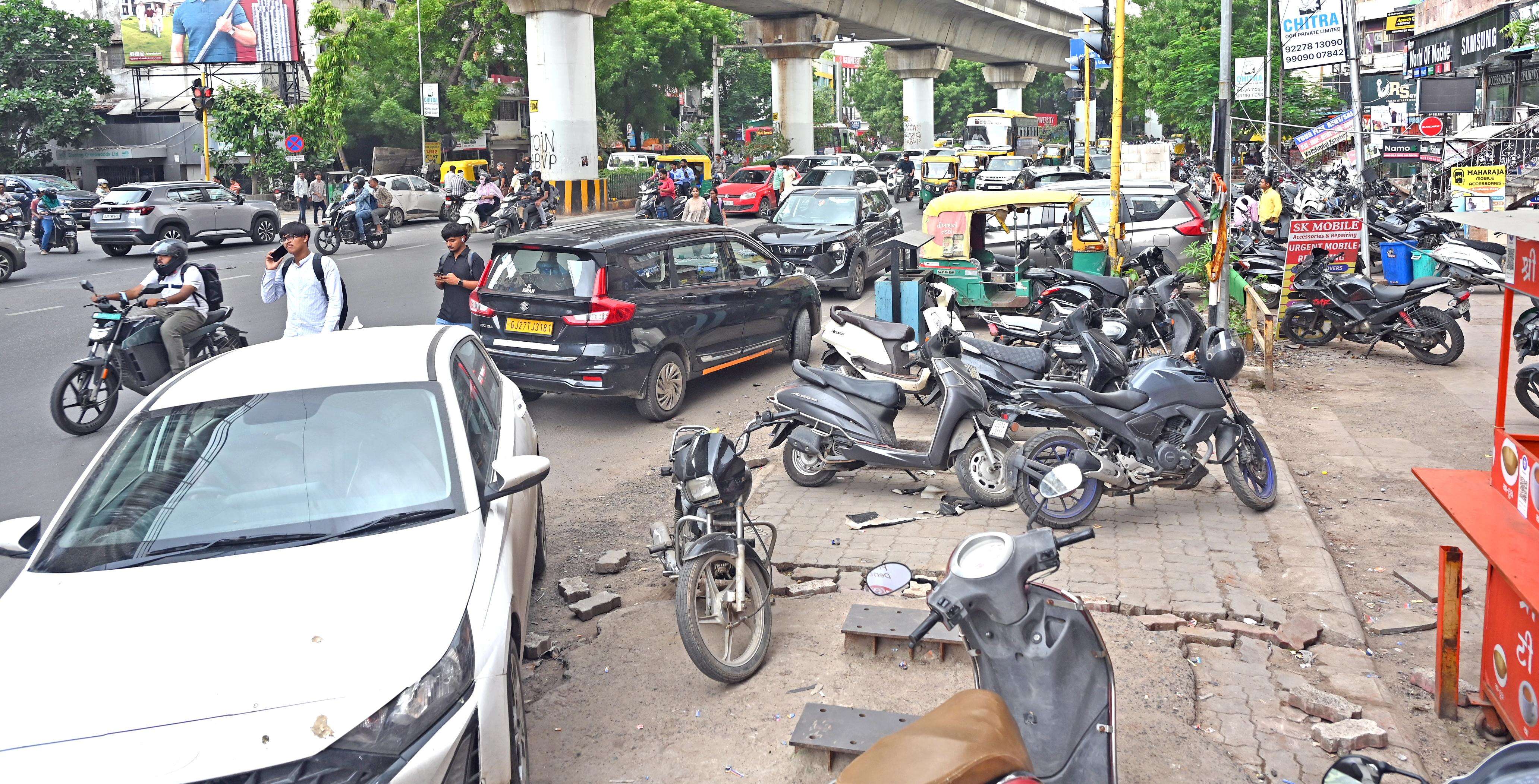
Outside Himalaya Mall: The footpath is used as a parking lot
Kanchan says, “If 55% of points along a street are clear, it does not mean pedestrians have a continuous, safe route. Without ground-level evidence, cities will keep building pavements that look good on paper but fail completely in practice.”
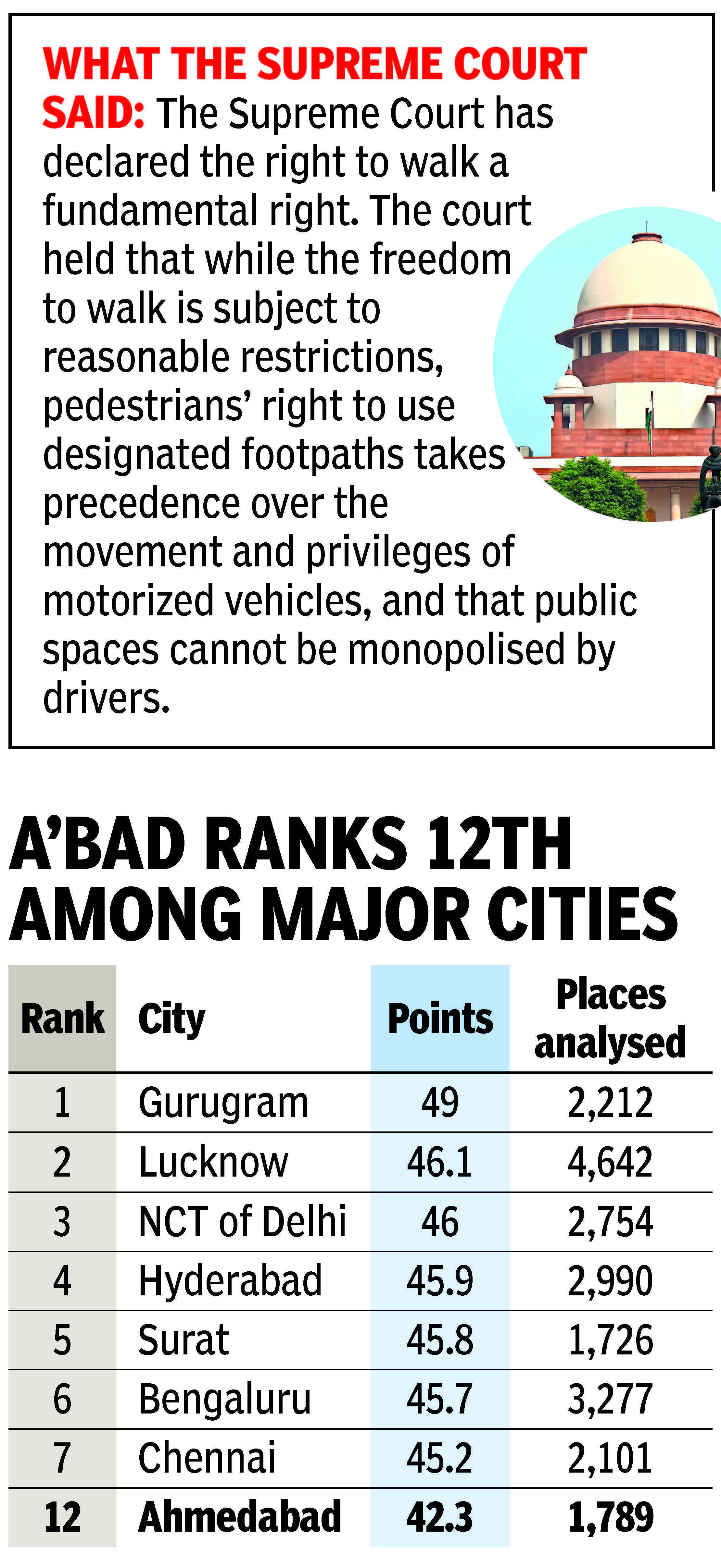
Where does Ahmedabad stand

How has Ahmedabad failed its citizens