








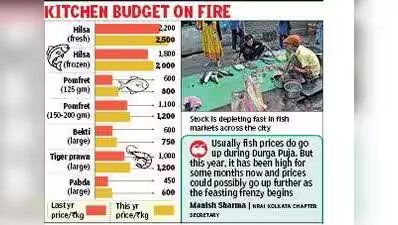
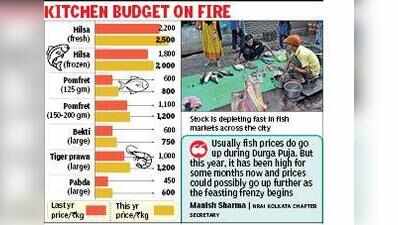
Kolkata: Durga Puja feasting in Kolkata is set to become costlier this year, with a sharp rise in fish prices forcing households, restaurants and pubs to rethink festive menus.A poor catch in the Bay of Bengal, limited supplies from Gujarat and Odisha, and the absence of Bangladeshi hilsa ahead of the festival have tightened the market just when demand is beginning to peak. Fish has always been central to puja indulgence, from home-cooked hilsa and prawn delicacies to restaurant platters and pub starters. This year, that festive spread will come at a higher price.Restaurants specialising in Bengali cuisine said puja platters are likely to cost more because of the steep increase in prices of hilsa, bekti, pomfret and prawns. Many establishments that usually absorb the routine 10%-15% seasonal rise are now considering increasing prices of select dishes by around 10%.“There is a perceptible decline in fish available in markets. Hence, price of all types of fish has increased. Apart from cultivated fish like rohu and katla, and freshwater fish like pabda, there is hardly any variety available. While hilsa is in demand, the price is extremely steep for the variety on offer. Aar and pomfret too are in short supply,” said Chayan Saha of Prince restaurant on Free School Street.The biggest disappointment for many puja shoppers is the absence of Bangladeshi hilsa, traditionally one of the most sought-after festive purchases. With Bangladesh not sending hilsa to India this year and local catches remaining poor, Myanmar hilsa is the main option in the market. Fresh hilsa arriving by air is retailing at Rs 2,200-Rs 2,500 per kg, while frozen hilsa is selling at around Rs 2,000 per kg.Fish Importers’ Association secretary Syed Anwar Maqsood said traders had tried to source Bangladeshi hilsa for the festive season but were unsuccessful. “Myanmar hilsa is now our hope. Hilsa consignments are arriving by air twice a week, on Thursdays and Sundays. On average, around 200-250 cartons arrive per flight, with each carton weighing 20kg. We hope supplies will continue through the season,” he said.The price shock is not limited to hilsa. Bekti, widely used in restaurants for fish fingers, fish tandoori and continental dishes, has also become costlier because of a short supply of Bombay bekti and bhola fish. Large bekti weighing over 4kg is selling at around Rs 800 per kg while medium-sized fish are retailing at Rs 750 per kg and smaller local varieties at around Rs 700 per kg.This is expected to affect not only Bengali restaurants but also North Indian, continental and pub menus, where fish-based starters see high demand during Puja outings.“Usually fish price does go up during Durga Puja. But this year, it has been high for some months now and prices could possibly go up further as the feasting frenzy begins. In most non-Bengali restaurants and pubs, the highest demand is for chicken. In fish items, it is bekti and basa that is used. Those that offer fish fingers may go for basa but other items like fish tandoori and continental dishes like Fish Florentine will require bekti,” said NRAI Kolkata chapter secretary Manish Sharma.Prawns, another festive favourite, are also pinching buyers. The supply of giant freshwater prawns, or golda chingri, has dried up, while tiger prawns, or bagda chingri, are available in limited quantities. Depending on size, bagda is selling at Rs 800-1,200 per kg, compared with Rs 700-1,000 per kg last Puja.Pomfret, popular among festive shoppers and restaurant-goers, has also turned expensive. Smaller pomfret weighing around 125gm is selling at Rs 750-800 per kg, while fish in the 150-200gm range are priced at around Rs 1,200 per kg.Fish traders said customers are already feeling the strain. Amar Das, a trader at Lake Mall market, said the shortage of sea fish had forced traders to buy hilsa, pomfret and tiger prawns at much higher rates. “Discerning customers are disappointed at the absence of Bangladeshi hilsa. While not many could afford the Bangladesh hilsa due to its high price, the rise in price of other fish varieties due to scarcity of fish in the market has affected all customers. Buyers have little choice but to pay more for the fish available in the market,” he said.For households, the puja menu may see some compromises, with many buyers shifting to cultivated fish such as rohu and katla or comparatively affordable freshwater options like pabda, which is selling at Rs 450-600 per kg depending on size.The festive appetite for fish remains strong, but this puja, the traditional indulgence is likely to be more selective, more expensive and, for many, less abundant.