








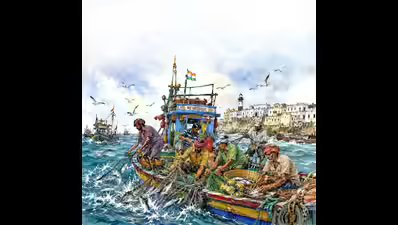
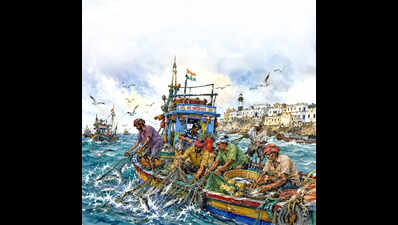
Gujarat has never been known for its appetite for fish. The state catches it for everybody else. The longest coastline in India sends almost its entire marine harvest into export — frozen, packed, shipped out to China, Japan, US, Europe and Southeast Asia. Fish remains a marginal item on most plates within the state. Yet Gujarat now houses one in five of India’s marine fish processing units, a share that has more than doubled in the last decade.Boats unload at the wharves of Veraval in Gir Somnath district, where 80 per cent of fish processing in the state takes place. Trucks idle at the gates of the GIDC processing units.Inside, the catch is being sorted, graded, frozen and stamped for shipment to ports around the world — and, from there, to supermarkets and restaurants.Not all of it leaves the country. Fresh fish from Veraval is moved by road to northern Indian states, where demand has held up.The state has 137 marine fish processing units, out of 671 across the country, with a combined daily processing capacity of 7,646.82 metric tonnes — roughly 19.5% of the national capacity of 39,927 MT, spread across 13 coastal states and Union territories. The figures were presented to Parliament during its recently concluded session.Why Veraval, though, is the question the figures don’t answer. “Veraval has skilled manpower, the highest concentration of fishing boats, industrial land through GIDC, and all the necessary export infrastructure,” said Jagdish Fofandi, a fish exporter and former president of the Seafood Exporters Association of India. “That is why it developed into a cluster for fish processing.”The economics, however, are tighter than the scale suggests. Setting up a processing unit takes an investment of Rs 7 crore to Rs 10 crore, industry estimates suggest, and profit margins sit between 3% and 5%. The business runs on volume, on cold-chain logistics, and on the sea.
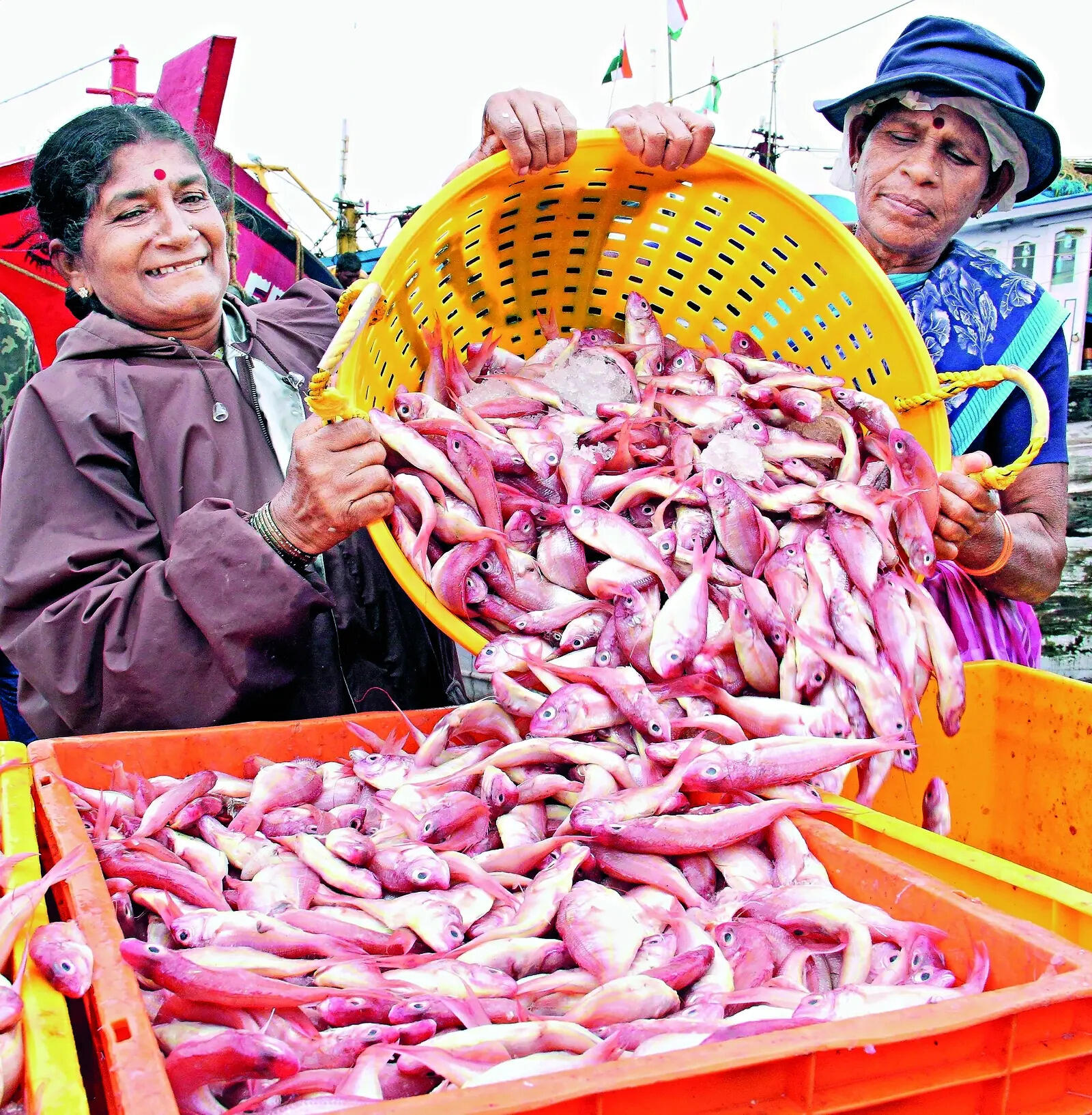
Sagarmanthan Machimar Utthan’s 700 women are involved in producing snacks using dried fish
“Fish processing is a prerequisite for export. And in the last decade, a number of fishermen and longtime suppliers to exporters have moved into the export business, which is why the number of processing units in the state has more than doubled,” Fofandi said.The ownership composition of those processing plants has shifted, along with the count. “The fish processing industry was, for a long time, dominated by the Kharwa community of the state. In the past ten years or so, a number of Muslim community entrepreneurs have entered the fray,” said Tushar Chamadia, another exporter. Smaller plants, he added, have come up across Saurashtra and South Gujarat.The big numbersGujarat’s official fish production for 2024-25 stood at 10.42 lakh metric tonnes — 7.64 lakh MT from marine production and 2.78 lakh MT from inland output. The state govt expects 2025-26 to cross 11 lakh MT. The state ranks second in the country in marine fish production, and sixth overallWhat gets caughtAround 50 species are processed for export from Gujarat. Shrimp, squid, cuttlefish, ribbonfish and croaker dominate the trade. Per-kilogram export realizations, exporters say, hover around $1.50 for ribbonfish, $1.75 for croaker, $3.50 for cuttlefish and squid, and $4 for shrimp.“Lobsters and white pomfret fetch a higher export value, but their catch in the state is minimal,” Fofandi said. “These numbers, however, vary with demand and the volume of the catch,” said another exporter.Raw fish moves through cleaning, gutting, filleting, grading, scaling and packaging — each step pushing back the spoilage clock. Plants use freezing, drying, salting, smoking and canning to add further value. Waste is rendered into fish meal, fish protein concentrate, fish oils and aquaculture feed.The state’s shrimp storyGujarat is among India’s major shrimp-producing states, but it trails Andhra Pradesh in aquaculture. Andhra’s controlled shrimp cultivation in artificial ponds expanded sharply over the last 15 years. Gujarat has not kept pace, hemmed in by the lack of suitable land, poor water quality, high electricity costs and environmental constraints.Where the fish actually ends upThe US accounts for a large share of Gujarat’s fish exports as a final market, exporters say. But the immediate buyer is often somebody else. China is the single largest direct importer, taking 50% to 55% of the outflow from Gujarat. Much of it does not stay there. Frozen Indian fish is processed further in China — turned into skinless, boneless, ready-to-eat products — and then re-exported to markets such as the US.Around 30% of Gujarat’s seafood goes to European countries, where it surfaces on the menus of luxury hotels. The remainder is divided among Vietnam, Thailand and other South East Asian markets, while the Middle East also draws a small share. The arrangement is under pressure. Countries like Ecuador have grabbed shrimp share in the American market thanks to lower tariffs, and Gujarat’s exporters are watching those margins closely.Four lakh people in the businessBehind the boxes of frozen seafood is a coast of people. Boat associations put the number of fishing vessels registered in Gujarat at over 30,000, with more than four lakh people directly tied to the fishing economy. They are crews spending two or three weeks at a stretch in deep sea waters, wholesalers at the auction halls, labourers in the processing units, transport workers, and the exporters at the top of the chain.Up and down the coast — Veraval, Porbandar, Mangrol, Jafrabad, Rajula, Una, Okha, Diu, Jakhau and the small ports of South Gujarat — the rhythm of the sea sets the rhythm of the household. The trade has shaped a culture that pours itself into Gujarati novels, poetry and folk songs about courage, longing and devotion to the sea.The women of SagarmanthanInside Veraval itself, a different kind of fish economy has been taking shape. In several fishing communities, women are turning dry fish, which has been for long a low-margin staple, into value-added products. Sagarmanthan Machimar Utthan, a fish farmer producer organization, runs one of the larger such efforts. Its nearly 700 women members produce fish pickle, wafers, kurkure, biscuits, samosas, pizzas and cutlets, all built around dry fish. The products travel to markets in Ahmedabad, Northeast, Andhra Pradesh, and Kochi. “We started with only a few women a decade ago. Today, more than 700 women are associated with the group, and our turnover last financial year reached Rs 50 lakh,” said Shailesh Shriyani, who leads the organization. For coastal women whose families have always fished, it is a redrawing of the line between catching and earning.Strangers in the netsThe Arabian Sea, long considered relatively cool and stable, has been warming over the past decade. Cyclonic activity has intensified, particularly during the early fishing season between Aug and Sep — the very window in which the year’s best catch has traditionally been landed. “The new fishing season starts in mid-Aug, and we usually get our best catch of the year between Aug and Dec. But in recent years, cyclonic warnings have forced us to recall boats from the sea. These conditions also affect the catch,” said Tulsi Gohil, president of the Veraval Boat Association.Many Gujarat fishermen now sail south, into the waters of Maharashtra and Karnataka, in search of better fishing grounds.The biology of the coast is shifting along with the weather. Ribbonfish, cuttlefish, squid, pomfret, tuna, reef cod and croaker still dominate the Gujarat haul. But over the last four years, fishermen have been pulling something else from their nets: mackerel and sardines, species long associated with Kerala’s waters, are turning up off Gujarat in significant numbers.Marine experts, and even the fishermen, believe the warmer southern waters are pushing these species north, in search of cooler refuges. The fish are migrating with the climate. Last year, between July and Aug, a record 4,000 tonnes of hilsa — the prized fish more often associated with West Bengal and Bangladesh— were sent from Bharuch to Howrah. Larger fish fetched up to Rs 1,200 a kilogram, the smaller variety around Rs 800.“The window for hilsa fishing is very small in Gujarat. During the receding monsoon, hilsa is traditionally found in estuaries around Bharuch. Every year, for several years now, a small quantity of hilsa caught off the Bharuch coast is sent to Bengal,” Fofandi said. “Last year, there was an unusually high landing of hilsa in Bharuch. The traders there have been dealing with West Bengal for several years, so they sent across a bumper 4,000 tonnes. It was an exception.”Jafrabad’s Bombil boomIn Amreli’s Jafrabad, a separate economy has grown around Bombay duck, also called Bombil. The species favours warm, shallow coastal waters. Once dried, Bombil is sent to markets across India and to Bangladesh. “This fish is special and popular,” said Kanaiya Solanki, president of the Jafrabad Boat Association.The cost of going to the seaRisk is not new to this trade. Rough seas, cyclones, mechanical failure and the simple distance from shore have always taken their toll. Crews leave their families for two to three weeks at a time, with limited communication. A navigational mistake near the India-Pakistan maritime boundary can mean arrest and years of imprisonment in Pakistan, a fate that has shadowed Gujarati fishing families. There is also a cost the books don’t carry. Frequent rough weather is shortening the working life of fishing boats, forcing owners to scrap and replace vessels much earlier than they once did. The trade has its numbers, and the sea has its mood.