










What does a state known for factories and pharmaceutical companies seek to patent today? Artificial intelligence and cyberphysical systems top the list, while patent applications in smart mobility, telecommunications, and semiconductors have grown significantly. Private funding dominates patent activity in Gujarat, and industry’s share in patent filings is more than twice the national figure.There is, however, a concern on the academic front. While Gujarat’s researchers are publishing more papers than they did four years ago, the share of papers ranking among the most highly cited has declined. The recently published India Science and Technology (S&T) Scoreboard by NITI Aayog places Gujarat eighth among states and Union Territories (UTs) in patent filings, with 3,029 applications, and tenth in research publications, with 10,503 papers indexed in an international research database.In 2024-25, the state accounted for 4.8% of the country’s patent applications and 4.7% of its research publications.What Gujarat is patentingArtificial intelligence (AI) and cyberphysical systems accounted for 755 patent applications in 2024-25, followed by pharmaceuticals, medical technology and healthcare (637) and telecommunications and networks (477).Together, these three categories accounted for over 60% of the state’s total patent applications. Between 2021-22 and 2024-25, patent applications in pharma, medtech and healthcare rose from 371 to 637, while those in telecommunications and networks more than doubled from 203 to 477. Patent applications in transportation and smart mobility more than tripled, from 67 to 205, while electronic component manufacturing and semiconductors saw filings rise from 126 to 247. Overall patent activity, however, has fluctuated. Applications peaked at 4,674 in 2023-24, the highest in four years, before falling to 3,029 the following year.Private funding drives patent activityGujarat differs considerably from the national average in who files patents. Among the patent applications classified by institutional sector, industry’s share stood at 43.2%, more than twice the national figure of 19%. Academia accounted for 55.6%, while govt R&D laboratories contributed just 1.2%, half the national figure of 2.4%.Of the 2,571 patent application counts reported under funding categories in 2024-25, 2,239, or 87.1%, were attributed to privately funded research. State-funded research accounted for 7.4% and centrally funded research for 5.5%. Academicians attribute the strong private-sector presence to industry’s growing interest in research directed at solving practical problems. The scoreboard draws its patent data from Clarivate’s Derwent World Patents Index (DWPI).

Where Gujarat stands
“Despite the rise in patent registrations, only about 20-30% are commercially viable. Some researchers identify industry needs and gaps to develop market-ready solutions, while others pursue innovations without necessarily considering their practical applications or commercial potential,” said Nakul Sharedalal, an IPR lawyer.Pharmaceuticals, agricultural solutions, solar power, AI and IT account for a significant share of patent registrations, with many demonstrating strong commercial prospects, he added.More papers, fewer among the citedGujarat’s research publications increased by about 32%, from 7,943 in 2021-22 to 10,503 in 2024-25. During the same period, the share of papers among the top 10% most cited fell from nearly 11% to 9.12%, while the share of those among the top 1% fell from 1.4% to 1.02%. Despite its strong pharmaceutical manufacturing base, Gujarat ranks ninth nationally in research publications in pharma, medtech and healthcare.The sector accounted for 2,924 publications in the state, well behind Tamil Nadu and Maharashtra, which recorded 11,396 and 10,045 papers, respectively.

Industry voices
Within Gujarat, critical minerals and mining was the second-largest research area, with 2,145 publications, followed by agriculture and food security (828), water, ocean technologies and land resources (802), and biotechnology and biologics (707).Among broader academic disciplines, clinical and life sciences accounted for the highest number of publications (2,700), followed by chemistry (2,056), electrical engineering, electronics and computer science (1,339), agriculture, environment and ecology (997), and engineering and materials science (767). US, Saudi Arabia, UK, China and South Korea are among the leading international research partners for state’s researchers. Gujarat’s research priorities broadly mirror national trends. Pharmaceuticals, medtech and healthcare remained India’s largest research area, while research in green energy, critical minerals and semiconductors gained ground.Who is doing the research?Industry may have a substantial share in patent activity, but scientific publishing in Gujarat remains largely the domain of academia, which accounts for 78% of the reported institutional research output. Govt-funded R&D laboratories contribute 14.5%, while industry accounts for 7.6%, slightly above the national figure of 6.5%.
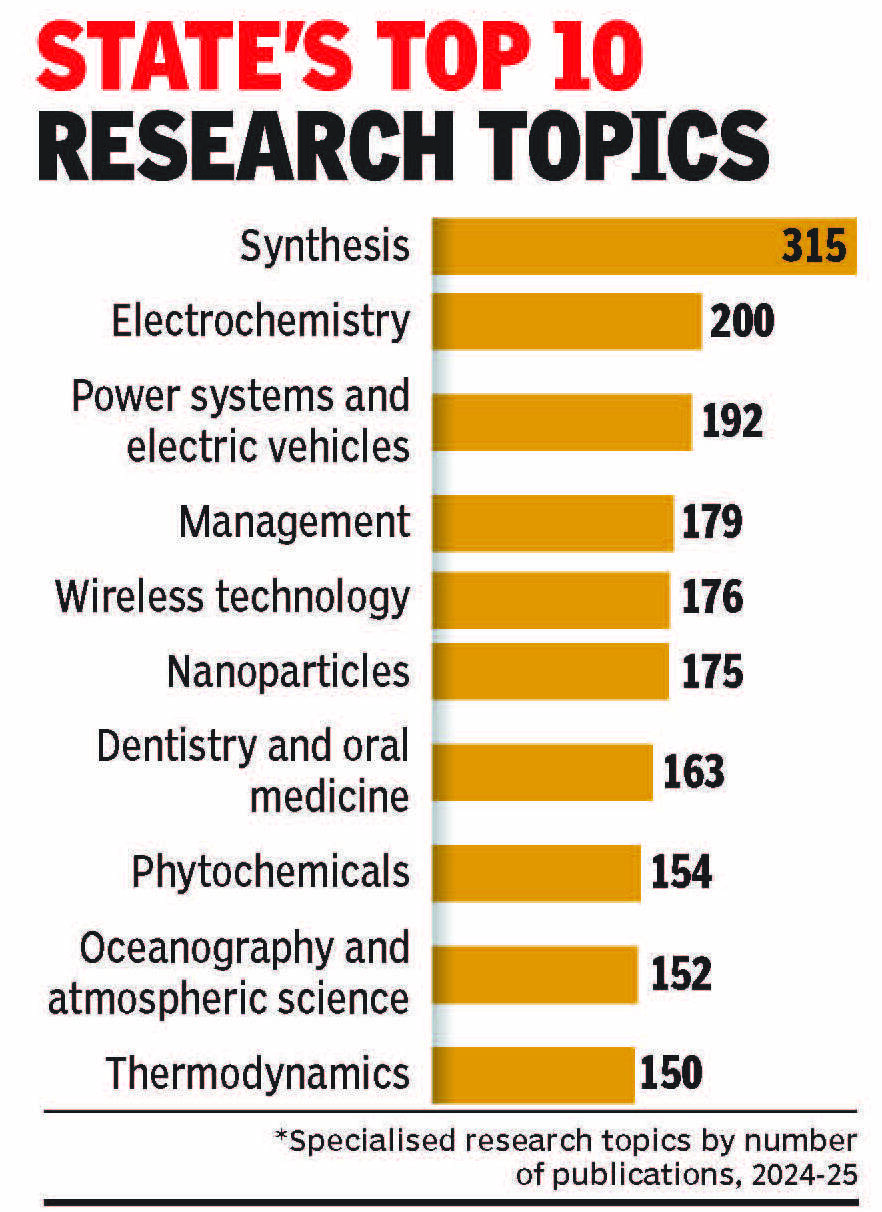
Gujarat’s top 10 research topics
Privately funded and state-funded academic institutions account for 48% and 28.5% of Gujarat’s academic research publications, respectively, both above national levels.Centrally funded academia’s share is lower, at 23.5% against 35.5% nationally.Centrally funded institutions account for 93% of the research published by govt R&D laboratories in Gujarat, with state-funded institutions contributing the remaining 7%.Beyond the laboratoryAcademicians and industry experts point to growing industry-academia collaboration, particularly in Ahmedabad and Gandhinagar. Prof R N Patel, in-charge director general of Nirma University, said businesses are increasingly approaching academic institutions to solve operational problems. “It is a win-win situation. Students gain exposure to real-world problems, while industry benefits from solutions backed by academic rigour and resources. Our focus in research publications remains on translational research. In recent years, we have seen considerable interest in areas such as cybersecurity, blockchain, semiconductors and electric vehicles,” he said.Sudhir Naik, treasurer of India Electronics and Semiconductor Association (IESA), said that while one in five semiconductor engineers globally is Indian, the country’s companies have largely remained service-oriented. “The creation of original intellectual property in semiconductors, embedded systems and electronics product design remains limited. Recognising this, Centre has made R&D the first pillar of India Semiconductor Mission (ISM) 2.0, offering substantial grants for full-chip design,” he said. Naik pointed to improved access to chip fabrication facilities at SCL Mohali, the lack of which was earlier a constraint for Indian startups, and the impact of the Chips to Startup (C2S) programme.Turning IP into market valueHelping researchers protect and commercialise their innovations is another priority. Digvijaysinh Jadeja, director general of the Gujarat Council on Science and Technology (GUJCOST), said the council and its network of IP cells in universities and colleges have facilitated more than 1,400 patent applications and over 1,000 industrial design applications over the past three years. GUJCOST data shows patent applications facilitated through the network rose more than ninefold, from 109 in 2024 to 334 in 2025 and 996 so far in 2026, while design applications rose from 205 in 2024 to 504 so far in 2026. “Through our Intellectual Property Facilitation Centre, students, researchers, startups and MSMEs get patentability searches and filing support without paying any professional fee,” Jadeja said.GUJCOST has also signed an MoU with National Research Development Corporation (NRDC) to strengthen Gujarat’s IP and technology commercialisation ecosystem, he added. For Gujarat, the next challenge is not simply to produce more research, but to make more of its research count. (With inputs from Parag Dave)