








In Charotar, the prosperous belt of central Gujarat spanning Anand and Kheda districts, journeys that began in modest village homes have often ended in success stories across distant continents. Yet, for many who left, the journey has never quite been one-way. Their affection for their native villages has found expression in grand gateways, schools, hospitals, community halls and gardens, built with fortunes earned overseas. Over generations, these gestures of gratitude from NRIs have transformed the rural landscape, bringing facilities that sometimes rival those in cities.Now, the region’s philanthropists are looking beyond community institutions to see what they can do for individual households. And rooftop solar appears to have caught their imagination. By helping families cover the initial cost, donors could spare them hefty electricity bills for the next two decades or more.Piplav village in Anand district has taken the first big step. Its example has prompted a similar announcement in Kavitha, while Alarsa and Valasan are considering plans of their own. The Vadtal Swaminarayan temple has also joined the initiative, offering employees rooftop solar systems in place of the customary Diwali bonus.In Piplav, a plan for nearly every homeAt Piplav in Sojitra taluka, the family of Tejas Patel, chairman of the Kheda District Central Cooperative Bank, has pledged to cover the cost of rooftop solar installations after govt subsidies are applied. The plan covers about 1,290 households, each receiving a 2.18 kW system. Of the village’s 1,675 houses, 332 already have solar panels. Under the PM Surya Ghar scheme, central and state subsidies meet a substantial part of the installation cost. The Patel family will pay the balance, estimated at an average of Rs 10,000 per household.
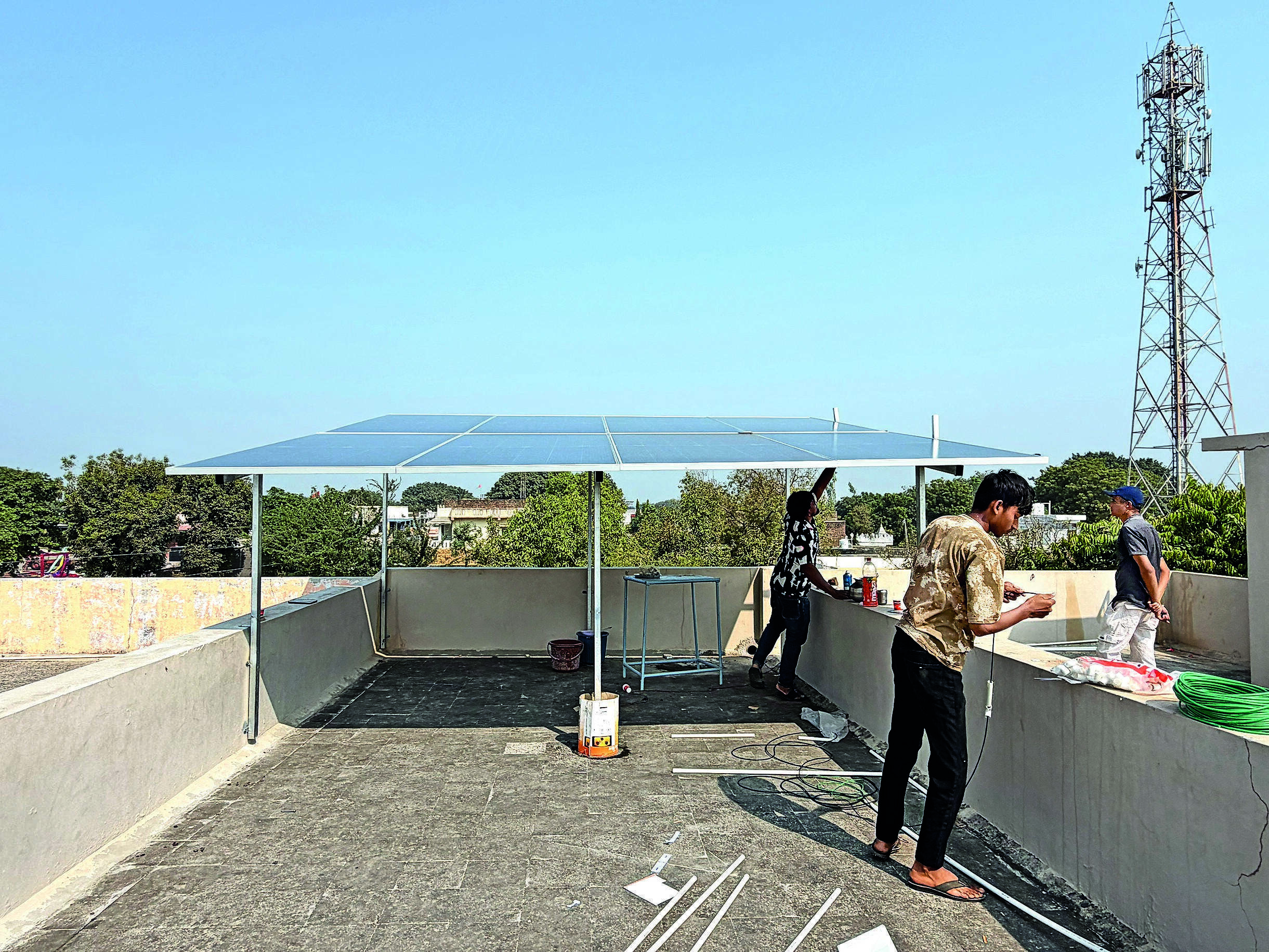
SUNSHINE SAVINGS: Workers install rooftop solar panels in Piplav village of Anand district, where a donor-backed initiative aims to cover nearly every household
The financial benefit for individual households could be considerable. Patel estimates savings of at least Rs 2,000 a month, or Rs 6 lakh to Rs 8 lakh over the expected 25-year life of the system.“The idea is to make Piplav a model that other villages can follow. We want to ensure that even the last household in the village benefits from the shift to solar energy,” he said.The initiative has a personal story behind it. Patel’s late father, Bipinchandra Patel, was closely associated with the village’s development. As sarpanch in 1977, he helped unveil a statue of Sardar Vallabhbhai Patel at Sardar Baug. The family announced the solar project on Sardar Patel’s 151st birth anniversary, carrying forward Bipinchandra Patel’s legacy of public service in a different form.Tejas Patel, who is also associated with the Petlad-Sojitra Solar Energy Producers Cooperative Society, believes the project fits naturally with the cooperative movement’s ideals. The society was established with an ambitious idea: to become the world’s first solar energy producers’ cooperative, adapting the collective model made famous by Amul in dairying. “Along with prosperity through cooperation, we are now taking steps towards realising the vision of a solar-powered future through cooperation,” Patel said.The paperworkGetting an entire village to adopt solar power, however, is turning out to be as much an exercise in sorting out old records as in installing new technology. In Piplav, officials have collected documents from around 350 households. Nearly 150 electricity connections are still in the names of family members who have died, and the records must be updated before applications can move forward. For houses occupied by tenants, permission must come from the property owners.The village panchayat has opened a help desk to address these difficulties. The sarpanch, ward representatives, residents and even the village dairy are helping families complete the necessary formalities.There are doubts to clear up, too. Some residents have asked whether solar panels will work during the monsoon or on cloudy days. Others want to know why they cannot start using the electricity immediately after installation.Volunteers are explaining how the systems work and the role of net meters, which must be installed before the rooftop units can become operational.The scale of the exercise also gives an idea of what the village stands to gain. According to Patel’s estimates, which are based on around 1,200 households, the systems could together generate nearly 36 lakh units of electricity a year.He estimates the project could avoid consuming about 2,780 metric tonnes of coal annually, or 69,500 metric tonnes over 25 years, with avoided carbon emissions equivalent to the annual absorption capacity of about 1.3 lakh mature trees. The tree comparison also highlights the limits of relying on plantations alone to offset emissions. Finding space in one village for 1.3 lakh trees, and keeping them alive long enough to mature, would be a formidable task. Reducing coal use tackles emissions at their source.“People often speak about planting trees to protect the environment. While that is important, we can also prevent carbon emissions by adopting solar energy,” he said. Patel puts the collective savings on electricity expenditure at as much as Rs 89 crore over two and a half decades. For some Piplav residents, the savings are already a reality.Naimish Patel, a Piplav farmer who installed solar panels two years ago, has seen the difference firsthand. “Our annual electricity bill used to be nearly Rs 30,000. Now it is virtually zero,” he said. His five-member family has since increased the number of its air-conditioners from two to four. “We use them comfortably without worrying about the expense.”Ankit Ashwinbhai Patel, a private-sector employee, tells a similar story. His family previously paid Rs 17,000 to Rs 18,000 a year for electricity. Since the family installed solar panels over a year ago, the bill has been almost zero. “We even export surplus electricity to the grid,” he said. “Running the AC through summer nights no longer means dreading the bill.”Kavitha’s NRI donor takes noteAbout the same time that Piplav’s plans began attracting attention, another village in Charotar found a willing benefactor. In Kavitha, in Borsad taluka, US-based NRI Nirmal Patel has announced plans to provide rooftop solar facilities to households through the HM Patel Foundation. Kavitha has a population of around 7,500 and nearly 2,100 households. Like many villages in the region, it has long benefited from the generosity of its overseas community. NRI contributions have helped build its entrance gates and schools and improve drinking water and drainage facilities. For the past eight years, the HM Patel Foundation, working in memory of the donor’s father, has also supported needy families with grocery kits, assisted widows, and distributed cattle feed.Village sarpanch Sachinkumar Ravjibhai Patel sees the solar initiative as another addition to Kavitha’s growing list of development projects.The decision followed a meeting between the donor and the Piplav project team, facilitated by minister of state for finance Kamlesh Patel. After learning how the scheme was being implemented, Nirmal Patel announced his plans at a village gathering.Word has since travelled to Alarsa, where US-based donor Ghanshyam Patel has shown interest in supporting rooftop installations. In Valasan, near Karamsad, discussions are under way to extend the benefit to 700 households. NRIs from other villages have also contacted the Piplav team, seeking details of the scheme and how they might introduce it back home.A Diwali bonus beyond the festivalAt the Vadtal Swaminarayan temple, the management has found its own way to make a festive benefit last longer. Instead of giving its employees the customary Diwali bonus, the temple board, chaired by Dr Sant Swami, is providing rooftop solar systems to around 600 staff members.The benefit extends from gatekeepers and support staff to managers. Each installation is estimated to cost around Rs 10,800 over and above the applicable subsidy, with the Kheda District Central Cooperative Bank providing the initial funding. Govt subsidies will be adjusted when received. Employees will not have to pay anything. Those who already have solar installations at home can nominate eligible relatives for the benefit.

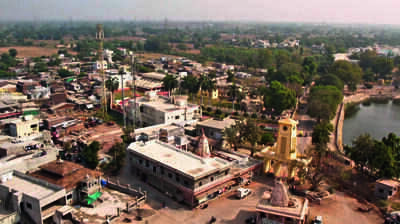
Let there be light: The Vadtal Swaminarayan temple (right) is extending similar benefits to around 600 employees, replacing one-time Diwali bonuses with long-term savings
A Diwali bonus is usually spent during the festive season. By putting that money towards rooftop solar, the temple hopes to give employees a benefit they can enjoy every time an electricity bill arrives.“Organisations that consume electricity can contribute to the clean-energy transition while creating lasting benefits for their employees,” said Dr Sant Swami.The power of community givingGujarat has already seen villages such as Modhera, Masali, Sukhi and Dhordo embrace solar power through govt-supported initiatives.Charotar’s approach is different, relying on private donors to make the technology affordable for households across entire villages.For families who might never have considered installing solar panels on their own, that support could make all the difference between watching the transition happen around them and becoming part of it.